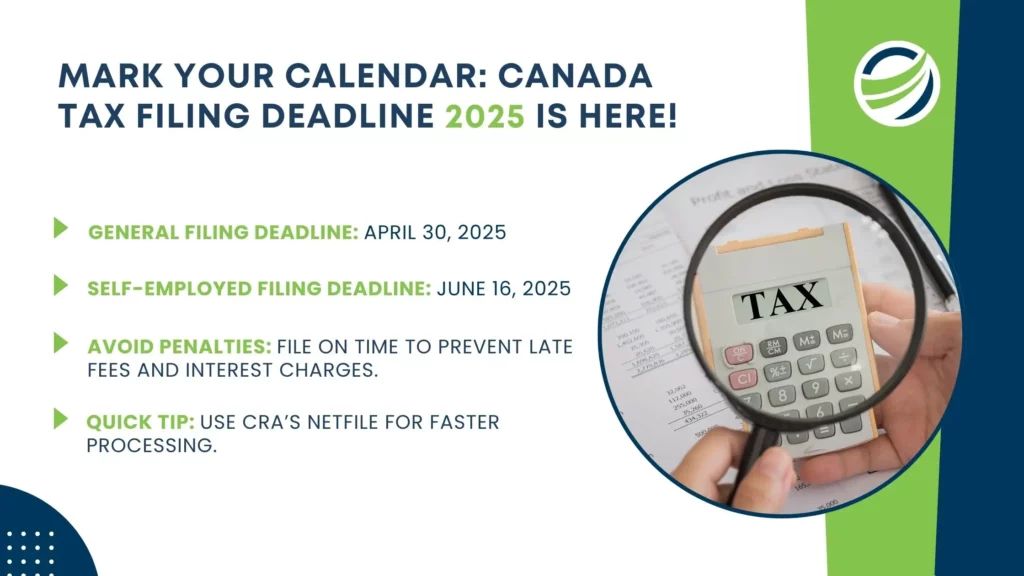
The primary deadline for most Canadians to file their personal income tax return and pay any taxes owed is April 30 of each year. For self-employed individuals and their spouses or common-law partners, the filing deadline is extended to June 15, but any tax payment is still due by April 30. Understanding these deadlines is crucial to avoid penalties and interest charges from the Canada Revenue Agency. Staying organized with these dates also ensures you receive all eligible benefits and credits on time.
Key Personal Income Tax Deadlines
The core annual deadline for filing a personal income tax and benefit return is April 30. This date applies to the vast majority of individuals who are not self-employed. For the 2025 tax year, the filing and payment deadline is April 30, 2026. If April 30 falls on a weekend, the Canada Revenue Agency extends the deadline to the next business day. Electronically submitted returns must be filed by midnight local time on the due date, while paper returns must be postmarked by that date. Filing by this deadline helps you avoid late-filing penalties and ensures you receive any refund or benefit payments without delay. The CRA opens its NETFILE service for electronic filing in late February, with February 23, 2026, noted as the earliest day to file your taxes online for that tax season.
Individuals who are self-employed, or who have a spouse or common-law partner who is self-employed, receive an extension for filing their return. Their deadline is June 15 of each year. For the 2025 tax year, this extended filing deadline is June 15, 2026. It is critical to understand that this extension applies only to filing the return, not to paying any tax owed. Any balance owing to the CRA is still due by the standard April 30 deadline. If payment is made after April 30, compound daily interest will be charged on the outstanding amount starting May 1. This rule applies even if the individual died during the year. For a deceased person where the spouse was self-employed, the filing deadline may be extended to June 15 but interest still begins on April 30.
The deadline for making a Registered Retirement Savings Plan contribution that can be deducted on your tax return is also a key date. For the 2025 tax year, you have until March 2, 2026, to contribute to your RRSP and have it count toward your 2025 deduction limit. Contributions made during the first 60 days of a year can be applied to the previous year's taxes. Your RRSP contribution room is based on your earned income from the previous year, and you can find your personal deduction limit on your latest notice of assessment from the CRA. Furthermore, December 31 of the year you turn 71 is the last day you can contribute to your own RRSP.
For the First Home Savings Account, the rules differ from the RRSP. The last day to make an FHSA contribution that can be deducted on your 2026 income tax return is December 31, 2026. Unlike RRSP contributions, contributions made during the first 60 days of 2027 cannot be deducted for the 2026 tax year. Your available FHSA participation room dictates how much you can contribute, and like the RRSP, you should verify your room with the CRA before contributing.
Important Dates for Benefits, Credits, and Information Returns
Filing your tax return on time is directly linked to receiving several government benefits and credits. The Canada Revenue Agency uses the information from your return to determine your eligibility for programs like the GST/HST credit and the Canada Carbon Rebate. For the Grocery Rebate, which helps low and modest income Canadians, payments are issued quarterly on specific dates. In 2026, these payment dates are scheduled for January 5, April 2, July 3, and October 5. A one time top up payment for this benefit is also expected in the spring of 2026, no later than June. Provincial credits, such as the Ontario energy and property tax credit, Northern Ontario energy credit, and Ontario sales tax credit, also depend on you filing your return annually.
Even though the Canada Carbon Rebate program is winding down, eligible taxpayers can still receive credits for past years by filing outstanding tax returns. If you have not filed returns for the 2021 through 2024 tax years, submitting them during the current tax season ensures you do not miss out on any payments you are entitled to. Filing promptly is the only way to secure any remaining CCR payments. The CRA begins assessing benefit entitlements as soon as your return is processed, so a delay in filing directly delays these payments.
Employers and payers have strict deadlines for providing information slips. T4 slips for employment income and T5 slips for dividends and investment income must be issued to recipients and filed with the CRA by the last day of February following the tax year. For the 2026 tax year, since February 28, 2027, falls on a Sunday, this deadline moves to the next business day, Monday, March 1, 2027. These slips are essential for individuals to complete their tax returns accurately, and employers face penalties for failing to issue them on time.
Deadlines for Self-Employed Individuals and Tax Instalments
Self employed individuals and business owners have several important deadlines beyond the personal filing date. Sole proprietors and partners in a partnership must file their T1 return by June 15 if their business operates on a calendar year. However, as noted, any tax owing is due by April 30. Business owners are also responsible for meeting payroll obligations. If you are the legal representative for a deceased person, different rules apply for their final return. If the individual died between January 1 and October 31, the return is due by the following April 30. If the death occurred between November 1 and December 31, the return is due six months after the date of death.
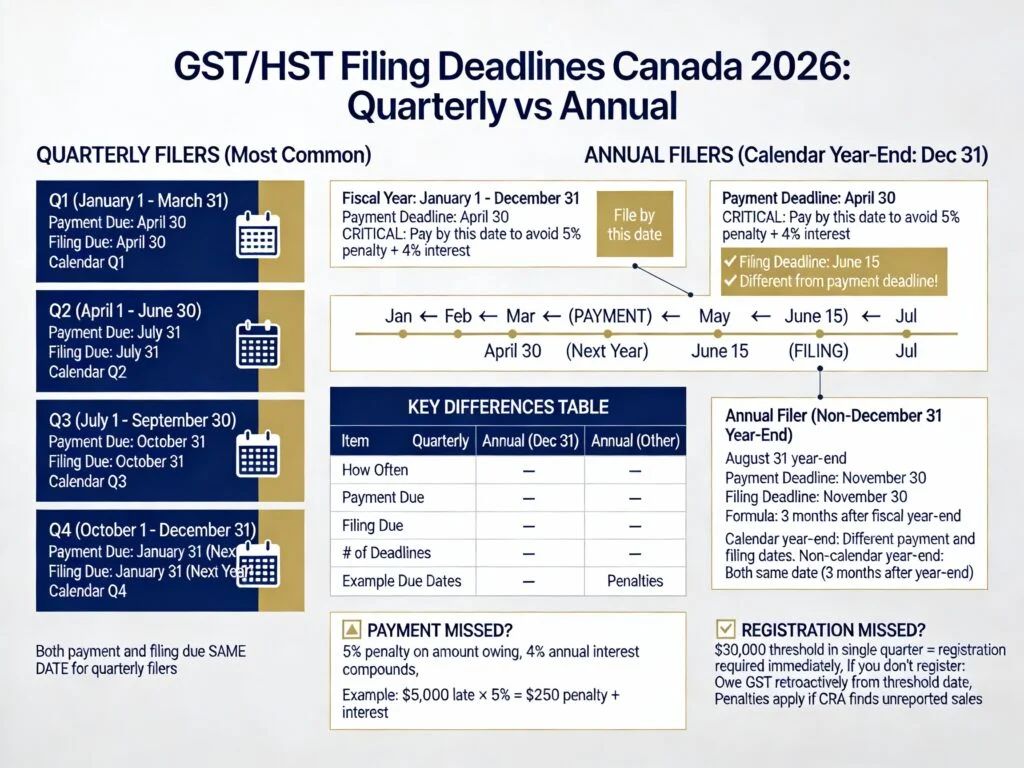
If you are required to pay tax instalments, you must make quarterly payments throughout the year. The standard instalment due dates for individuals are March 15, June 15, September 15, and December 15. If any of these dates falls on a weekend or public holiday, the deadline moves to the next business day. Self employed farmers and fishers have a different schedule. They receive an instalment reminder in November and must pay by December 31. The CRA may charge interest and a penalty if instalment payments are late or insufficient, particularly if the total instalment interest charge exceeds one thousand dollars.
The penalty for late or insufficient instalments is calculated as the greater of one thousand dollars or twenty five percent of the instalment interest charge. To determine the final penalty, this greater amount is subtracted from your total instalment interest charges and the result is divided by two. This penalty only applies if your instalment interest charges for the year are more than one thousand dollars. The CRA charges compound daily interest on any late or insufficient instalment payment starting the day after it was due.
- T1 Filing Deadline for Self-Employed: June 15.
- Tax Payment Deadline for All: April 30.
- Individual Tax Instalments: March 15, June 15, September 15, December 15.
- Farmer/Fisher Instalment Deadline: December 31.
- Instalment Penalty Threshold: Applies if interest charges exceed $1,000.
- Final Return for Deceased (Death Jan 1-Oct 31): Following April 30.
- Final Return for Deceased (Death Nov 1-Dec 31): 6 months after date of death.
Corporate, Trust, and Charity Filing Deadlines
Corporations have deadlines based on their fiscal year end, which can differ from the calendar year. A corporation's income tax return, the T2, is due no later than six months after the end of its tax year. For a corporation with a December 31 year end, the filing deadline for the 2026 fiscal year would be June 30, 2027. The balance of tax owing is generally due two months after the tax year end, though certain Canadian controlled private corporations may qualify for a three month balance due date if specific CRA conditions are met. Incorporated businesses that opt for a non calendar fiscal year have their returns due six months after that fiscal year ends.
Trusts, including certain bare trusts under new reporting rules, have their own filing schedules. A T3 Trust Income Tax and Information Return is generally due 90 days after the trust's tax year end. For a trust with a December 31, 2026 year end, the filing and payment deadline would be March 31, 2027. New enhanced reporting rules apply for taxation years ending on or after December 31, 2026, which may require more trusts, including some bare trusts, to file a T3 return and Schedule 15 to report beneficial ownership information. The T5013 Partnership Information Return has a filing due date that depends on the type of partners involved, including end members of a tiered partnership.
Registered charities must file Form T3010, the Registered Charity Information Return, annually. This return is due no later than six months after the end of the charity's fiscal period. For example, a charity with a December 31, 2026, year end must file its T3010 by June 30, 2027. Failure to file this return on time can result in the charity's registration being revoked, which is a severe consequence for any charitable organization operating in Canada.
Penalties and Interest for Missing Deadlines
The Canada Revenue Agency imposes significant financial penalties for failing to meet tax deadlines. If you file your personal income tax return late and have a balance owing, you will be charged a late filing penalty. This penalty is five percent of your balance owing, plus an additional one percent for each full month your return is late, up to a maximum of 12 months. If you have been charged a late filing penalty in any of the three previous years and received a formal demand from the CRA, the penalty increases to ten percent plus two percent per month, up to a maximum of 20 months. This heightened penalty is designed for repeat offenders.
Interest charges apply separately from penalties. Compound daily interest is charged on any unpaid taxes or instalments, starting the day after the balance was due. This applies whether you filed on time but did not pay, or if you filed and paid late. The prescribed interest rate is set quarterly by the CRA. For corporations that make a false statement or omission on a return due to gross negligence, the penalty can be the greater of one hundred dollars or fifty percent of the tax avoided. You may apply to the CRA to cancel or waive penalties and interest under certain circumstances, such as through the Voluntary Disclosures Program if you come forward voluntarily to correct an error.
There are also specific penalties for failure to report income. You could face federal and provincial penalties if you fail to report an amount of five hundred dollars or more on your return for the current year or any of the three previous years. The federal penalty is the lesser of ten percent of the amount you failed to report or fifty percent of the difference between the tax payable based on the false statement and the tax that would have been payable based on the true facts. For payroll accounts, failure to deduct required amounts can result in a penalty of ten percent for the first failure, increasing to twenty percent for subsequent failures. Late filing or non payment penalties for payroll start at three percent and can go up to twenty percent.
Special Situations, Exceptions, and Planning
There are specific rules for the final tax return of a deceased person. If the individual died between January 1 and October 31 of the tax year, their final return is due by the following April 30. If the death occurred between November 1 and December 31, the return is due six months after the date of death. If the deceased or their spouse was self employed, the filing deadline may be extended to June 15, but interest on any amount owing still begins accruing after April 30. The legal representative is responsible for ensuring this final return is filed correctly and on time.
For Canadian controlled private corporations, there are exceptions to the requirement to pay monthly instalments. A corporation may not have to pay instalments if its tax payable for the current or previous year is less than three thousand dollars, or if it is a new corporation in its first tax year. Corporations wanting to pay quarterly instead of monthly instalments must meet strict CRA eligibility requirements, including having paid all required tax instalments on time in the previous year and having a perfect compliance history for the preceding 12 months. These rules ensure corporations are treated similarly to employees who have tax deducted at source.
It is important to note that if you file your taxes late but are due a refund or do not owe any further tax, the CRA will not charge a late filing penalty. However, you will delay the receipt of your refund and any benefit payments. The CRA uses the information from your return to calculate benefits for up to a year after the filing deadline, so a late filing can disrupt this process. Keeping organized records and being aware of all applicable deadlines, including those for RRSPs, FHSAs, and instalments, is the best way to manage tax season and avoid unnecessary costs.
| Entity Type | Return Deadline |
|---|---|
| Individual (Non Self-Employed) | April 30 |
| Individual (Self-Employed) | June 15 |
| Corporation (T2) | 6 months after year-end |
| Trust (T3) | 90 days after year-end |
| Charity (T3010) | 6 months after fiscal period end |
| Partnership (T5013) | Depends on partner type |
Frequently asked questions
When is the tax deadline for most Canadians?
For most individuals, the deadline to file your personal income tax return and pay any amount owing is April 30 of each year. For the 2025 tax year, this date is April 30, 2026. If this date falls on a weekend, the deadline moves to the next business day. Filing by this date helps avoid penalties and ensures timely benefit payments. The CRA typically opens its NETFILE electronic filing system in late February, allowing for early submission.
Do self-employed people get more time to file?
Yes, self-employed individuals and their spouses or common-law partners have until June 15 to file their tax return. For the 2025 tax year, this extended filing deadline is June 15, 2026. However, this extension is for filing the return only. Any taxes you owe must still be paid by April 30 to avoid interest charges. Compound daily interest is applied to any unpaid balance starting May 1, regardless of the June filing extension.
What happens if I file my taxes late?
If you file late and owe money, the CRA charges a late-filing penalty of 5% of your balance owing, plus 1% for each full month your return is late, up to 12 months. If you were penalized in the past three years and received a formal demand, the penalty is 10% plus 2% per month. Compound daily interest is also charged on any unpaid amounts from the day after the payment due date. If you are due a refund, there is no penalty for filing late, but you delay your refund and benefits.
When are quarterly tax instalments due?
If you are required to pay tax instalments, the quarterly due dates are March 15, June 15, September 15, and December 15. If a date falls on a weekend or holiday, it moves to the next business day. Self-employed farmers and fishers must pay by December 31. The CRA charges compound daily interest on late or insufficient payments, and a penalty may apply if the total instalment interest for the year exceeds one thousand dollars.
What are the deadlines for T4 and T5 slips?
Employers must issue T4 slips to employees and T5 slips to investment income recipients by the last day of February each year. For the 2026 tax year, the slips must be issued by March 1, 2027, because February 28, 2027, is a Sunday. These slips must also be filed with the CRA by this date. Failure to issue these slips on time can result in penalties for the employer or payer.
What is the RRSP contribution deadline?
The deadline to contribute to an RRSP for the 2025 tax year is March 2, 2026. This is the last day to make a contribution that can be deducted from your 2025 taxable income. The Canada Revenue Agency sets this annual deadline, which typically falls on March 1 or 2. Your contribution is limited by your available RRSP deduction room, which you can find on your latest notice of assessment. Making a contribution by this deadline is a key way to reduce your tax payable for the previous year.
Sources and further reading
- Benefit payment dates and Canadian tax deadlines. hrblock.ca
- Tax Deadline 2026: When Is the Last Day to File Taxes? turbotax.intuit.ca
- 2027 Canadian Tax Deadlines sterncohen.com
- Canadian Tax Filing Deadlines and Due Dates accountingtoronto.ca
- What are the Canadian tax deadlines? Why should I file on ... fbc.ca
This article explains how things work and is not financial, tax or legal advice. Rules, limits and rates change, so check the current figures with the Canada Revenue Agency, your province or your financial institution before you act.