Live currency exchange rates determine the value of the Canadian dollar against foreign currencies like the US dollar, euro, and British pound. These rates are set by the global foreign exchange market and fluctuate constantly based on economic factors. For Canadians, understanding live rates is essential for travel, international money transfers, and cross-border shopping. Financial institutions publish indicative rates, but the actual rate applied to a transaction includes a margin and fees.
How Currency Exchange Rates Are Set and Published
The value of the Canadian dollar is primarily determined by the global foreign exchange market, where currencies are traded around the clock. The Bank of Canada publishes daily average exchange rates for information purposes, calculated and released by 16:30 Eastern Time each business day. These published rates are indicative and reflect the wholesale or mid-market rates used between large financial institutions. The mid-market rate is the precise midpoint between the global buy and sell prices for a currency pair and is the benchmark used by services like Xe for their informational currency converters. For individual client transactions, banks and currency services apply a retail exchange rate, which includes a margin added to the wholesale rate to cover costs and profit. The Bank of Canada very rarely intervenes in foreign exchange markets to influence the Canadian dollar's value, allowing market forces to set the price. The rates displayed by the Bank apply to non-cash transactions such as wire transfers and drafts for amounts up to $9,999, serving as a reference point for consumers and businesses alike.
Economic and Market Factors That Move Exchange Rates
Exchange rates fluctuate due to a complex mix of economic and geopolitical factors that influence supply and demand for a currency. Interest rate differentials between Canada and other countries are a primary driver, as higher relative rates can attract foreign investment, increasing demand for the Canadian dollar. Commodity prices, especially for oil and natural gas, significantly impact the CAD due to Canada's status as a major exporter, creating a correlation often called a 'commodity currency'. Broader economic indicators such as inflation reports, employment data, and gross domestic product growth also influence investor sentiment and currency value, with strong data typically supporting the dollar. Political stability and global risk appetite play roles, with investors often seeking safer currencies like the US dollar during times of uncertainty, which can pressure the CAD. The Canadian Effective Exchange Rate index, which replaced the older CERI index in January 2018, is a weighted average of the CAD against currencies of Canada's major trading partners and tracks these broader movements beyond any single bilateral rate.
Historical Context and Notable Data for the Canadian Dollar
The Canadian dollar has experienced significant volatility against major currencies throughout its modern history, with its value often closely tied to the US dollar. Historical data shows periods where the CAD traded both significantly above and below parity with the USD, influenced by oil price cycles, interest rate policies, and relative economic strength. The Bank of Canada maintains several historical data series, including annual average exchange rates published on the last business day of the year by 12:30 ET and monthly averages typically published on the last business day of the month. Legacy data, such as the old noon and closing rates calculated under a previous methodology, was last updated on 28 April 2017 and is no longer maintained, marking a shift in official reporting. The Canadian-Dollar Effective Exchange Rate index data was also last updated in January 2018 when it was replaced by the CEER. This historical context helps illustrate the cyclical nature of currency values and the impact of long-term economic trends on the purchasing power of Canadian travellers and businesses.

Methods for Canadians to Convert Currency
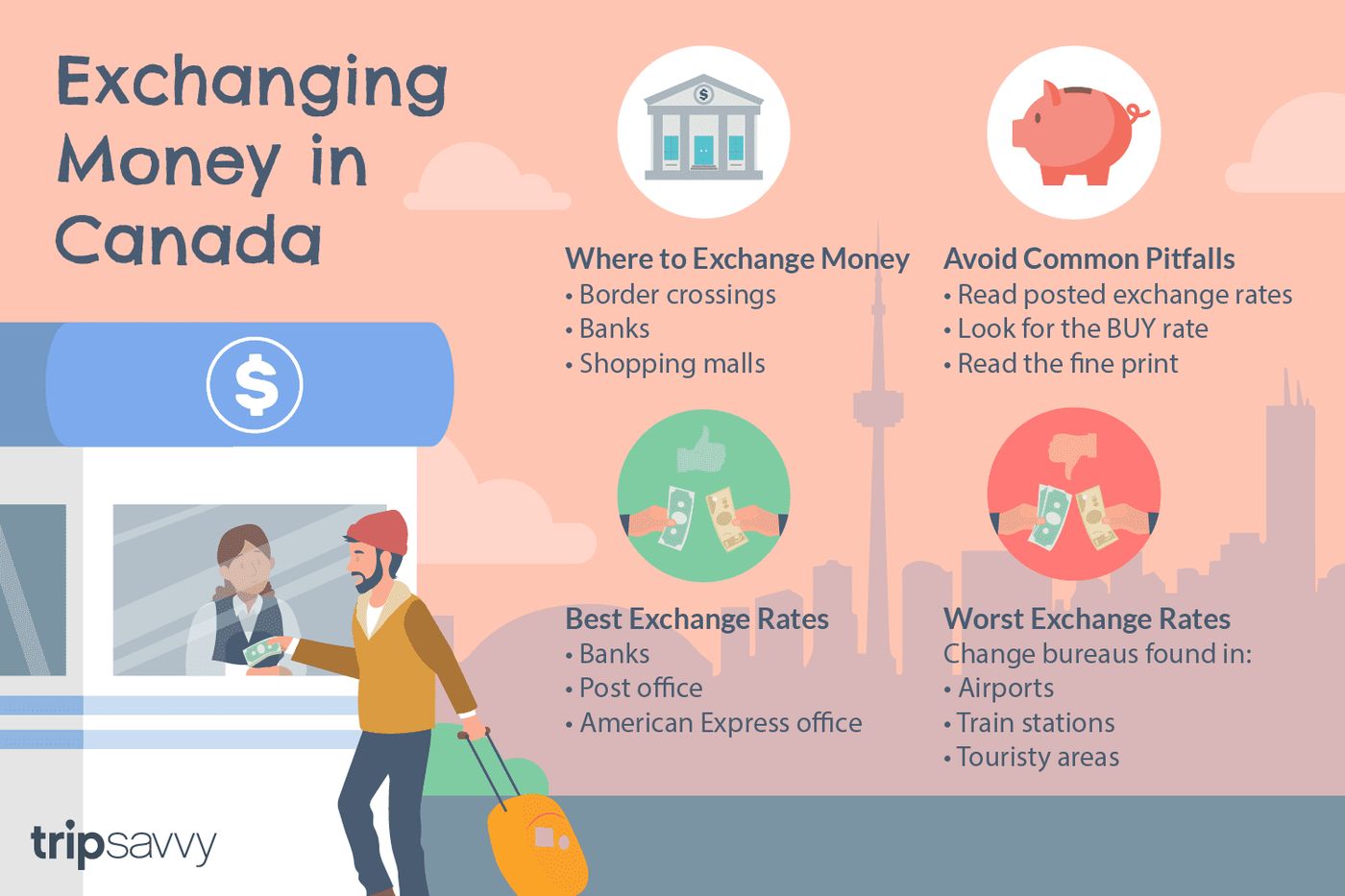
Canadians have several options for converting currency, each with different processes, costs, and speed of delivery. Major banks like TD, Scotiabank, and RBC offer foreign exchange services both online through their websites and apps, and in physical branches across the country. For cash, customers can often order online for branch pickup within three to seven business days, while some major currencies like US dollars, euros, and pounds sterling are available on hand at most branches. Non-cash transactions, such as incoming and outgoing wire transfers, drafts, and cheques, use different, typically more favourable rates than cash conversions because they do not require physical handling. Specialized foreign exchange centres, such as TD Foreign Exchange Centres or ICE Canada locations, provide alternative channels with a wider selection of currencies available immediately. Online international money transfer services like Xe provide another option, often promoting bank-beating rates and transparent fees for sending money to over 190 countries. It is often more beneficial to convert Canadian dollars to a destination's local currency before leaving Canada, as banks and kiosks abroad frequently charge higher rates and additional commissions on top of less favourable exchange rates.
Key methods for obtaining foreign currency cash from banks include ordering online through a bank's website or mobile app for branch pickup within three to seven business days. You can also visit a branch directly to purchase US dollars, Euros, and Pounds Sterling, which are often available immediately. Other foreign currencies can typically be ordered in branch and delivered to your preferred location within three to seven business days. Some banks have dedicated foreign exchange centres that keep over fifty foreign currencies and precious metals on hand for immediate purchase. A fourth option is to order foreign currency cash by phone for subsequent branch pickup.
- Online ordering through bank websites or apps like EasyWeb for branch pickup within 3-7 business days.
- Purchasing directly at a bank branch for immediately available currencies like USD, EUR, and GBP.
- Using dedicated foreign exchange centres for immediate purchase of over 50 foreign currencies and precious metals.
- Ordering by phone, for example by calling TD at 1-866-222-3456, for later branch pickup.
- Scanning a QR code with a smartphone at some institutions to place a cash order quickly.
For electronic transactions, services range from wire transfers and foreign currency deposits through your bank to specialized international money transfer platforms. Banks allow you to send money abroad and transfer funds in foreign currencies. You can also hold funds in a foreign currency deposit account of your choice. International money transfer platforms enable you to schedule payments across 130 currencies in over 190 countries. These services provide live exchange rate quotes and allow you to execute trades for non-cash transactions.
Understanding Fees, Margins, and Total Conversion Costs
The total cost of converting currency involves more than just the quoted exchange rate and includes both built-in margins and explicit fees. Financial institutions apply a retail exchange rate, which is the wholesale mid-market rate plus a margin that varies by provider, transaction type, and amount. For cash transactions, the rate is deliberately less favourable than for non-cash transactions because it incorporates costs for shipping, handling, security, and storage of physical bills, making cash the most expensive common conversion method. Non-cash rates apply to instruments like cheques, drafts, and electronic wire payments, which incur lower processing costs and therefore receive a better rate from the service provider. When using debit or credit cards abroad for purchases or ATM withdrawals, different exchange rates and fees apply as set by the card networks and issuers, not the customer's bank for teller services, and these typically include a foreign transaction fee. Customers should review their card agreements for these details, as the bank does not set the rate for these card-based transactions. Online transfer services typically show all fees upfront before a transaction is completed, allowing for cost comparison, and they may highlight potential savings against bank rates for specific transfer amounts.
| Transaction Type | Typical Rate Applied | Primary Additional Costs |
|---|---|---|
| Cash Purchase/Sale | Retail cash rate (includes handling margin) | Margin built into the rate. No separate fee common |
| Wire Transfer | Retail non-cash rate | Wire transfer fee (fixed or percentage) |
| Bank Draft/Cheque | Retail non-cash rate | Draft issuance fee |
| Debit/Credit Card Abroad | Network rate + issuer margin | Foreign transaction fee (often 2-3% of amount) |
| Online Transfer Service | Service's retail rate | Transparent fee shown upfront. Sometimes no fee |
Using Live Rates, Tools, and Alerts for Financial Planning
Monitoring live exchange rates and using available financial tools can help Canadians time their currency conversions more advantageously and understand cost structures. Many online platforms offer currency converters and interactive charts that track mid-market rates over specific periods, such as the past 7, 30, or 90 days, showing ranges, averages, and volatility percentages. Setting up rate alerts through services like Xe, either on their website or within their app, can notify you when a target exchange rate is reached, allowing you to act when the market moves in your favour. When planning a money transfer, it is crucial to use tools that show the total cost upfront, including the exchange rate margin and any fixed fees, to accurately compare providers like banks versus specialized transfer services. The rates quoted in media are wholesale rates and not directly available to consumers for personal transactions, which is a key distinction for realistic budgeting. For transactions like incoming wire transfers where funds are deposited in a foreign currency, banks convert them at their applicable retail rate in effect when the deposit is posted to the account, not at the time the transfer is initiated. Commercial and corporate customers may have access to different platforms, such as ScotiaFX, for live quotes and trade execution, highlighting the different service tiers available.
The Role of Financial Institutions in Currency Exchange
Banks and other financial institutions act as intermediaries between the wholesale foreign exchange market and Canadian consumers, setting the retail rates that apply to everyday transactions. For services where the bank sets the rate, such as teller cash exchanges, wire transfers, and draft purchases, they quote an applicable exchange rate at the time of the transaction for customer acceptance. The exchange rate determines how much in Canadian Dollars it will cost to purchase another currency, or how much CAD you will receive when selling foreign currency back to the bank. Financial institutions also offer foreign currency deposit services, allowing clients to hold funds in accounts denominated in US dollars or other currencies, which can be useful for managing foreign income or expenses. They provide supporting services like travel insurance for eligible medical emergencies and trip interruptions, often linked to credit card products used abroad. It is important to note that up-to-the-minute rates can only be guaranteed at the time a purchase or sale is actually conducted, even if approximate rates are available online or by phone beforehand, and these retail rates are subject to change at any time.
Key Differences Between Wholesale and Retail Foreign Exchange
The foreign exchange market operates on two distinct levels: the wholesale interbank market and the retail market serving consumers and businesses. The wholesale market involves trades between banks and large financial institutions, dealing in massive volumes and using the mid-market rate as their benchmark. Exchange rates quoted in the media and used for indices like the CEER are derived from this wholesale market, representing the pure price of currency without added costs. The retail market, where consumers participate, involves much smaller transaction amounts and requires additional processing, security, and customer service. Client transactions are therefore priced using a retail rate, which is the wholesale rate plus a margin that covers these operational costs and generates profit for the institution. This fundamental difference explains why the rate a customer sees on a financial news website is never the rate they will actually receive when exchanging money at their bank or through a transfer service.
Frequently asked questions
What is the difference between the mid-market rate and the rate I get?
The mid-market rate is the wholesale midpoint between global buy and sell orders, used between large financial institutions. The rate you receive from a bank or currency service is a retail rate, which is the mid-market rate plus a margin. This margin covers the provider's costs, processing, and profit, so you will not receive the pure mid-market rate on personal transactions. Exchange rates quoted in the media are these wholesale rates, not the retail rates applied to client transactions.
Why is the exchange rate for cash worse than for a wire transfer?
Cash transactions involve physical bills, which incur costs for shipping, handling, storage, and security. These operational expenses are built into the exchange rate applied to cash, making it less favourable. Non-cash transactions like wire transfers, drafts, and cheques are electronic or paper-based without physical storage needs, so they receive a better rate. Banks explicitly state that non-cash rates are applied to paper instruments and electronic transactions because they require less time and cost to process.
Should I exchange money before leaving Canada or at my destination?
It is often more beneficial to convert your Canadian dollars to the local currency of your travel destination before you leave Canada. Many banks, foreign exchange kiosks, and hotels in other countries charge commission or service charges in addition to exchange rates. These exchange rates are often higher than those typically available in Canada. Therefore, converting before you travel can lead to better value for your money.
How often are official exchange rates updated?
The Bank of Canada publishes daily average exchange rates each business day by 16:30 Eastern Time. Monthly average exchange rates are typically published on the last business day of the month by 16:30 ET. Annual average exchange rates are published on the last business day of the year by 12:30 ET. Financial institutions may obtain up to the minute rates, but they can only guarantee a rate at the time a purchase or sale is conducted.
What fees are charged when using my debit or credit card abroad?
When you use your debit or credit card outside of Canada to withdraw cash from an ATM or make a purchase, you will pay different exchange rates and fees for those services. The exchange rate for these transactions is not set by your bank, unlike for services such as wire transfers. You should review the agreements governing services and the use of those cards for more information on the specific rates and fees that apply. It is important to understand these costs, as they can vary significantly from the retail exchange rates banks use for other foreign currency purchases. Many banks, foreign exchange kiosks, and hotels in other countries may also charge commissions or service charges on top of exchange rates that are often higher than those available in Canada.
Can I lock in an exchange rate for a future transaction?
For services where the bank sets the exchange rate, such as for a wire transfer, the rate is quoted and you may choose whether or not to complete the transaction at that rate. However, rates can only be guaranteed at the time the purchase or sale is actually conducted, not when it is merely inquired about. The exchange rate used is typically the applicable retail rate in effect when the transaction is posted to your account. For incoming wire transfers in a foreign currency, the funds are converted using the bank's applicable exchange rate in effect when the deposit is posted. Although up to the minute rates may be obtained by contacting a branch, they are subject to change and are provided for information purposes only.
Sources and further reading
- Exchange rates bankofcanada.ca
- Foreign Currency Exchange Rates scotiabank.com
- Currency Converter & Live Exchange Rates td.com
- Foreign Exchange Currency Converter, RBC Royal Bank apps.royalbank.com
- 1 USD to CAD, Convert US Dollars to Canadian Dollars xe.com
This article explains how things work and is not financial, tax or legal advice. Rules, limits and rates change, so check the current figures with the Canada Revenue Agency, your province or your financial institution before you act.