An HST calculator helps Canadians determine the sales tax on purchases or extract the tax amount from a total price. This is essential for accurate bookkeeping, expense tracking, and understanding final costs for goods and services. The Harmonized Sales Tax (HST) combines the federal Goods and Services Tax (GST) with a provincial sales tax into a single rate, which varies across participating provinces. Knowing how to calculate HST ensures compliance with tax rules and helps businesses and consumers manage their finances.
How the HST Calculator Works
The HST calculator performs calculations in two primary directions, adding tax to a base price or extracting tax from a total amount. Users select their province or territory, which determines the applicable tax rate used in the computation. They then enter a single known value into one of the three input fields: the price before tax, the sales tax amount, or the total price including tax. The calculator instantly computes and displays the other two missing values based on the selected provincial rate. This dual functionality makes it both a standard sales tax calculator and a reverse sales tax calculator, useful for decoding receipts where only the final total is shown.
For adding tax, the calculation multiplies the pre-tax amount by the combined tax rate. In Ontario, with a 13% HST rate, a $100 purchase would be multiplied by 1.13 to yield a total of $113. The tax portion itself is $13. For extracting tax from a total, the process divides the total amount by one plus the tax rate. Using the same Ontario example, $113 divided by 1.13 returns the pre-tax price of $100. The HST included is then the difference, which is $13. These formulas apply uniformly across all provinces, with the calculator automatically applying the correct rate for the selected region.
The calculator is designed to handle any Canadian sales tax structure, including Harmonized Sales Tax (HST), separate Goods and Services Tax (GST) and Provincial Sales Tax (PST), and Quebec Sales Tax (QST). It uses rates verified for 2026, such as Ontario's 13% HST and Nova Scotia's 14% HST. Results are estimates, and due to rounding, final totals may differ by a cent. This tool is particularly valuable for self-employed individuals, contractors, and small business owners who need to separate HST from commission payments or invoice totals for income tax reporting purposes.
Canadian Sales Tax Rates and Structures
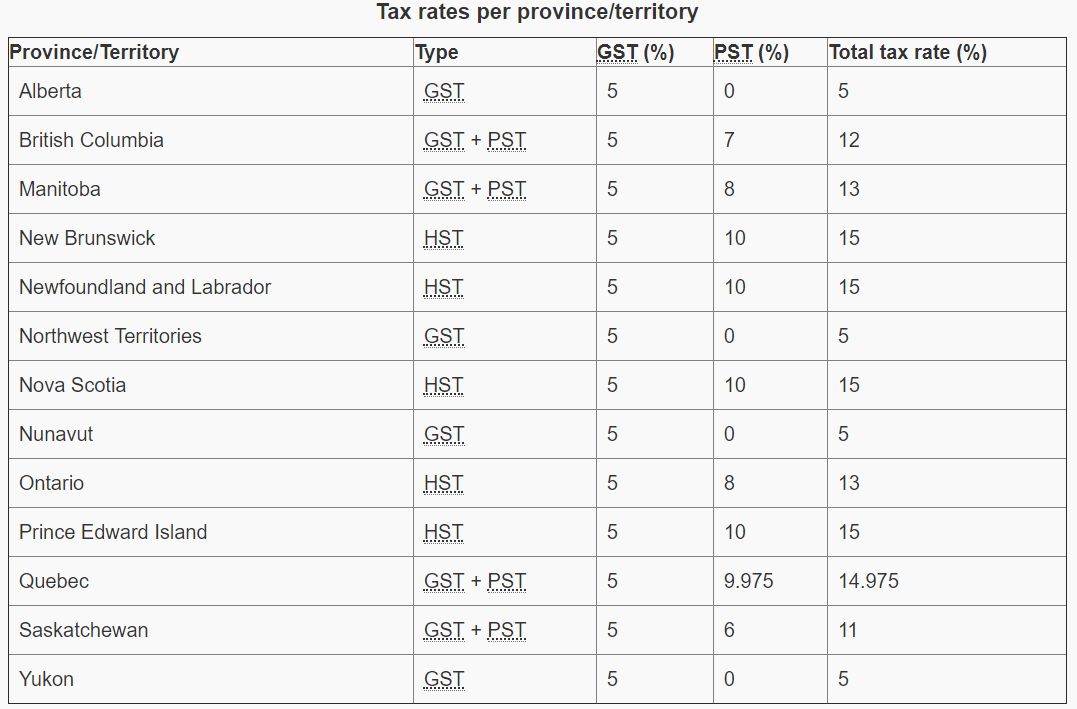
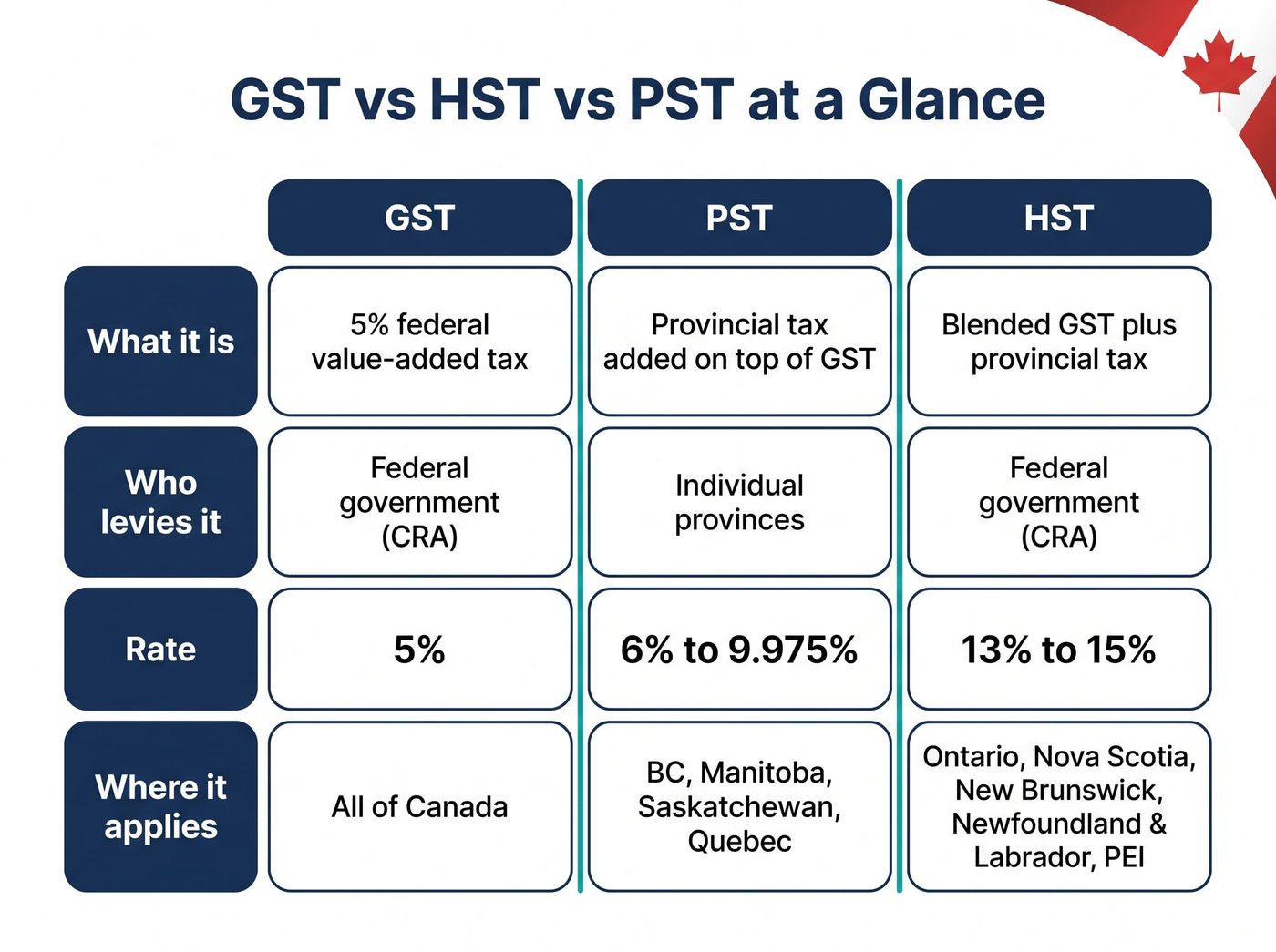
Canada employs a multi-layered sales tax system with a federal tax and various provincial taxes. The federal Goods and Services Tax (GST) is a 5% rate applied to most goods and services sold across the country. This tax is collected by businesses and remitted to the Canada Revenue Agency. All provinces and territories are subject to the GST, though its application differs based on whether a province uses a harmonized system or a separate provincial tax. Five provinces currently use the Harmonized Sales Tax (HST), which combines the federal GST with a provincial portion into a single tax.
The total HST rate and its federal and provincial components vary by province. Ontario applies a 13% HST, consisting of the 5% GST plus an 8% provincial portion. New Brunswick, Newfoundland and Labrador, and Prince Edward Island all apply a 15% HST rate. Nova Scotia's HST rate is 14%, reduced from 15% effective April 1, 2025. British Columbia replaced its HST with a separate GST and PST system in 2013. Other provinces and territories use different structures, with British Columbia, Saskatchewan, and Manitoba charging Provincial Sales Tax (PST) separately from the 5% GST.
Quebec charges the Quebec Sales Tax (QST) at a rate of 9.975% in addition to GST. Alberta, Yukon, Northwest Territories, and Nunavut have no provincial sales tax, so only the 5% federal GST applies. The following table outlines the 2026 sales tax rates for each Canadian province and territory. These rates are effective as of January 2026. It is important to verify current rates with the Canada Revenue Agency for official tax filing purposes, as rates can change and specific transactions may be subject to historical rates or special rules.
| Province/Territory | Tax Structure | Total Rate |
|---|---|---|
| Ontario | HST | 13% |
| New Brunswick | HST | 15% |
| Newfoundland and Labrador | HST | 15% |
| Nova Scotia | HST | 14% |
| Prince Edward Island | HST | 15% |
| British Columbia | GST + PST | 5% + 7% |
| Saskatchewan | GST + PST | 5% + 6% |
| Manitoba | GST + PST | 5% + 7% |
| Quebec | GST + QST | 5% + 9.975% |
| Alberta | GST only | 5% |
| Yukon, NWT, Nunavut | GST only | 5% |
History and Implementation of HST in Canada
The Harmonized Sales Tax system was introduced as a way to simplify sales tax administration by combining federal and provincial taxes. The federal Goods and Services Tax itself was introduced on January 1, 1991, at an initial rate of 7%. This rate was reduced in subsequent years, reaching the current rate of 5% which applies across Canada. The first provinces to adopt HST did so in 1997, which were New Brunswick, Newfoundland and Labrador, and Nova Scotia.
The system expanded in 2010 when Ontario and British Columbia implemented HST. However, British Columbia later reversed this decision and replaced HST with the previous GST and PST system in 2013. That same year, Prince Edward Island harmonized its Provincial Sales Tax with the GST to implement HST. Several rate changes have occurred since harmonization. On July 1, 2016, the HST rate increased from 13% to 15% in New Brunswick and Newfoundland and Labrador.
Prince Edward Island increased its HST rate from 14% to 15% on October 1, 2016. More recently, Nova Scotia reduced its HST rate from 15% to 14% on April 1, 2025. Ontario's HST rate has remained at 13% since its introduction in 2010. These historical changes are important for understanding the tax applicable to past transactions, as current calculators typically apply the most recent rates.
Ontario HST Rules and Specific Applications
Ontario's Harmonized Sales Tax is a single 13% tax applied to most goods and services sold within the province. There is no separate line for GST and PST on an Ontario receipt. The rate combines the 5% federal GST and an 8% provincial portion. This rate is confirmed for 2026 and remains unchanged since its introduction. The tax applies uniformly across all Ontario cities including Toronto, Ottawa, Hamilton, London, and Mississauga.
Certain items are taxed differently under Ontario's rules. Basic groceries are zero-rated, meaning they are subject to a 0% tax rate. Residential rent and most health services are exempt from HST. A significant provision is the Point-of-Sale rebate, which removes the 8% provincial portion of HST on specific consumer items. Buyers pay only the 5% federal GST on children's clothing and footwear, children's car seats and booster seats, diapers, feminine hygiene products, and qualifying print newspapers and books.
Vendors apply this rebate automatically at checkout, and invoices should reflect the net 5% tax, not the full 13%. This rebate does not apply to adult clothing, electronics, or general merchandise. Ontario also offers a new housing rebate for buyers of newly built or substantially renovated homes. This rebate covers 75% of the 8% provincial HST, up to a maximum of $24,000. The full rebate applies to homes priced at $400,000 or less.
For homes priced between $400,000 and $450,000, the rebate is reduced proportionally. Homes over $450,000 receive no provincial rebate. A separate federal GST new housing rebate of up to $6,300 is available for homes under $350,000, phasing out between $350,000 and $450,000. For a $400,000 new home, the provincial HST is $32,000, the rebate is $24,000, and an additional federal rebate may apply, significantly reducing the effective tax.
Business Registration and Compliance for HST
Most Canadian businesses must register for GST/HST once their annual revenue from taxable supplies exceeds the small-supplier threshold of $30,000. This threshold applies to revenue over four consecutive calendar quarters. Once a business exceeds this limit, it is required to register and begin charging the applicable tax on its sales. Voluntary registration is available for businesses with revenue under $30,000, which allows them to claim Input Tax Credits on business expenses, though it also requires them to charge tax on all taxable sales and file returns regularly.
After registration, businesses must file HST returns according to a schedule based on their annual revenue. Businesses with taxable supplies over $6 million must file monthly returns. Those with revenue between $1.5 million and $6 million file quarterly. Businesses under $1.5 million may file annually. Annual filers must remit any tax owing within three months of their fiscal year-end. If a business's prior-year net tax exceeded $3,000, the Canada Revenue Agency requires quarterly instalment payments, due one month after each fiscal quarter.
Late filing incurs a penalty of 1% of the balance owing plus an additional 0.25% per month overdue, for up to 12 months. Registered businesses can recover the HST paid on business expenses by claiming Input Tax Credits. Eligible expenses include office rent, equipment, professional services, vehicle costs for business use, advertising, and office supplies. To claim an ITC for an expense of $100 or more, a valid tax receipt showing the supplier's GST/HST number is required.
ITCs are reported on the HST return and reduce the net tax the business must remit. For home-based businesses, ITCs can be claimed proportional to the business-use percentage of the home on expenses like utilities, internet, and insurance. The CRA may audit ITC claims going back four years, so maintaining detailed records is crucial. This record-keeping requirement underscores the importance of using accurate tools like HST calculators for initial calculations.
Common Calculations and Worked Examples
Understanding how to manually calculate HST is useful for verifying automated tool results or for quick estimates. The fundamental formula for adding HST to a pre-tax price is to multiply the price by one plus the tax rate expressed as a decimal. A shortcut to find just the HST portion is to multiply the total tax-included amount by 0.115044. For reverse calculations, the goal is to find the pre-tax price and the tax amount from a known total. The formula divides the total by one plus the tax rate. With a $113 total in Ontario, dividing by 1.13 yields a pre-tax price of $100. The HST included is then $113 minus $100, which is $13.
This method is essential for bookkeeping when dealing with receipts that only show the final amount paid. Common amounts at the 13% Ontario rate provide quick reference points. A $100 pre-tax price results in $13 HST and a $113 total. Practical examples illustrate these calculations in real-world scenarios.
A Toronto real estate agent earning a $12,000 commission must collect HST. The HST amount is $12,000 multiplied by 0.13, which is $1,560. The agent collects this amount and remits it to the CRA, minus any Input Tax Credits on eligible business expenses. An Ottawa IT consultant billing a $25,000 contract to a federal department includes $3,250 in HST. While government departments pay HST, they self-assess and remit it directly, so the contractor still reports the full $3,250 on their return.
A Hamilton manufacturer invoicing $50,000 to an Ontario customer collects $6,500 in HST. The manufacturer can offset this collected tax with Input Tax Credits on business expenses like raw materials, equipment leases, and shipping costs. This offset often results in a net refund when filing the HST return. These examples show how the tax flows through different types of businesses and why accurate calculation is critical for financial reporting and remittance to the Canada Revenue Agency.
Key Points for Using Sales Tax Calculators
When using an online HST or sales tax calculator, several key points ensure accuracy and proper application. First, always select the correct province or territory, as this determines the tax rate applied. The calculator should use rates verified for the current year, such as 2026 rates. For transactions that occurred in the past, it may be necessary to use historical rates, as seen with Nova Scotia's rate change on April 1, 2025. The tax charged can also depend on the type of supply, the place of supply, and the purchaser, so the calculator provides an estimate.
Input the known value using a dot as the decimal separator, not a comma. For example, enter 10.45, not 10,45. The calculator allows entry into any of the three fields: price before tax, sales tax amount, or price including tax. Upon entry, the other two fields populate automatically. This bidirectional functionality is what makes it both an add-tax and reverse-tax calculator. It is designed to handle all Canadian tax structures, including HST, GST/PST, and GST/QST.
Results are estimates, and due to rounding, the final calculated amounts might differ from official totals by a cent. The calculator is a tool for planning and estimation, not a substitute for official accounting. For business use, especially when filing GST/HST returns, amounts should be reconciled with official invoices and accounting records. The calculator is particularly useful for self-employed individuals needing to extract HST from a total payment for income tax purposes, or for consumers wanting to understand the tax component of a purchase. It serves as a quick reference to confirm the tax implications of any transaction across Canada.
Frequently asked questions
What is the HST rate in Ontario for 2026?
The Harmonized Sales Tax rate in Ontario for 2026 is 13%. This rate combines the 5% federal Goods and Services Tax with an 8% provincial portion into a single tax. It applies to most goods and services sold within the province. The rate has remained at 13% since HST was introduced in Ontario on July 1, 2010.
How do I calculate HST from a total amount?
To calculate the HST included in a total amount, divide the total by one plus the HST rate expressed as a decimal. For example, in Ontario with a 13% rate, divide the total by 1.13. If you have a receipt for $113, dividing by 1.13 gives a pre-tax price of $100. The HST amount is the difference, which is $13. Online calculators automate this reverse calculation instantly when you enter the total price.
Which Canadian provinces use HST?
Five Canadian provinces currently use the Harmonized Sales Tax. These are New Brunswick, Newfoundland and Labrador, Nova Scotia, Ontario, and Prince Edward Island. Their HST rates are 15% for New Brunswick, Newfoundland and Labrador, and PEI. 14% for Nova Scotia. And 13% for Ontario. British Columbia used HST from 2010 to 2013 but has since returned to a separate GST and PST system.
What is the small-supplier threshold for GST/HST registration?
The small-supplier threshold for mandatory GST/HST registration is $30,000 in annual revenue from taxable supplies. This threshold is calculated over four consecutive calendar quarters. Once a business's revenue exceeds this amount, it must register with the Canada Revenue Agency and begin charging GST or HST on its sales. Businesses with revenue under $30,000 can register voluntarily to claim Input Tax Credits.
Are there items exempt from Ontario HST?
Yes, certain items are exempt or taxed at a reduced rate under Ontario HST rules. Basic groceries are zero-rated, meaning no tax applies. Residential rent and most health services are exempt. Additionally, a Point-of-Sale rebate removes the 8% provincial portion of HST on specific items like children's clothing, children's car seats, diapers, feminine hygiene products, and books, leaving only the 5% federal GST to be paid at checkout.
How does the new housing rebate work in Ontario?
Ontario's new housing rebate provides a refund of 75% of the 8% provincial HST paid on a newly built or substantially renovated home, up to a maximum of $24,000. The full rebate applies to homes priced at $400,000 or less. For homes priced between $400,000 and $450,000, the rebate is reduced proportionally. Homes over $450,000 receive no provincial rebate. A separate federal GST rebate may also apply, further reducing the tax burden for eligible buyers.
Sources and further reading
- HST Calculator / Harmonized Sales Tax Calculator hstcalculator.ca
- GST Calculator Canada | HST, PST & Reverse Sales Tax gstcalculator.ca
- HST Calculator Ontario, 13% Rate Breakdown (2026) ibill.ca
- HST Calculator, Add or Reverse GST, PST & QST (Canada ... chatgpt.ca
- Canadian Sales Tax Calculator (GST, HST, PST) helpsme.com
This article explains how things work and is not financial, tax or legal advice. Rules, limits and rates change, so check the current figures with the Canada Revenue Agency, your province or your financial institution before you act.