The United Arab Emirates Dirham (AED) is the official currency of the UAE, subdivided into 100 fils. It is pegged to the US dollar at a fixed rate of approximately 3.6725 AED to 1 USD. For Canadians, the dirham is relevant for travel, business, and remittances, with its value fluctuating against the Canadian dollar based on the USD/CAD exchange rate. Understanding the dirham's history, features, and conversion process helps Canadians manage financial transactions with the UAE effectively.
History and Introduction of the Dirham
The dirham's name originates from the Greek drachme, a unit of currency with a long history in the region. Prior to the formation of the UAE, the various emirates used the Gulf rupee, which was pegged to the Indian rupee. When India devalued the Gulf rupee in June 1966, the Trucial States sought alternatives. Most emirates adopted the Qatar and Dubai riyal, while Abu Dhabi chose the Bahraini dinar. This monetary fragmentation ended in 1973 with the unified introduction of the UAE dirham. The new currency replaced the Bahraini dinar in Abu Dhabi at a rate of 1 dinar to 10 dirhams, while the Qatar and Dubai riyal were exchanged at par in the other emirates. This established a single national currency for the fledgling federation.
The dirham's value was initially managed against a basket of currencies and was officially pegged to the International Monetary Fund's Special Drawing Rights in 1978. In practice, it has maintained a close relationship with the US dollar. Since November 1997, the peg has been formalized at a fixed rate of 3.6725 dirhams to one US dollar. This stability is a key part of the UAE's monetary policy and international trade. In a modern development, the Central Bank of the UAE announced a new Latin-based currency symbol for the dirham in March 2025. The design features the letter D crossed with two horizontal lines inspired by the UAE flag, and it was encoded into the Unicode standard in September 2026.
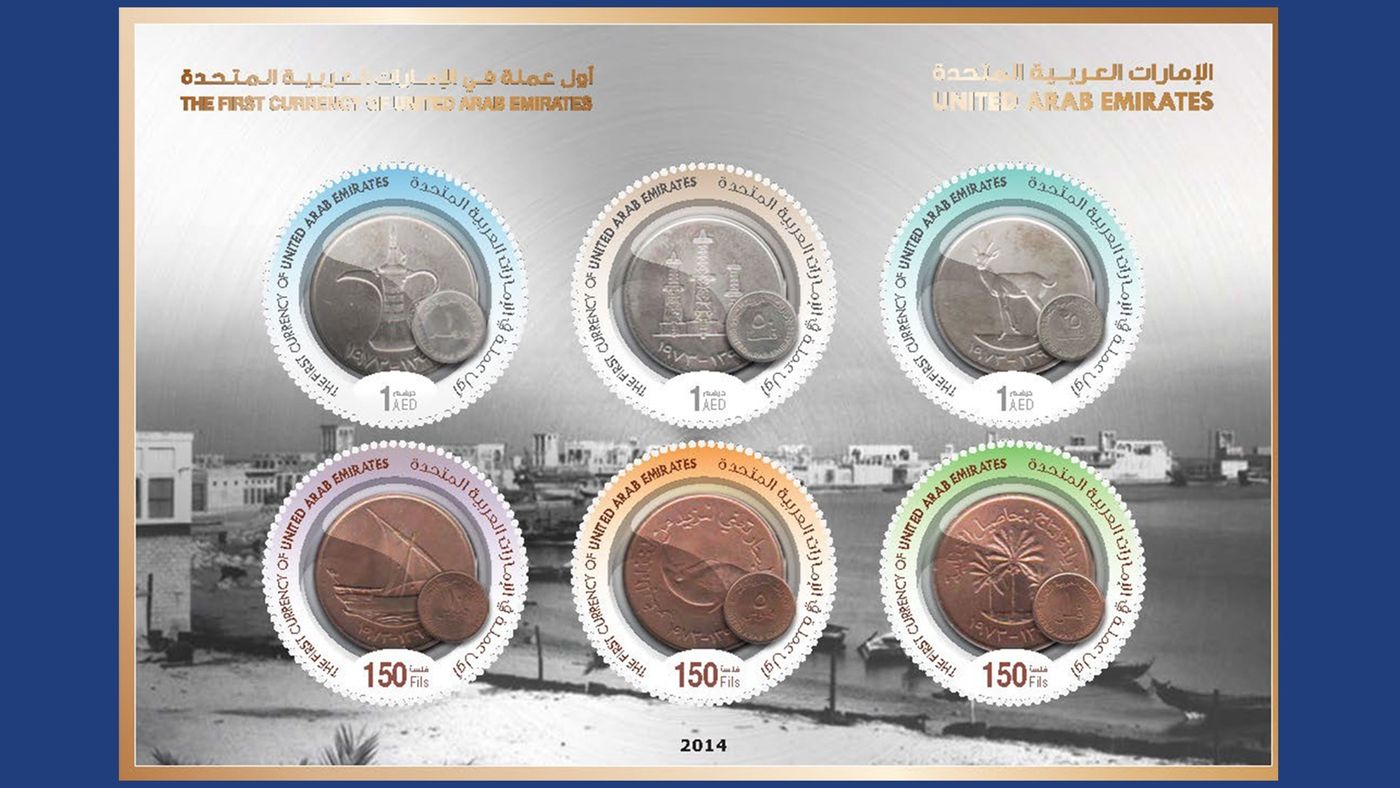
Coins and Banknotes in Circulation
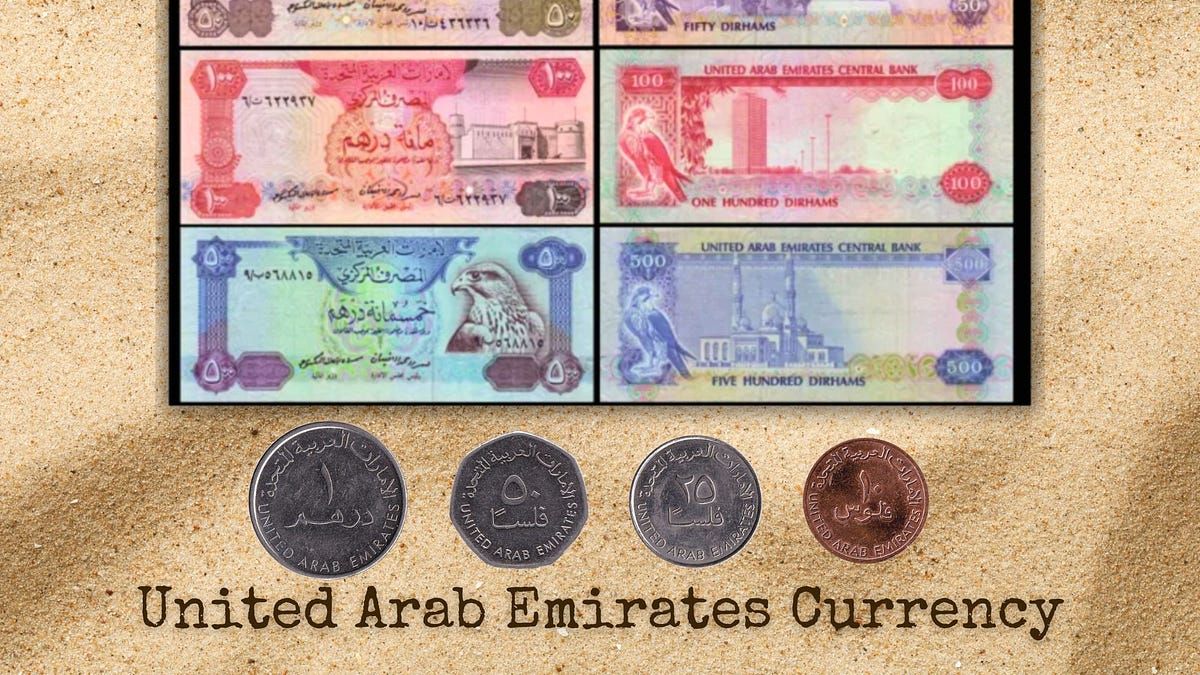
Coins were first introduced in 1973 in denominations of 1, 5, 10, 25, and 50 fils, plus 1 dirham. The lower fils coins were bronze, and the higher values were cupro-nickel. In 1995, several coins, including the 50 fils and 1 dirham, were reduced in size, with the new 50 fils taking a distinctive curve-equilateral-heptagonal shape. The value and text on coins are in Arabic using Eastern Arabic numerals. In everyday commerce, the 1, 5, and 10 fils coins are rarely used, with transactions typically rounded to the nearest 25 fils. The Central Bank still mints these small denominations primarily for collectors and commemorative issues. A notable issue has been coin fraud, as several foreign coins share the size of the UAE one-dirham coin, including the Philippine one-peso coin, the Pakistani five-rupee coin, the Omani 50-baisa coin, and the Moroccan 1 dirham, leading to potential confusion in vending machines.
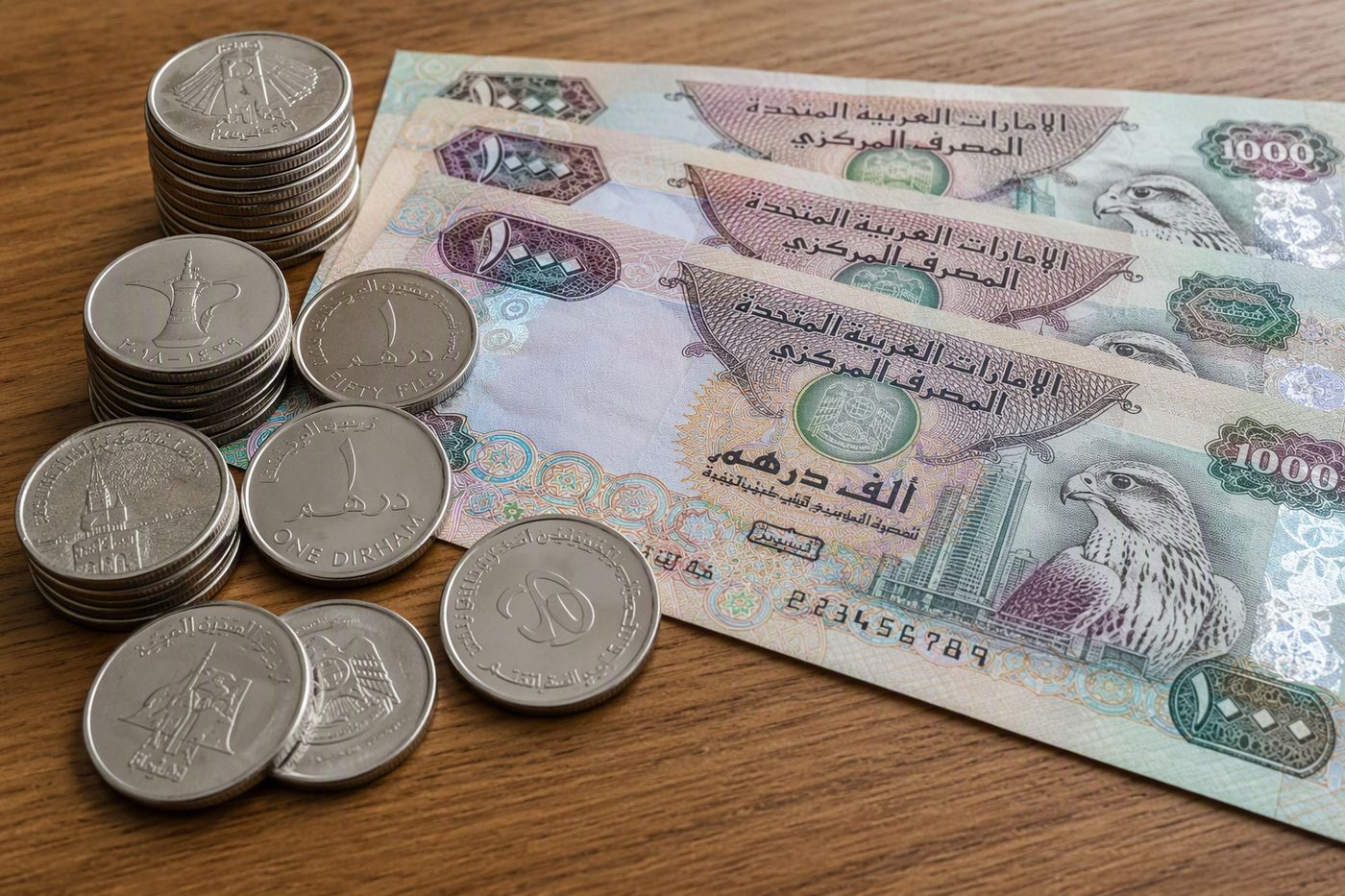
Banknotes entered circulation in May 1973, starting with denominations of 1, 5, 10, 50, and 100 dirhams. A 1,000-dirham note followed in 1976. Subsequent series introduced and revised denominations, with 500-dirham notes added in 1983 and 200-dirham notes in 1989. The current suite of banknotes includes Dhs 5, 10, 20, 50, 100, 200, 500, and 1,000. The obverse of each note features Arabic script and Eastern Arabic numerals, while the reverse uses English and standard Arabic numerals. A key security feature across all notes is a falcon watermark to deter counterfeiting. The UAE has begun transitioning to polymer banknotes, starting with a redesigned Dhs 50 note in December 2021 to mark the country's golden jubilee. Polymer Dhs 5 and Dhs 10 notes followed in April 2022, with a Dhs 1,000 polymer note released in the first half of 2023 and a Dhs 500 polymer note reportedly introduced in November 2023.
The AED to CAD Exchange Rate and Market Performance
The exchange rate between the Emirati dirham and the Canadian dollar is not fixed, as the CAD floats independently on global markets. The rate is derived from the cross-rate of the USD/AED peg and the USD/CAD pair. Consequently, the value of one dirham in Canadian dollars fluctuates based on the strength of the US dollar against the loonie. As of October 2026, the mid-market exchange rate was approximately 0.3829 Canadian dollars for one UAE dirham. This rate represents the midpoint between the global buy and sell prices and is used as a benchmark, though consumers will typically receive a different rate when conducting actual transactions due to fees and margins applied by financial institutions.
The AED/CAD pair exhibits moderate volatility over short and medium terms. Analysis of market data from 2026 shows the exchange rate moving within a range over recent periods. The 30-day performance prior to October 2026 saw a high of 0.3888 and a low of 0.3821, with an average of 0.3862. Over a 90-day period, the range was wider, from a high of 0.3888 to a low of 0.3748, averaging 0.3814. These fluctuations reflect broader movements in commodity prices, interest rate differentials, and global risk sentiment that affect the Canadian dollar. For Canadians sending money to or from the UAE, these variations mean the amount received can change from one day to the next.
How to Convert and Send Dirhams from Canada
Canadians looking to convert dirhams to Canadian dollars or send money to the UAE have several options, including banks, specialized currency exchange services, and international money transfer operators. The process typically involves comparing the offered exchange rate, which will be less favourable than the mid-market rate, and any associated transaction fees. Many providers allow customers to initiate transfers online or via mobile apps, where they can see the total cost upfront before committing. For those receiving dirhams from the UAE, the funds can often be deposited directly into a Canadian bank account or picked up in cash at an agent location. It is important for users to verify the recipient's details and be aware of any identification requirements for larger transfers.
Providers often emphasize features designed to save money and simplify the process. These include offering bank-beating exchange rates with no hidden fees, providing real-time tracking of transfers, and allowing users to set up rate alerts to act when the market moves favourably. The steps for a typical transfer involve registering with a service, entering the recipient's information and the amount to send, reviewing the exchange rate and total fees, and then completing the payment from a Canadian bank account or card. Transfers can often be completed within minutes for cash pickup or within a business day for bank deposits, though timing can vary based on the service, amount, and destination.
Common Uses and Considerations for Canadians
The primary uses of the UAE dirham for Canadians involve travel, commerce, and personal remittances. Canadians visiting the UAE for tourism or business will need dirhams for daily expenses. While credit cards are widely accepted in urban centres, having local currency is essential for markets, taxis, and smaller vendors. For businesses, the fixed peg to the US dollar simplifies pricing and invoicing for goods and services traded with the UAE. A significant use case is sending financial support to family members living in the UAE or receiving funds from employment or investments there. The stability of the dirham due to its dollar peg can be advantageous for planning these regular transfers, as it removes uncertainty from the AED side of the exchange rate equation.
When handling dirhams, Canadians should be aware of a few practical considerations. Due to rounding, the smallest coin commonly encountered is the 25 fils, worth roughly one Canadian cent. The 200-dirham banknote was scarce for many years after its 1989 introduction but was reissued in a new colour in May 2008 and is now in circulation. Travellers should also be cautious when receiving coins, as older 50-fils coins are almost the same size as the modern 1-dirham coin, which could lead to confusion. For those converting money, it is crucial to understand that the advertised mid-market rate is a reference point, and the actual rate received will include a margin that constitutes the service provider's profit.
Key Historical Dates for the UAE Dirham
The development of the UAE dirham is marked by several important milestones that shaped its role as the national currency. These events trace the currency's evolution from regional monetary systems to a unified, modern currency with a global presence. The list includes the devaluation of the Gulf rupee in June 1966, which forced the emirates to adopt new currencies. The dirham was introduced in 1973 to create a single national currency. Banknotes first appeared in May 1973, and the 1,000-dirham note followed in January 1976. The peg to the US dollar was formalized in November 1997, providing long-term stability. More recent developments include the reissue of the 200-dirham note in 2008 and the move to polymer banknotes starting in 2021.
- 6 June 1966: India devalues the Gulf rupee, prompting the Trucial States to seek alternative currencies.
- 1973: The UAE dirham is introduced, unifying the currency across all seven emirates.
- 20 May 1973: The first series of dirham banknotes is issued.
- 3 January 1976: The 1,000-dirham banknote is introduced.
- 28 January 1978: The dirham is officially pegged to the IMF's Special Drawing Rights (SDRs).
- November 1997: The dirham's peg is formally fixed to the US dollar at 1 USD = 3.6725 AED.
- May 2008: The 200-dirham banknote is reissued into general circulation.
- 7 December 2021: The UAE issues its first polymer banknote, a Dhs 50 note, for the country's golden jubilee.
- March 2025: The Central Bank of the UAE announces a new Latin-based currency symbol for the dirham.
The UAE dirham has evolved toward greater stability and modernization. In March 2025, the Central Bank of the UAE announced the creation of a new currency symbol for the dirham. The UAE has also introduced polymer banknotes, starting with a redesigned 50 dirham note in December 2021. These polymer notes, which include denominations of 5, 10, 500, and 1000 dirhams, incorporate advanced security features like a falcon watermark.
Comparison of Recent AED to CAD Exchange Rates
The value of the dirham in Canadian dollars varies over time. The following table shows the high, low, and average exchange rates for the AED/CAD pair over different periods based on 2026 market data. These figures illustrate the typical range of fluctuation Canadians might encounter when converting currency. The data indicates that while the dirham's value in Canadian cents is relatively stable in the short term, it can experience more pronounced movements over longer periods. This volatility underscores the benefit of monitoring rates or using alert tools if timing a transfer is flexible.
| Time Period | High (AED to CAD) | Low (AED to CAD) | Average |
|---|---|---|---|
| Last 7 Days | 0.3888 | 0.3841 | 0.3860 |
| Last 30 Days | 0.3888 | 0.3809 | 0.3860 |
| Last 90 Days | 0.3888 | 0.3747 | 0.3815 |
Exchange rate figures such as one UAE dirham equaling approximately 0.3829 Canadian dollars are based on the mid-market rate. The actual rates offered by banks or money transfer services include a margin and differ from this benchmark. Canadians planning a money transfer should check the current rate with their chosen provider. This is necessary to understand the exact cost of converting Canadian dollars to UAE dirhams.
Frequently asked questions
Can I use Canadian dollars in the United Arab Emirates?
No, Canadian dollars are not accepted for everyday transactions in the UAE. You will need to exchange your Canadian dollars for UAE dirhams. This can be done before you travel, at airports, at banks, or at currency exchange offices within the UAE. Major credit cards are widely accepted.
Are there small coins like pennies in the UAE?
The dirham is divided into 100 fils. However, coins for 1, 5, and 10 fils are rarely used in daily life. Transactions are typically rounded to the nearest 25 fils. The most commonly used coins are the 25 fils, 50 fils, and 1 dirham coins.
What is the UAE dirham (AED) pegged to?
The UAE dirham is pegged to the United States dollar. Since November 1997, the official and constant peg has been 1 US dollar to 3.6725 Emirati dirhams, which is approximately Dh 1 to US$0.272294. This peg was formally established after the dirham was initially linked to the IMF's Special Drawing Rights in 1978. The fixed rate provides stability and means the dirham's value moves in tandem with the US dollar against other global currencies.
What are the most common UAE dirham banknotes?
The most common UAE dirham banknotes in circulation are denominations of 5, 10, 20, 50, 100, 200, 500, and 1,000 dirhams. The 200 dirham note, initially scarce after its 1989 release, was reissued in a new colour in May 2008 and is now in circulation. Furthermore, the UAE has introduced modern polymer banknotes, starting with a redesigned Dhs 50 note in December 2021, followed by Dhs 5 and Dhs 10 notes in April 2022, and Dhs 500 and Dhs 1000 notes in late 2023. All dirham notes feature a falcon watermark for security.
How do I send money from Canada to the UAE?
To send money from Canada to the UAE, you can use banks, online money transfer services like Western Union or OFX, or currency exchange providers. The process typically involves registering with a service, entering the amount in Canadian dollars, and providing the recipient's details in the UAE. These services provide real time exchange rates and show all applicable fees upfront before you confirm the transfer. The recipient in the UAE will then receive the funds in Emirati dirhams, often within minutes for cash pickup or directly to a bank account.
Sources and further reading
- United Arab Emirates dirham (Wikipedia) en.wikipedia.org
- United Arab Emirates dirhams to Canadian dollars today wise.com
- 1 AED to CAD, Convert Emirati Dirhams to Canadian Dollars xe.com
- Convert United Arab Emirates Dirham to Canadian Dollar westernunion.com
- Convert Dirhams to Canadian Dollars | AED to CAD currency.me.uk
- 1 AED to CAD | United Arab Emirates Dirhams To ... luluexchange.com
This article explains how things work and is not financial, tax or legal advice. Rules, limits and rates change, so check the current figures with the Canada Revenue Agency, your province or your financial institution before you act.