The Nigerian naira (NGN) is the official currency of Nigeria, subdivided into 100 kobo. Managed by the Central Bank of Nigeria (CBN), the naira has a complex history of redenomination plans, pegs to the US dollar, and recent volatility. For Canadians, the naira is relevant for remittances, travel, and business, with exchange rates available through banks, money transfer services, and a parallel market. Understanding the naira's value and the mechanisms for converting Canadian dollars is important for financial planning involving Nigeria.
What Is the Nigerian Naira?
The Nigerian naira is the legal tender of the Federal Republic of Nigeria, issued solely by the Central Bank of Nigeria. Its Currency Operations Department handles the entire lifecycle of banknotes and coins, including design, procurement, distribution, and disposal. The currency's name was derived from the word 'Nigeria' by Obafemi Awolowo, and it was launched in 1973 by then-Finance Minister Shehu Shagari. The naira sign is ₦, and its ISO code is NGN. One naira is divided into 100 kobo, though due to significant inflation over the decades, kobo coins have become essentially worthless and are rarely used in everyday transactions. The naira's management is a core function of the CBN, which aims to control money supply to ensure monetary and price stability within the Nigerian economy.
History and Evolution of the Currency
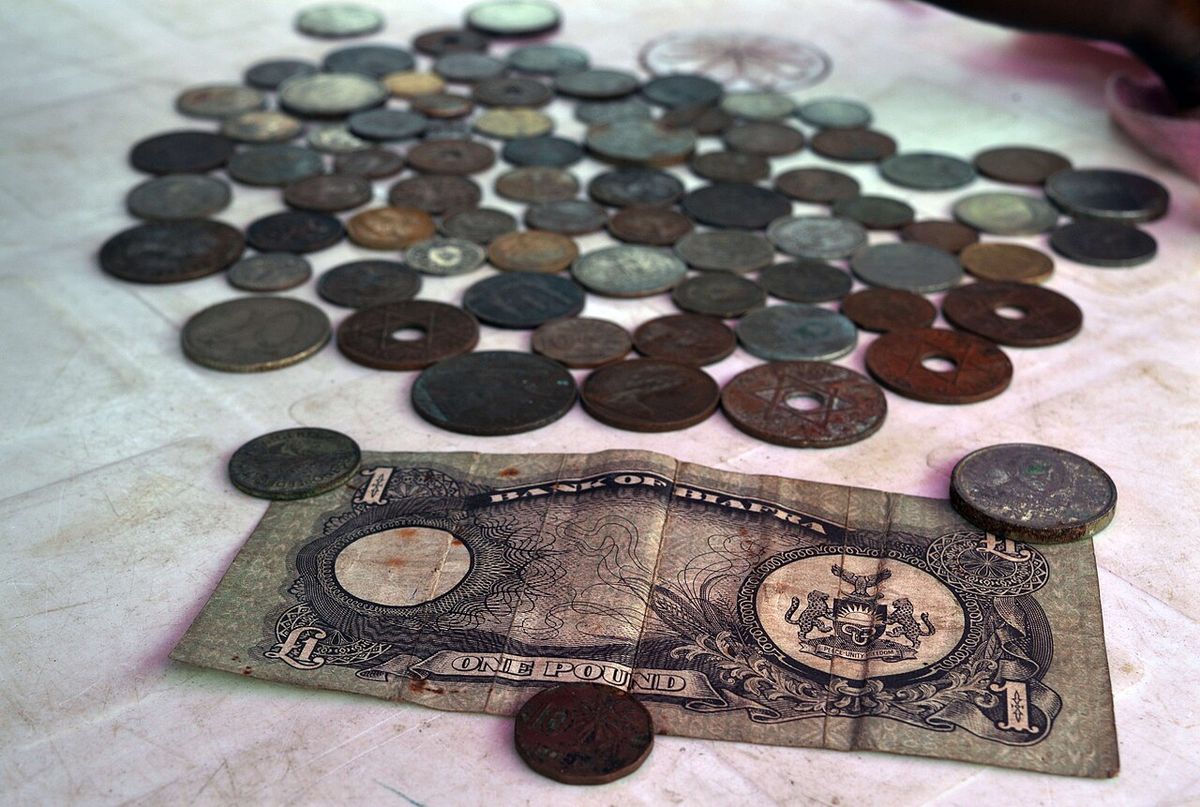
The naira was introduced on 1 January 1973, replacing the Nigerian pound at a rate of two naira for one pound. This move made Nigeria the last country in the world to abandon the pounds, shillings, and pence (£sd) system in favour of a decimal currency. The initial coins were the first issued by an independent Nigeria, as all previous coins bore the image of Queen Elizabeth II. Between 1993 and 1998, the naira was pegged to the US dollar. The Central Bank has historically aimed to control inflation, raising its key interest rate from 6.25% to 12% across six increases in 2011. After being pegged at ₦197 to US$1 from March 2015, the naira was allowed to float on 20 June 2016. A major redenomination plan set for 2008, which would have converted 100 old naira to 1 new naira, was suspended by President Umaru Musa Yar'Adua.
The naira has experienced severe volatility in recent years. In 2023, a currency redesign for the ₦200, ₦500, and ₦1,000 notes led to a cash crunch and widespread protests after too few new notes entered circulation. On 14 June 2023, the central bank abandoned a currency peg in place since 2017, causing the naira to fall 23% in a day to ₦600 per US dollar. It reached a record low of ₦853 per dollar in July 2023 and fell further to approximately ₦1,400 per dollar in early February 2024 before drifting to around ₦1,600 by late July 2024. The currency's value has been profoundly impacted by these policy shifts and market pressures.
Banknotes and Coins in Circulation
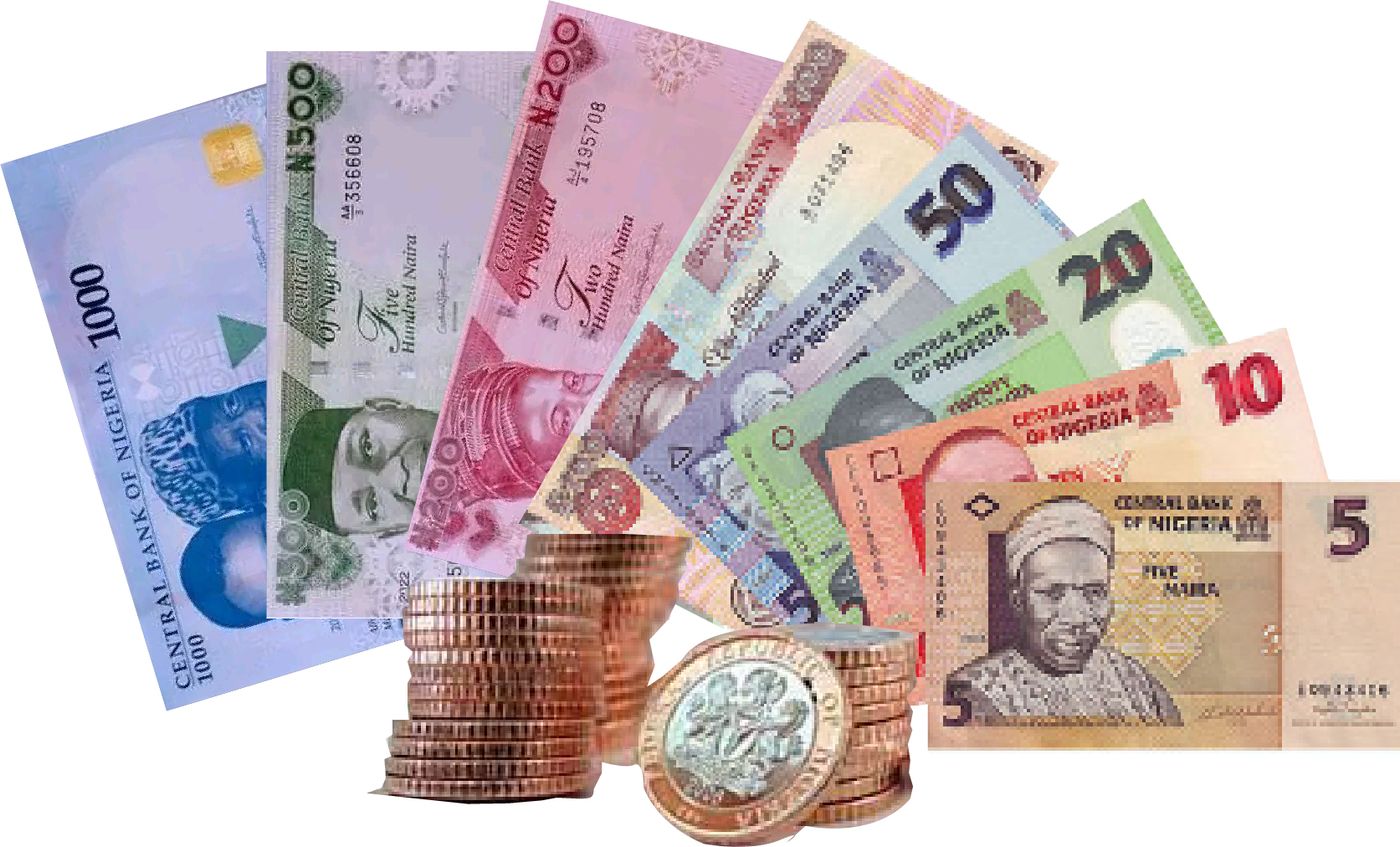
When introduced, naira banknotes came in denominations of 50 kobo, ₦1, ₦5, ₦10, and ₦20. Over time, higher denominations were added: ₦50 in 1991, ₦100 in 1999, ₦200 in 2000, ₦500 in 2001, and ₦1,000 on 12 October 2005. The 50 kobo and ₦1 notes were replaced by coins in 1991. In February 2007, redesigned notes for ₦5 to ₦50 were issued, with plans for some to be polymer. Initially, only the ₦20 was released in polymer, but by mid-2009 the ₦5, ₦10, and ₦50 were also converted to polymer notes. The CBN has since moved away from polymer notes citing higher costs and environmental concerns. Current banknotes feature enhanced security features like holographic strips and colour-shifting elements to prevent counterfeiting.
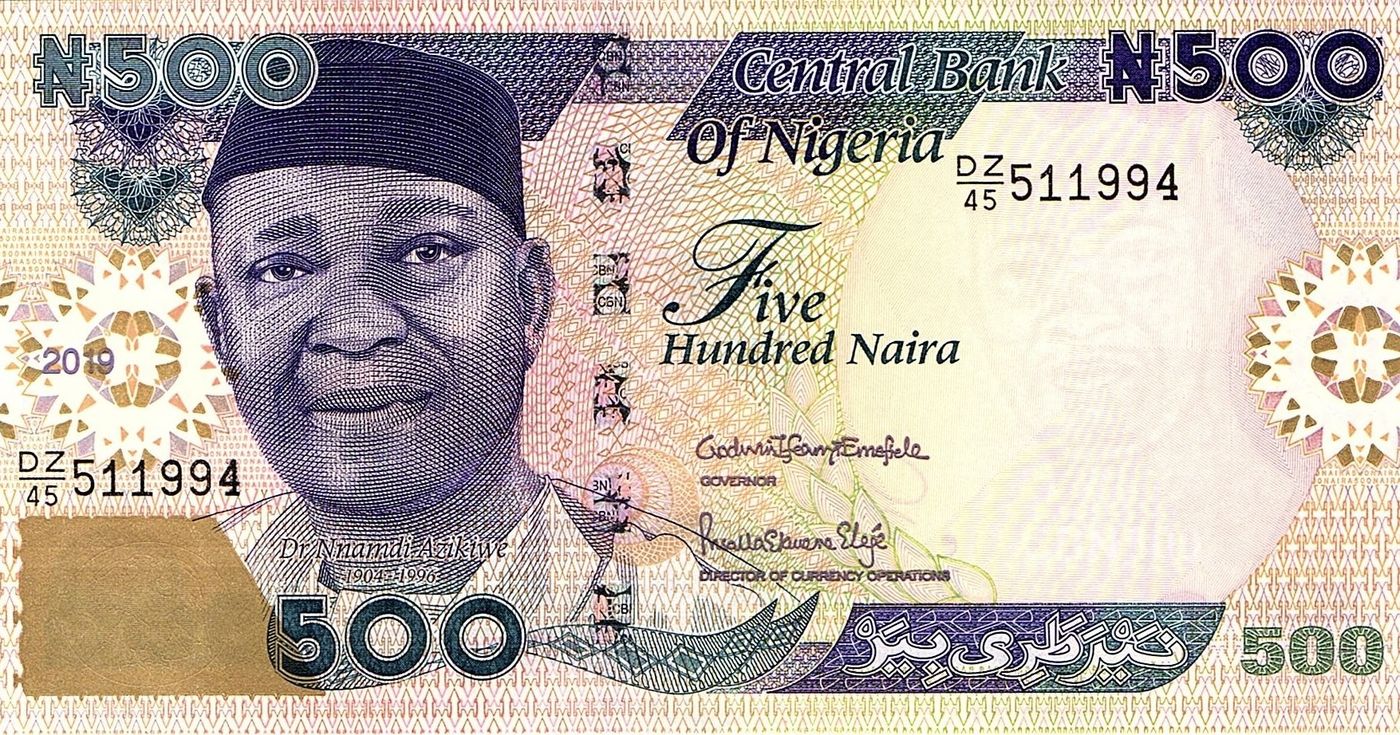
Current banknotes feature enhanced security. The ₦1,000 note, for example, has a shiny gold strip on the back and a colour-shifting triangle on the front. Portraits of former CBN governors Alhaji Aliyu Mai-Bornu and Dr. Clement Isong appear on the ₦1,000 note. As of 2022, there are two versions each of the ₦200, ₦500, and ₦1,000 notes in circulation due to the 2022 redesign, which changed their colour schemes. The ₦1,000 note became blue, the ₦500 green, and the ₦200 a reddish hue. A commemorative ₦100 note was issued in November 2014 to mark Nigeria's centennial, featuring a QR code linking to historical information.
Coins have been issued in various series since 1973. The initial 1973 coins were in denominations of 1⁄2, 1, 5, 10, and 25 kobo, with the 1⁄2 kobo minted only that year. In 1991, smaller, steel-based coins for 1, 10, 25, 50 kobo and ₦1 were introduced. A new series dated 2006 entered circulation in February 2007, comprising 50 kobo, ₦1, and ₦2 coins, with the ₦1 and ₦2 being bimetallic. The 1⁄2 to 25 kobo coins were officially withdrawn from circulation on 28 February 2007. The 2006-dated coin series depicts Herbert Macaulay on the ₦1 coin and the National Assembly building on the ₦2 coin. Due to high inflation, all coins now have negligible purchasing power and are rarely seen in daily use.
Exchange Rates and Value Against the Canadian Dollar
The naira's value has fluctuated dramatically. When introduced, its official rate was US$1.52 for ₦1, though a black market already existed. As of September 2025, the official Central Bank of Nigeria exchange rate was approximately ₦1,480.15 per US dollar. The parallel market rate often differs significantly. In June 2024, it was around ₦1,483 per dollar, highlighting ongoing economic pressures. For Canadians, the exchange rate between the Canadian dollar (CAD) and the naira (NGN) is critical for transfers. This rate is a benchmark, but the actual rate offered by money transfer services may include a margin or fee.
The table below shows a snapshot of recent Canadian Dollar to Nigerian Naira exchange rates from various sources as of October 2026. As of October 17, 2026, the exchange rate for one Canadian Dollar was 962.7483 Nigerian Naira. Another source from the same period indicated a rate of 945.58 NGN per CAD. A promotional rate offered by a service was 985.56 NGN per Canadian Dollar. These figures illustrate the typical range of exchange rates between the two currencies at that time.
| Source / Service | Approximate Rate (1 CAD to NGN) |
|---|---|
| Mid-Market Reference (Xe) | 947.09 |
| Western Union Promotional | 985.56 |
| Pesa Converter | 961.00 |
| General Market Rate | 950.20 |
Exchange rates are dynamic, influenced by factors like interest rates, economic performance, and geopolitical events. Over a 90-day period leading to October 2026, the CAD to NGN rate moved between 929.13 and 981.54, with an average of 958.01. The black market rate for 1 CAD was reported as 970 Naira, typically higher than official channels due to being unregulated. Factors affecting this black market rate include supply and demand, political stability, and the overall health of the Nigerian economy, and exchanging currency there carries a risk of scams.
How to Convert Canadian Dollars to Naira in Canada
Canadians looking to send money to Nigeria or convert currency have several options, each with different costs and speeds. Major international money transfer services like Western Union and Wise (formerly TransferWise) offer online and in-person services. Western Union allows transfers online, via its app, or at agent locations for cash pickup in Nigeria, using encryption and fraud prevention measures. It shows an estimated exchange rate and transfer fee before confirmation. Wise promotes transparency by using the real mid-market rate and charging a clear fee, avoiding hidden markups. Specialist services like Pesa advertise zero transfer fees and competitive exchange rates for converting CAD to NGN, operating through a mobile app.
The process for converting currency generally involves a few common steps. First, you must register and verify your identity with the chosen service provider, which can often be done online in minutes. Next, you select the amount in Canadian dollars you wish to send and choose Nigerian naira as the receiving currency. The service will then quote an exchange rate and any applicable transfer fees, showing the total amount in naira that the recipient will receive. Finally, you complete the payment using a bank account, debit card, or credit card, and the funds are delivered, often for cash pickup or bank deposit in Nigeria. It is important to review all costs upfront, as the final rate can differ from the mid-market rate seen on financial websites. Many services offer tracking so you can monitor the transfer's progress in real time.
Key Risks and Debates Surrounding the Naira
The naira faces significant challenges, primarily driven by volatility and policy decisions. A major debate centres on the existence of a dual exchange rate system, with a wide gap often persisting between the official rate set by the Central Bank of Nigeria and the parallel 'black market' rate. This disparity, such as the ₦8 to ₦13 spread noted in August 2025, reflects underlying economic pressures, limited foreign currency supply, and market speculation. Critics argue this system creates distortions, encourages corruption, and hampers foreign investment. The CBN has historically used weekly foreign currency auctions to manage the official rate, with plans to make the naira fully convertible shelved after the 2008 redenomination plan was cancelled.
Another major risk stems from monetary policy implementation. The 2022 banknote redesign for the ₦200, ₦500, and ₦1,000 notes, intended to curb inflation and illicit cash hoarding, backfired severely. A poorly executed rollout with tight deadlines caused a catastrophic cash shortage in early 2023. This led to widespread protests, a strain on digital payment systems, and the rise of a black market for cash where fees soared. The crisis contributed to a decrease in Nigeria's GDP growth from 3.5% in late 2022 to 2.3% in early 2023. The policy was challenged in the Supreme Court, which invalidated the government's demonetization deadline, forcing the old notes to remain legal tender. This event highlighted the risks of abrupt policy shifts in a cash-dependent economy.
Persistent high inflation remains a fundamental risk. Although the CBN has targeted keeping annual inflation below 10%, economic realities have often made this impossible. This erosion of purchasing power renders small denomination coins useless and constantly pressures the currency's stability on international markets. The central bank's ability to manage these interconnected risks of inflation, exchange rate volatility, and public confidence is a continuous and critical challenge.
The eNaira and Digital Currency Landscape
In October 2021, Nigeria launched the eNaira, a central bank digital currency (CBDC) that is a digital equivalent of the physical naira. President Muhammadu Buhari officially introduced the currency, making Nigeria one of the first major economies to roll out a CBDC. The eNaira operates on a blockchain-based platform and is designed to facilitate cheaper and faster transactions, improve financial inclusion, and provide the central bank with greater visibility over the money supply. Its launch was partly motivated by the government's broader goals of modernizing the payment system and reducing the volume of cash outside the banking system. The digital currency represents a significant shift in Nigeria's monetary framework.
The relationship between the eNaira and physical cash has been contentious. The cash crunch of early 2023 was exacerbated by government attempts to push citizens toward using the new digital currency and newly designed banknotes. The government's strategy of limiting the supply of new physical notes was seen by many as a forced migration to digital payments, which met with public resistance due to unreliable digital infrastructure and limited access in rural areas. While the eNaira represents a significant technological step, its adoption and integration into the everyday economy continue to evolve amidst Nigeria's complex financial landscape. The success of the eNaira will depend on overcoming these infrastructural hurdles and building public trust in digital finance.
Frequently asked questions
What is the current exchange rate for Canadian dollars to Nigerian naira?
This reference rate fluctuates constantly. Money transfer services like Western Union, Wise, or Pesa will offer a specific rate that may include a margin. For example, promotional rates have been shown around 985.56 NGN per CAD. It is important to check the live rate with your chosen provider at the time of transfer, as it will differ from the pure mid-market rate.
Is there a black market for naira in Canada?
Yes, a parallel or black market for naira exists, where exchange rates are typically higher than official channels because they are not regulated by the government. As of October 2026, the reported black market rate for 1 Canadian dollar was 970 naira. While some individuals seek out these dealers online or in person, there is a significant risk of being scammed. For safety and reliability, using licensed money transfer services or financial institutions is generally advised.
How can I send money from Canada to Nigeria?
You can send money from Canada to Nigeria using international money transfer services like Western Union, Wise, or Pesa. The process usually involves registering with the service, entering the amount in CAD, selecting NGN as the payout currency, and reviewing the quoted exchange rate and fees. Payment can be made via bank account, debit card, or credit card. The recipient can then collect the funds in cash at an agent location in Nigeria or receive it directly into a bank account. Services provide tracking numbers like an MTCN to monitor the transfer.
Why did Nigeria redesign its naira banknotes in 2022?
The Central Bank of Nigeria redesigned the ₦200, ₦500, and ₦1,000 banknotes in 2022. The bank cited several reasons for this policy. It noted that global best practice suggests currency should be redesigned every 5 to 8 years, and the naira was long overdue. The key objectives were to disrupt currency fraud and compel the return of hoarded cash outside the banking system. The redesign also aimed to undermine cash-based criminal activities like kidnapping, ease inflationary pressures by reducing money supply outside banks, and enhance the central bank's control over monetary policy.
What caused the Nigerian currency crisis in 2023?
The 2023 currency crisis was caused by the implementation of the 2022 banknote redesign. The Central Bank of Nigeria set a strict deadline to demonetize the old high-value notes but failed to supply enough of the new notes into circulation. This created a severe cash shortage, leading to long bank queues, business disruptions, and the emergence of a black market for cash where fees were exorbitant. The crisis sparked widespread street protests and legal challenges, with the Supreme Court ultimately invalidating the government's deadline and restoring the old notes as legal tender.
What is the eNaira?
The eNaira is Nigeria's central bank digital currency (CBDC), launched in October 2021. It is a digital form of the national currency, issued and regulated by the Central Bank of Nigeria. The eNaira aims to facilitate faster and cheaper transactions, improve financial inclusion, and give the central bank better oversight of the money supply. Its launch was part of a broader push towards a less cash-dependent economy, though its rollout coincided with the controversial 2022 to 2023 cash crunch that complicated public perception and adoption.
Sources and further reading
- Nigerian naira (Wikipedia) en.wikipedia.org
- CAD to NGN | Convert Canadian Dollar to Nigerian Naira westernunion.com
- Nigerian naira to Canadian dollars Exchange Rate History wise.com
- 1 CAD to NGN, Canadian Dollars to Nigerian Nairas ... xe.com
- Convert CAD to NGN, Pesa pesa.co
- 1 Canadian Dollar (CAD) to Naira Black Market Rate Today abokiforex.app
This article explains how things work and is not financial, tax or legal advice. Rules, limits and rates change, so check the current figures with the Canada Revenue Agency, your province or your financial institution before you act.