The euro is the official currency of 21 European Union member states, collectively known as the eurozone. It is one of the world's most important currencies, used daily by over 358 million people. For Canadians, the euro is a major foreign currency encountered in travel, trade, and investment, with its exchange rate against the Canadian dollar fluctuating based on global economic conditions. Understanding the euro's history, how it is managed, and its current value in Canadian dollars is essential for anyone dealing with European markets or planning a trip abroad.
What Is the Euro?
The euro is the sole legal tender for 21 of the 27 member states of the European Union. This group of countries is officially called the euro area, commonly referred to as the eurozone. Each euro is subdivided into 100 cents. The currency is also used officially by the institutions of the European Union itself. Beyond the EU, the euro is the official currency of four European microstates that are not EU members, Andorra, Monaco, San Marino, and the Vatican City, through monetary agreements. It is also used in some special territories of EU members and unilaterally adopted by two other European states. With more than €1.3 trillion in banknotes and coins in circulation as of December 2019, the euro has one of the highest combined values of cash in circulation globally. It is the second-largest reserve currency and the second-most traded currency in the world after the United States dollar.

History and Introduction
The euro was established by the provisions of the 1992 Maastricht Treaty, which set out a path for European economic and monetary union. Member states committed to adopting the euro upon meeting strict monetary and budgetary convergence criteria, such as limits on budget deficits and government debt. The name 'euro' was officially adopted on 16 December 1995. The currency was first introduced to world financial markets as an accounting currency on 1 January 1999, replacing the former European Currency Unit at a one-to-one ratio. Physical euro coins and banknotes entered circulation three years later on 1 January 2002, becoming the day-to-day operating currency. The changeover period, where old national currencies were exchanged, lasted about two months until 28 February 2002. The definitive conversion rates between the old national currencies and the euro were locked in on 31 December 1998. The euro's history includes several key phases and challenges. For its first few years, the euro traded below parity with the US dollar. It reached parity in December 2002 and has generally traded near or above it since. A significant event occurred on 13 July 2022, when the euro and US dollar briefly hit parity for the first time in nearly two decades, partly due to economic pressures from the Russian invasion of Ukraine. The eurozone also faced a major sovereign debt crisis starting in 2009, which acutely affected Greece, Cyprus, Ireland, Italy, Portugal, and Spain, testing the currency's stability and the political unity of the bloc.
- 16 December 1995: The name 'euro' is officially adopted.
- 1 January 1999: Euro introduced as an accounting currency.
- 1 January 2002: Physical euro cash enters circulation.
- 28 February 2002: Changeover period for old currencies largely ends.
- December 2002: Euro reaches parity with US dollar.
- 2009 to 2012: Eurozone sovereign debt crisis.
- 13 July 2022: Euro and US dollar hit parity again.
- 27 April 2019: Issuance of €500 banknote discontinued.
How the Euro Is Managed
The euro is managed and administered by the European Central Bank and the Eurosystem. The Eurosystem comprises the ECB and the national central banks of the eurozone countries. As an independent central bank, the ECB has the sole authority to set monetary policy for the eurozone, including key interest rates. The Eurosystem is responsible for the printing, minting, and distribution of euro banknotes and coins across all member states. It also operates the eurozone's payment systems. The legal foundation for the euro is the Maastricht Treaty, which was later amended by the Treaty of Nice in 2001. Most EU member states are obliged to adopt the euro once they meet the convergence criteria, though Denmark has a formal opt-out, and Sweden has circumvented its commitment. The ECB and national central banks issue euro banknotes on a joint basis. The ECB itself issues 8% of the total value of banknotes in circulation. The remaining 92% are issued by the national central banks in proportion to their share of the ECB's capital key, which is calculated based on each country's share of the EU population and GDP. This system ensures a unified currency supply across the diverse economies of the eurozone. For large-value euro transactions, the ECB operates the T2 clearing system, which has been in place since March 2023.
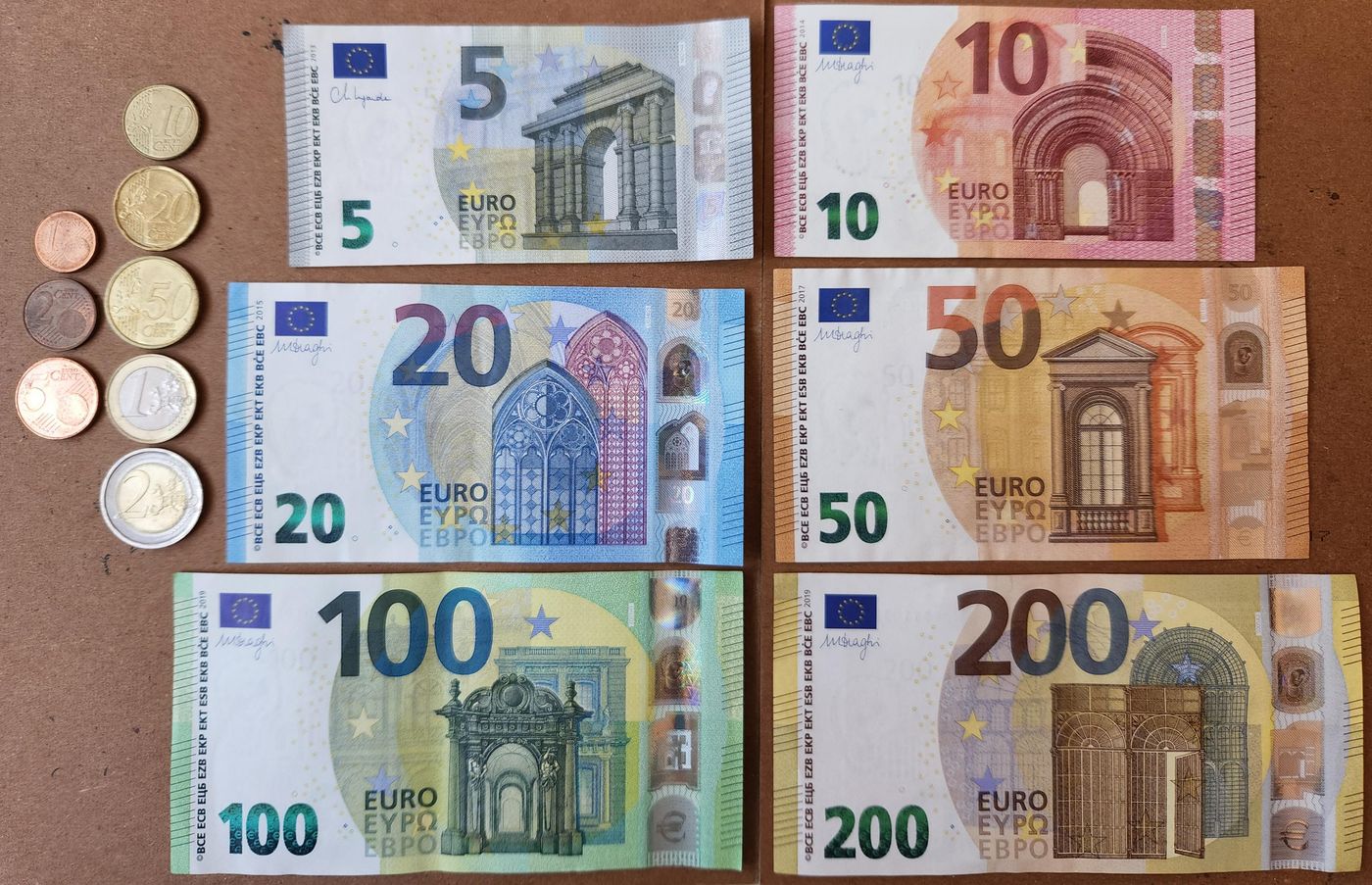
Euro Coins and Banknotes
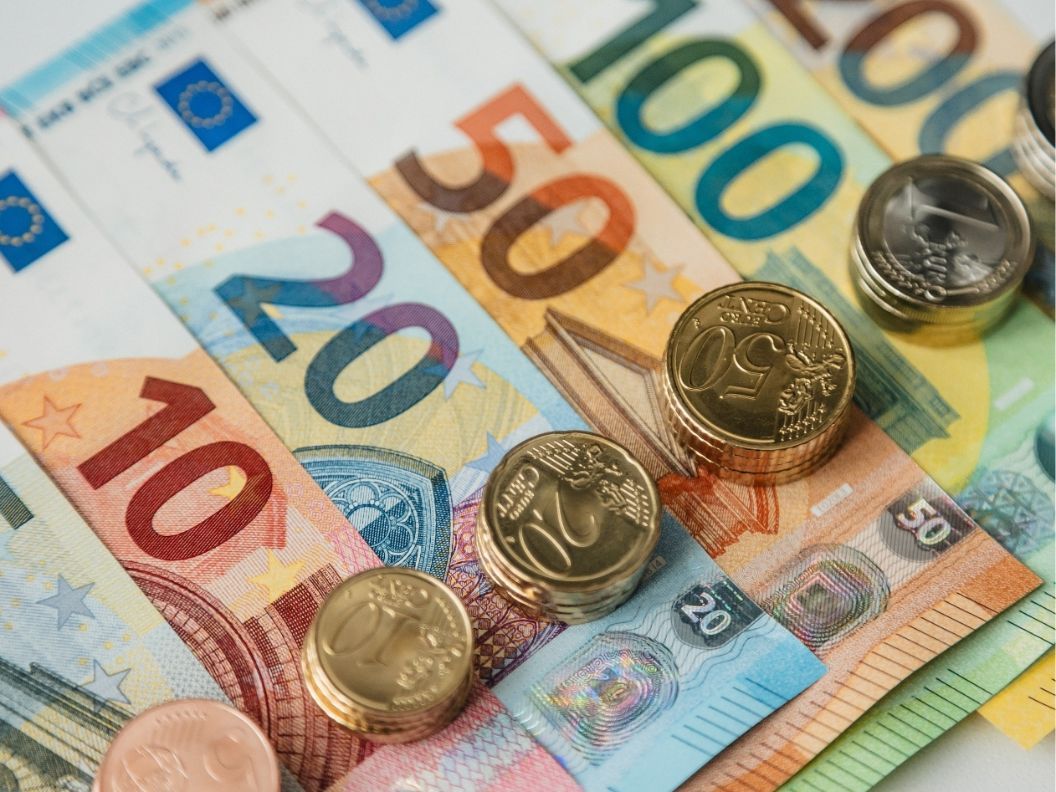
Euro coins are issued in eight denominations: €2, €1, 50c, 20c, 10c, 5c, 2c, and 1c. All circulating coins have a common 'European' side showing the denomination and a map, and a national side with a design chosen by the issuing country. The common sides were designed by Luc Luycx. Commemorative €2 coins with special national-side designs are legal tender throughout the eurozone. To phase out the smallest coins, cash transactions are rounded to the nearest five cents in the Netherlands, Ireland, Finland, and Italy. Euro banknotes come in seven denominations: €5, €10, €20, €50, €100, €200, and €500. The design, by Robert Kalina, features windows, gateways, and bridges symbolizing European unity. Each denomination has a distinct colour and represents a different artistic period of European architecture. The first series of banknotes included the €500 note, but its issuance was discontinued as of 27 April 2019 as part of the 'Europa' series revamp. Both the first and second series remain legal tender. In December 2021, the ECB announced plans to redesign euro banknotes by 2024, with a public vote on proposed themes. The production of banknotes and coins is authorized across several institutions in the eurozone. For example, coins are minted by national mints like Monnaie de Paris in France and the Royal Dutch Mint, while banknotes are printed by entities such as Banque de France and Bundesdruckerei in Germany.
The Euro and the Canadian Dollar
For Canadians, the exchange rate between the euro and the Canadian dollar is a key financial metric. The mid-market exchange rate is the benchmark rate used in currency markets. Conversely, one Canadian dollar is worth approximately €0.63. This rate fluctuates constantly based on global economic forces, interest rate differentials, commodity prices, and geopolitical events. The EUR to CAD exchange rate has shown volatility over recent periods. Over the last 30 days, the rate moved between a high of C$1.6127 and a low of C$1.5772, with an average of C$1.5995. Over the last 90 days, the range was between C$1.5772 and C$1.6222.
| Time Period | High (EUR/CAD) | Low (EUR/CAD) | Average Rate |
|---|---|---|---|
| Last 7 Days | 1.5937 | 1.5818 | 1.5893 |
| Last 30 Days | 1.6127 | 1.5772 | 1.5995 |
| Last 90 Days | 1.6222 | 1.5772 | 1.6059 |
Countries That Use the Euro
The euro is the sole official currency in 21 EU member states, constituting the eurozone. These countries are Austria, Belgium, Bulgaria, Croatia, Cyprus, Estonia, Finland, France, Germany, Greece, Ireland, Italy, Latvia, Lithuania, Luxembourg, Malta, the Netherlands, Portugal, Slovakia, Slovenia, and Spain. This represents a population of about 347 million people as of 2023. Furthermore, through formal agreements, the euro is the sole currency of four European microstates: Andorra, Monaco, San Marino, and Vatican City. These states have been awarded the right to mint their own euro coins with unique national designs. The euro is also used in some special territories of EU members, such as the French overseas departments and the Spanish enclaves of Ceuta and Melilla. Several EU members are committed to adopting the euro in the future but have not yet done so. These include the Czech Republic, Hungary, Poland, Romania, and Sweden. They have no fixed deadline and can delay the process by not meeting all the convergence criteria. Denmark is the only EU member with a formal opt-out from adopting the euro, though its currency, the krone, is pegged to the euro via the EU's exchange rate mechanism. The United Kingdom also had an opt-out but left the EU in 2020. Beyond Europe, a number of special territories of EU members also use the euro, and over 200 million people worldwide use currencies that are pegged to it.
Key Rules and Operational Details
The operational rules for the euro are designed to ensure its smooth function across borders. All intra-EU transfers in euro are treated as domestic transactions, meaning they should bear corresponding domestic transfer costs. This applies to all EU member states, even those outside the eurozone, provided the transaction is in euro. Credit card charges and ATM withdrawals within the eurozone are also treated as domestic. Capital within the EU may be transferred in any amount from one state to another. However, paper-based payment orders like cheques have not been standardized and remain domestic-based. The Eurosystem's national central banks are required to accept euro banknotes put into circulation by other Eurosystem members, and these notes are not repatriated, ensuring a unified cash system. The rules for adopting the euro are set by the Maastricht Treaty convergence criteria, which include limits on budget deficits, government debt, inflation, and interest rates. While these criteria were intended to ensure economic stability, they have been widely flouted by some members after the euro's introduction, contributing to the subsequent debt crisis. The treaty also included protocols granting opt-outs to Denmark and the United Kingdom. All nations that have joined the EU since 1993 have pledged to adopt the euro when they meet the conditions. The governance structure ensures that while monetary policy is centralized at the ECB, the physical production and distribution of cash involve decentralized national institutions working under common rules.
Debates and Risks Surrounding the Euro
The euro has been at the centre of significant economic and political debates since its inception. A primary debate revolves around the optimal currency area theory, questioning whether a single currency is suitable for such a diverse group of economies with different business cycles and fiscal policies. The eurozone debt crisis that began in 2009 exposed critical flaws in the original design, particularly the lack of a centralized fiscal authority or common treasury to backstop member states in crisis. This led to intense political negotiations, austerity measures, and the creation of rescue funds like the European Financial Stability Facility. The crisis underscored the difficulty of enforcing common fiscal rules and the political tensions between creditor and debtor nations within the union. Ongoing risks include the potential for future sovereign debt stress, especially in highly indebted member states, and the challenge of aligning national economic policies. The euro's value against major currencies like the US dollar is subject to volatility from global events, as seen in 2022 when it fell to parity due to the war in Ukraine and energy crises. Another debate concerns the democratic accountability of the European Central Bank, an independent institution with significant power over the economies of member states. Furthermore, the expansion of the eurozone to include newer EU members from Central and Eastern Europe presents both opportunities for deeper integration and risks if convergence is not achieved sustainably. These debates ensure the euro remains a dynamic and sometimes contentious project in global finance.
Frequently asked questions
What is the euro to Canadian dollar exchange rate?
The exchange rate between the euro and the Canadian dollar fluctuates constantly. This means one euro can buy about one dollar and fifty-eight cents Canadian. Conversely, one Canadian dollar is worth approximately €0.63. It is important to note that when you exchange money or make a transfer, you will not get this exact mid-market rate, as financial institutions add a margin or fee.
Which countries use the euro as their official currency?
The euro is the official currency of 21 European Union member states, known as the eurozone. These countries are Austria, Belgium, Bulgaria, Croatia, Cyprus, Estonia, Finland, France, Germany, Greece, Ireland, Italy, Latvia, Lithuania, Luxembourg, Malta, the Netherlands, Portugal, Slovakia, Slovenia, and Spain. Additionally, four European microstates, Andorra, Monaco, San Marino, and Vatican City, use the euro under formal agreements. The euro is also used in some special EU territories and has been adopted unilaterally by two other European states.
When was the euro introduced?
The euro was first introduced as an accounting currency for electronic payments on 1 January 1999, replacing the European Currency Unit. Physical euro coins and banknotes entered circulation three years later on 1 January 2002. The changeover period, during which old national currencies were exchanged, lasted about two months, until 28 February 2002. The name 'euro' was officially adopted on 16 December 1995.
Who manages the euro currency?
The euro is managed and administered by the European Central Bank and the Eurosystem. The Eurosystem consists of the ECB and the national central banks of the eurozone countries. The ECB, as an independent central bank, has the sole authority to set monetary policy for the euro area, including interest rates. The Eurosystem handles the printing, minting, and distribution of euro cash and operates the eurozone's payment systems.
Are all EU countries required to use the euro?
Most EU member states are required to adopt the euro once they meet strict economic and legal conditions known as convergence criteria. However, not all have done so. Denmark has a formal opt-out from adopting the euro. Sweden, while committed in its accession treaty, has circumvented adoption by not joining the required exchange rate mechanism. Several newer EU members, including Poland, Hungary, and Romania, are committed to future adoption but have no set deadline.
What are the denominations of euro coins and banknotes?
Euro coins come in eight denominations: €2, €1, 50c, 20c, 10c, 5c, 2c, and 1c. Euro banknotes are issued in seven denominations: €5, €10, €20, €50, €100, €200, and €500. The €500 banknote is no longer being issued as of April 2019, but existing notes remain legal tender. All banknotes feature designs representing European architectural styles and symbols of unity, such as windows and bridges.
Sources and further reading
- Euro (Wikipedia) en.wikipedia.org
- 1 EUR to CAD, Euros to Canadian Dollars Exchange Rate xe.com
- Euros to Canadian dollars Exchange Rate. Convert EUR ... wise.com
- EUR to CAD | Convert Euro to Canadian Dollar westernunion.com
- Canadian dollar (CAD) - European Central Bank ecb.europa.eu
- Currency Converter: Exchange Rate Calculator EUR ... iban.com
This article explains how things work and is not financial, tax or legal advice. Rules, limits and rates change, so check the current figures with the Canada Revenue Agency, your province or your financial institution before you act.