The Canadian twenty-dollar note is a primary denomination of Canadian currency and the most commonly dispensed bill from the nation's automated teller machines. It has undergone numerous design and security evolutions since its first issuance in 1935, transitioning from paper to advanced polymer. The current Frontier Series note, featuring Queen Elizabeth II, is being succeeded by a new vertical design portraying King Charles III, scheduled to enter circulation in late February 2027. This banknote serves as a frequent tool for everyday transactions and a canvas for Canadian symbols, history, and technological innovation in security.
The Current Frontier Series Twenty-Dollar Note
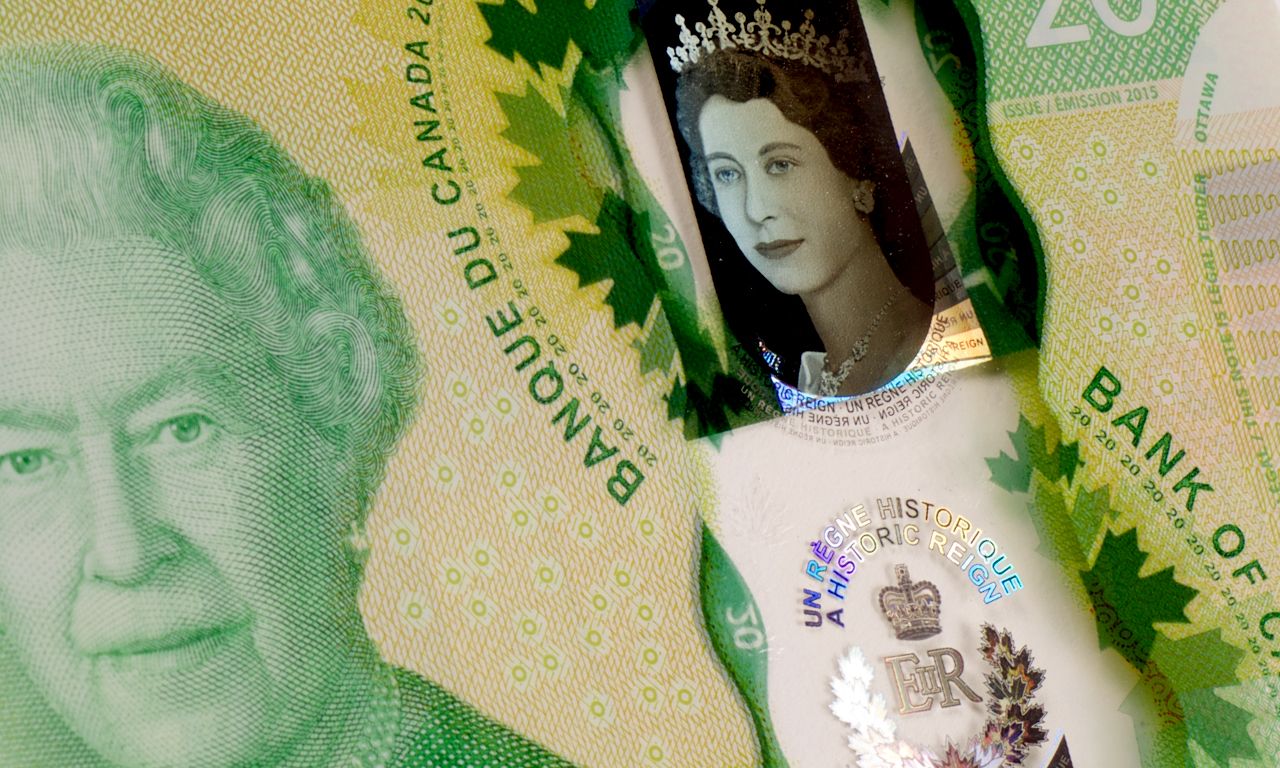
The Frontier Series twenty-dollar polymer note entered general circulation on November 7, 2012, replacing the paper-based Canadian Journey Series note. Its face features a portrait of Queen Elizabeth II, the Royal Arms of Canada, and a depiction of the Peace Tower within a large transparent window. The primary colour of the note is green. The reverse side is dominated by an image of the Canadian National Vimy Memorial in France, honouring Canadians who fought in the First World War. This polymer note was designed with enhanced durability and sophisticated anti-counterfeiting features compared to its paper predecessors. It remains legal tender following the death of Queen Elizabeth II, though future prints will feature King Charles III.
The security features of the polymer twenty-dollar note are multi-layered and designed for public verification. The large transparent window is a key element, containing complex metallic images and fine details that are difficult to replicate. The note incorporates a holographic stripe that shifts between the number 20 and maple leaves when tilted. Raised ink provides a tactile texture, including a series of dots to aid the visually impaired in identifying the denomination. Micro-printing, fluorescent elements that glow under ultraviolet light, and a unique polymer substrate that feels smooth and plastic-like complete the suite of security measures. These features are promoted under the "Feel, Look, Tilt and Flip" method for authentication.
Historical Designs and Key Changes
The twenty-dollar note's design history reflects Canada's evolving national identity and technological progress. Each series introduced new portraits, reverse imagery, and security measures. The first note in 1935 featured Princess Elizabeth, while subsequent issues shifted to focus on Canadian landscapes, art, and memorials. Major changes often coincided with new series releases, which occurred approximately every decade or two. The following list outlines the major series and their defining characteristics.
- 1935 Series: First issuance. Portrait of eight-year-old Princess Elizabeth. Reverse with "Testing the Grain" allegory. Soft pink tint.
- 1937 Series: Introduced bilingual text. Portrait of King George VI. Green colour adopted for the denomination. Reverse with fertility allegory.
- 1969 Series: Featured Moraine Lake, the "twenty-dollar view". Based on a Canadian Pacific Railway photograph. Portrait of Queen Elizabeth II.
- 1979 Series: Reissue of the 1969 design with a modified tint to distinguish it from the $1 bill. Serial numbers moved to the back for machine reading.
- 1986 Series: Featured the Doubtfire engraving of Queen Elizabeth II. Reverse showed common loons. Introduced a reflective security patch.
- 2004 Canadian Journey Series: Final paper $20. Green colour. Portrait of Queen Elizabeth II and Parliament's Centre Block. Reverse with Bill Reid art and Gabrielle Roy quote. Awarded Bank Note of the Year 2005.
- 2012 Frontier Series: First polymer $20. Portrait of Queen Elizabeth II. Reverse with Vimy Memorial. Transparent window and holographic stripe.
The design of the Canadian twenty-dollar note has evolved from British royal allegory to distinctly Canadian themes. The most significant material change was the move to polymer with the Frontier Series in 2012. This change was driven by the need for greater durability and advanced security features to combat counterfeiting. The polymer note replaced the paper note from the Canadian Journey Series.
The New Vertical Twenty-Dollar Note Design
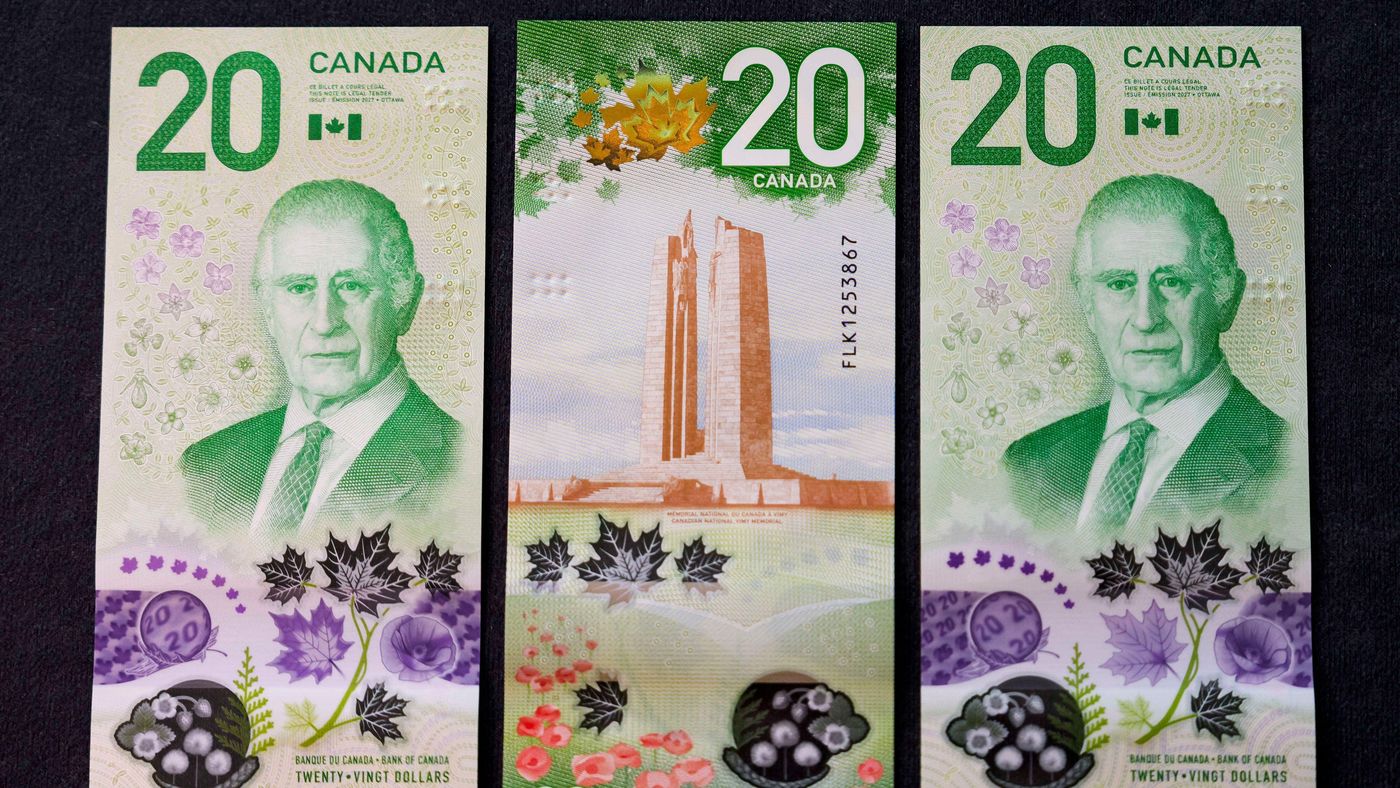
On September 3, 2026, the Bank of Canada unveiled a radically new design for the twenty-dollar note, marking a departure from the traditional horizontal format. This will be Canada's first vertical twenty-dollar bill and the second note in the Vertical Series, following the Viola Desmond ten-dollar note. The new note features a portrait of King Charles III on its face, making it the first Canadian banknote to carry his likeness and the first time in over seventy years that a new monarch has appeared on the twenty-dollar denomination. The portrait is surrounded by a floral and leafy design inspired by the King's advocacy for environmental sustainability. The reverse of the new vertical note retains the Canadian National Vimy Memorial, continuing the tribute to Canadian military sacrifice established on the Frontier Series note. The design incorporates several new symbolic elements developed through extensive consultation.
Provincial and territorial floral emblems for all thirteen provinces and territories appear on the front. A prominent circular window, visible from both sides, features plants that are culturally significant to Indigenous Peoples in Canada, developed in collaboration with the Bank's Indigenous Advisory Circle. The Bank consulted with accessibility groups, government partners, and organizations connected to Vimy Ridge during the design process. The new note introduces advanced security features never before used on Canadian currency. A central purple security stripe contains dynamic elements that spin, transform, and pulse when the note is moved. These features are designed to be easy for the public to check but extremely difficult for counterfeiters to replicate. The Bank of Canada plans to raise public awareness about the new design and its security features ahead of its release. The note will gradually enter circulation beginning in late February 2027, and the Bank is working with financial institutions and equipment manufacturers to ensure a smooth transition for cash-handling machines.
Security Features and Anti-Counterfeiting Evolution
The security of Canadian banknotes has evolved dramatically from simple paper and engraving to high-tech polymer and dynamic elements. Early notes relied on detailed engraving, fine line work, and unique paper textures to deter forgery. The 1991 series introduced a significant upgrade with special green ink dots called planchettes that glow under ultraviolet light. These were replaced in the 2004 Canadian Journey Series with more durable ultraviolet-detected threads and an ink imprint of the coat of arms. The 2004 note also included a holographic stripe, a watermark, and a special tactile feature similar to Braille dots for the blind. The shift to polymer with the Frontier Series in 2012 represented a major leap in security and durability. Polymer notes are harder to tear, more resistant to moisture, and generally last two to three times longer than paper notes. The transparent window is a central feature, incorporating detailed metallic imagery that is extremely complex to reproduce.
The new vertical twenty-dollar note announced in 2026 pushes security further with a dynamic purple stripe. This stripe contains elements that spin, transform and pulse when the note is moved. This continuous innovation aims to maintain a technical advantage over counterfeiters. These security features are described as easy to check and hard to counterfeit.
- Pre-1991: Reliance on engraving quality, cotton paper, and colour.
- 1991 Series: Introduction of ultraviolet-fluorescent green planchettes (ink dots).
- 2004 Canadian Journey Series: Ultraviolet-detected threads, holographic stripe, watermark, tactile feature, and interleaved metallic strip.
- 2012 Frontier Series (Polymer): Large transparent window with metallic details, holographic stripe, raised ink, micro-printing, and fluorescent elements.
- 2027 Vertical Series: Dynamic purple security stripe with spinning, transforming, and pulsing elements. New vertical format.
Each security advancement directly responded to the capabilities of counterfeiters at the time. The Bank of Canada's strategy integrates durable materials like polymer with increasingly complex features. These features are designed to be both machine-readable and human-verifiable. The goal is to protect the integrity of the Canadian currency.
Production, Controversies, and Public Reception
Canadian twenty-dollar notes are produced under contract for the Bank of Canada by specialized security printing firms. Historically, notes were printed on cotton-based paper by companies such as the Canadian Bank Note Company and BA International Inc. Since 2012, all twenty-dollar notes have been printed on polymer substrate. The transition to a new design, such as the vertical note featuring King Charles III, involves extensive planning with financial institutions, equipment manufacturers, and retailers to ensure machines can accept the new bills. All previous issues of the Canadian twenty-dollar note remain legal tender in Canada, regardless of series. This includes the earliest 1935 note, all paper series, and the current polymer notes. When a new design is introduced, older notes continue to circulate and are gradually removed from circulation as they wear out or are returned to the Bank of Canada for destruction. The public is not required to exchange old notes for new ones.
The design process has not been without public commentary or controversy. Following the release of the polymer Frontier Series note in 2012, a Canadian botanist complained on January 18, 2013, that the maple leaf emblem on the note was a foreign species, not the sugar maple found on the national flag. The unveiling of the new vertical design in 2026 also generated mixed reactions, with some Canadians expressing displeasure at featuring another British monarch. The Bank of Canada consults with various groups, including its Indigenous Advisory Circle for the new vertical note's window design, to incorporate broader perspectives. These instances highlight the challenge of creating a banknote that satisfies technical, security, and symbolic demands while resonating with a diverse public.

Cultural Significance and Symbolic Elements
The twenty-dollar note has long served as a medium for expressing Canadian identity and values. Its imagery has progressed from allegorical figures and British royalty to distinct Canadian landscapes, wildlife, and artistic achievement. The "twenty-dollar view" of Moraine Lake from the 1969 and 1979 notes remains one of the country's most famous landscapes. The Canadian Journey Series note highlighted Indigenous art through Bill Reid's sculptures and French-Canadian literature with a quote from Gabrielle Roy, reflecting the nation's cultural diversity. The current and forthcoming designs continue this symbolic tradition. The Vimy Memorial on the Frontier and new vertical notes is a powerful national symbol of sacrifice and remembrance. The new vertical note expands its symbolism to include environmental themes through the floral design surrounding the monarch's portrait. The incorporation of provincial and territorial flowers represents national unity, while the circular window with Indigenous plants acknowledges the cultures of First Nations, Inuit, and Métis peoples.
The design choices for the twenty-dollar note aim to create a banknote that evokes pride in Canada. The note is intended to tell a distinctly Canadian story. The specific symbols chosen for the reverse of the note have varied widely over different series. Each reverse design tells a different part of the Canadian national narrative.
- 1935: Agricultural allegory "Testing the Grain" (prosperity/fertility).
- 1969/1979: Moraine Lake, Banff (natural beauty and tourism).
- 1986: Common loons (Canadian wildlife).
- 2004: Bill Reid's "The Raven and the First Men" and "Spirit of Haida Gwaii" (Indigenous art and culture).
- 2012-Present: Canadian National Vimy Memorial (military history and sacrifice).
- 2027: Vimy Memorial retained. New front elements include provincial/territorial flowers and Indigenous plant designs.
The evolution of the twenty-dollar note's design moved from generic allegory to specific, place-based imagery. This demonstrates a conscious effort to root the currency in tangible aspects of Canadian geography, history, and culture. The scene of Moraine Lake in Banff National Park appeared on the 1969 and 1979 twenty-dollar notes. This view became known as the "twenty-dollar view" and is one of the most photographed locations in Canada.
Usage and Economic Role
The twenty-dollar note holds a unique position in the Canadian economy as the primary banknote dispensed from automated teller machines. This makes it the most common paper currency denomination handled by Canadians in daily transactions. Its widespread use necessitates the highest standards of durability and security, which directly influenced the shift to longer-lasting polymer. The Bank of Canada emphasizes that confidence in banknotes is essential for the functioning of the cash system, which is why security features are designed to be both technically advanced and publicly verifiable. The denomination's popularity also means that any design change, such as the move to a vertical format, requires coordinated efforts with the cash-handling industry to update ATMs, vending machines, and counters.
The Bank of Canada follows a specific process when introducing a new banknote design. This process ensures a smooth transition for the public and for businesses. It involves multiple stages of development, consultation, and implementation. The Bank consults with Canadians, government partners, and a range of stakeholders during development.
- Design and Consultation: Themes and elements are developed with input from experts, stakeholders, and sometimes the public (as with the Canadian Journey Series). For the vertical $20, consultations included accessibility groups and organizations connected to Vimy Ridge.
- Unveiling: The final design is publicly unveiled, as occurred on September 3, 2026, for the King Charles III note.
- Awareness Campaign: Prior to issuance, the Bank raises public awareness about the new note's design and security features through campaigns and materials.
- Industry Coordination: The Bank works closely with financial institutions, equipment manufacturers, and retailers to adapt cash-handling machines and inform businesses.
- Gradual Issuance: New notes enter circulation gradually through financial institutions, starting on a set date (late February 2027 for the new $20).
- Co-Circulation: Old and new designs circulate together indefinitely. Old notes remain legal tender and are slowly removed as they wear out.
This methodical approach minimizes disruption to commerce and maintains public trust in the currency. The twenty-dollar note is often at the forefront of technological and design transitions due to its high volume. The Bank of Canada's goal is to ensure Canadians can use the new twenty-dollar note with confidence. The security features on the 2027 note are designed to be easy to check and hard to counterfeit.
Frequently asked questions
When will the new $20 bill with King Charles come out?
The new twenty-dollar note featuring King Charles III will gradually enter circulation in late February 2027. The design was unveiled by the Bank of Canada on September 3, 2026. This marks the first time in over 70 years that a new monarch has appeared on the twenty-dollar denomination. The Bank is working with financial institutions and equipment manufacturers to ease the transition. This new note is the second in the Vertical series, following the Viola Desmond ten-dollar note.
Is the old $20 bill with the Queen still valid?
Yes, all banknotes featuring Queen Elizabeth II continue to be legal tender. This includes the polymer Frontier Series note released in 2012 and all previous paper series. The Bank of Canada confirmed this status following the Queen's death. Older notes will remain valid even after the new note with King Charles III enters circulation in 2027. They are typically removed from the system as they wear out or are returned to the Bank.
What is on the back of the current $20 bill?
The back of the current Frontier Series polymer twenty-dollar note features the Canadian National Vimy Memorial in France. This monument commemorates the 1917 Battle of Vimy Ridge and honours Canadian contributions and sacrifices in military conflicts. The design includes a depiction of the memorial itself along with the Canadian flag. This imagery was retained from the earlier Canadian Journey Series note and will also appear on the new vertical note featuring King Charles III.
What are the security features of the polymer $20 bill?
The polymer twenty-dollar note incorporates several advanced security features. These include a large transparent window with metallic details and a holographic stripe. The Bank of Canada advises using the Feel, Look, Tilt and Flip method to authenticate notes. Specific features for the new vertical note include a purple security stripe with elements that spin, transform and pulse when moved. These features are designed to be easy to check and hard to counterfeit, maintaining confidence in Canada's currency.
Why is the new $20 bill vertical?
The new twenty-dollar note is vertical because it is part of the Bank of Canada's Vertical Series. This series began with the Viola Desmond ten-dollar note. The vertical orientation allows for a modern design layout and the integration of new, dynamic security features. It provides a distinctive format that differs from traditional horizontal notes. The design also facilitates the inclusion of design elements like a circular window featuring plants significant to Indigenous Peoples.
What was the 'twenty-dollar view'?
The "twenty-dollar view" refers to the scene of Moraine Lake in Banff National Park from the Valley of the Ten Peaks. This view was featured on the reverse of the 1969 and 1979 issues of the Canadian twenty-dollar note. It became one of the most photographed locations in Canada. The original engraving for the 1969 note was created from a photograph provided by the Canadian Pacific Railway. This landscape was chosen to represent pristine Canadian scenery on the banknote.
Sources and further reading
- Canadian twenty-dollar note (Wikipedia) en.wikipedia.org
- Bank of Canada unveils new vertical $20 bank note bankofcanada.ca
- Scenes of Canada Series $20 Note bankofcanadamuseum.ca
- Canadian Twenty Dollar Bill Stock Photos istockphoto.com
- A look back at every Canadian $20 bill design from the ... dailyhive.com
This article explains how things work and is not financial, tax or legal advice. Rules, limits and rates change, so check the current figures with the Canada Revenue Agency, your province or your financial institution before you act.