The Canadian silver dollar is a one-dollar coin first issued by the Royal Canadian Mint in 1935. It was created to commemorate the Silver Jubilee of King George V and features the Voyageur design of a canoe. Minted for circulation from 1935 to 1967, these coins contain 80% silver, giving them significant value beyond their face value. They remain highly collectible pieces of Canadian numismatic history, with rare dates and varieties commanding substantial premiums.
Origins and Historical Context
After joining Confederation in 1871, British Columbians were required to adopt Dominion currency, but the available Canadian coins were of low denominations. American silver dollars were popular in the region for larger transactions, creating a persistent call for a Canadian equivalent. For years, Members of Parliament from British Columbia petitioned the federal government to authorize a silver dollar. The opening of the Royal Canadian Mint's Ottawa branch in 1908 provided the necessary facility, but political will was initially lacking. Finance Minister William S. Fielding was not originally in favour of the idea. However, during debates on amendments to the Currency Act in 1910, Fielding relented, citing representations from British Columbia MPs. The amendment, known as Bill 195, was passed on May 4, 1910, and included a provision authorizing the minting of a silver dollar. Master dies for the new coin were ordered from the Royal Mint in London on November 10, 1910, though production delays significantly postponed the project.
The 1911 Pattern Dollar: The Emperor of Canadian Coins
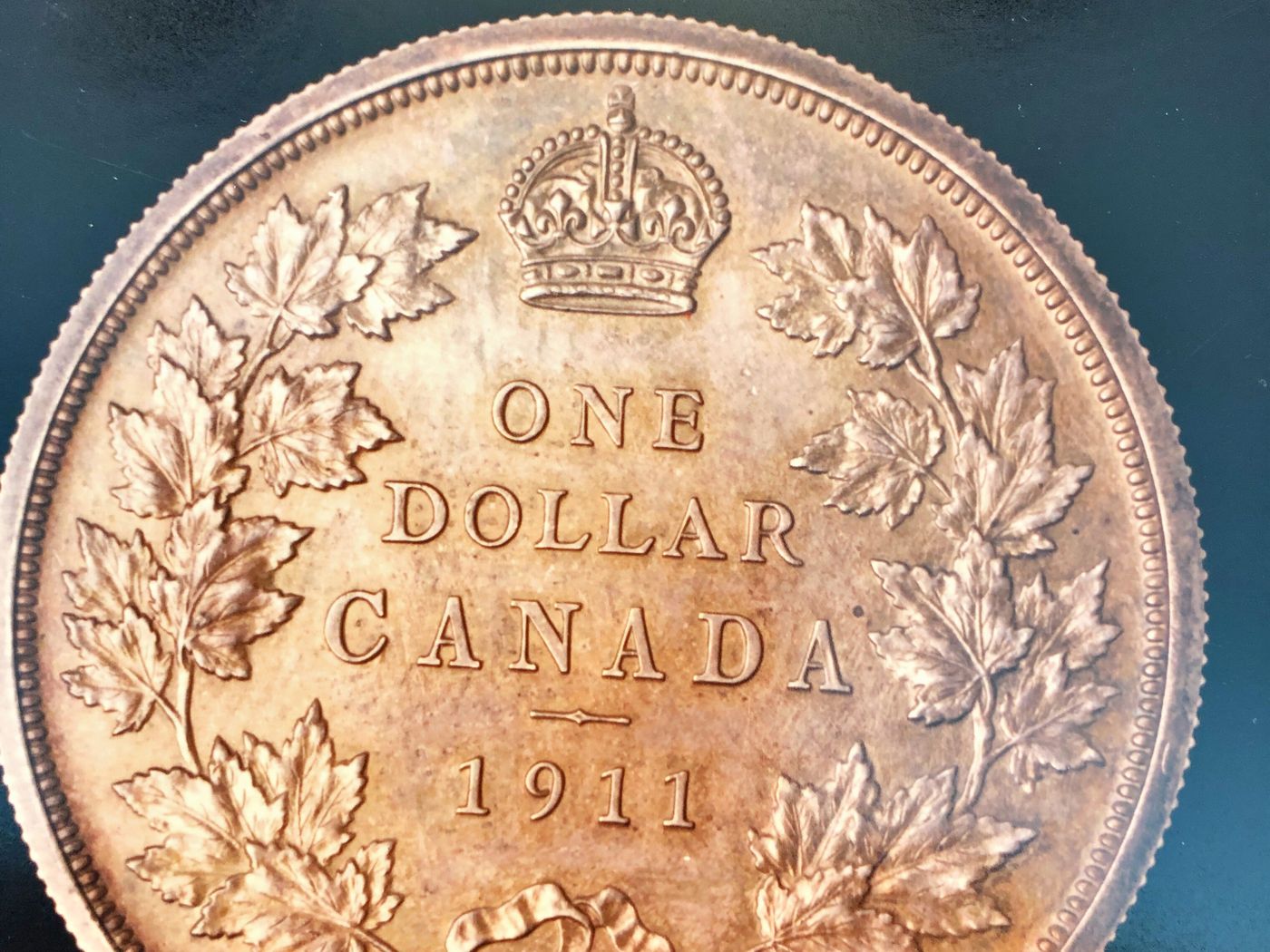
Although authorized in 1910, the silver dollar did not enter production that decade. Instead, three unique trial strikes, known as pattern coins, were produced by the Royal Mint in London in 1911. Two were struck in silver and one in lead. These coins were not intended for circulation and remain exceptionally rare. One of the silver patterns has been owned by the Royal Mint Museum and loaned to the Bank of Canada since 1976, where it is displayed. The lead pattern was discovered in 1977 during an office move on Parliament Hill and joined the National Currency Collection. The second silver pattern led a storied private life, gaining the nickname the Emperor of Canadian Coins. It was originally owned by William Ellison-Macartney, deputy master of the Royal Mint, and after his death in 1924, it passed through several collectors. It was first displayed publicly at a Canadian numismatic convention in Sherbrooke in 1960. The coin changed hands multiple times, being sold for US$160,000 in 1979 and US$325,000 later. On January 13, 2003, it was auctioned for US$690,000 to renowned Canadian collector George H. Cook. Following Cook's death in 2018, his collection was auctioned at the American Numismatic Association World's Fair of Money in Chicago. The coin was purchased for $734,000 after fees by collectors Sandy Campbell and Ian Laing, who then offered it to the Bank of Canada Museum to ensure it remained in Canada's public cultural sphere. It now resides with its counterparts in the National Currency Collection.
The Voyageur Dollar Era (1935 to 1967)
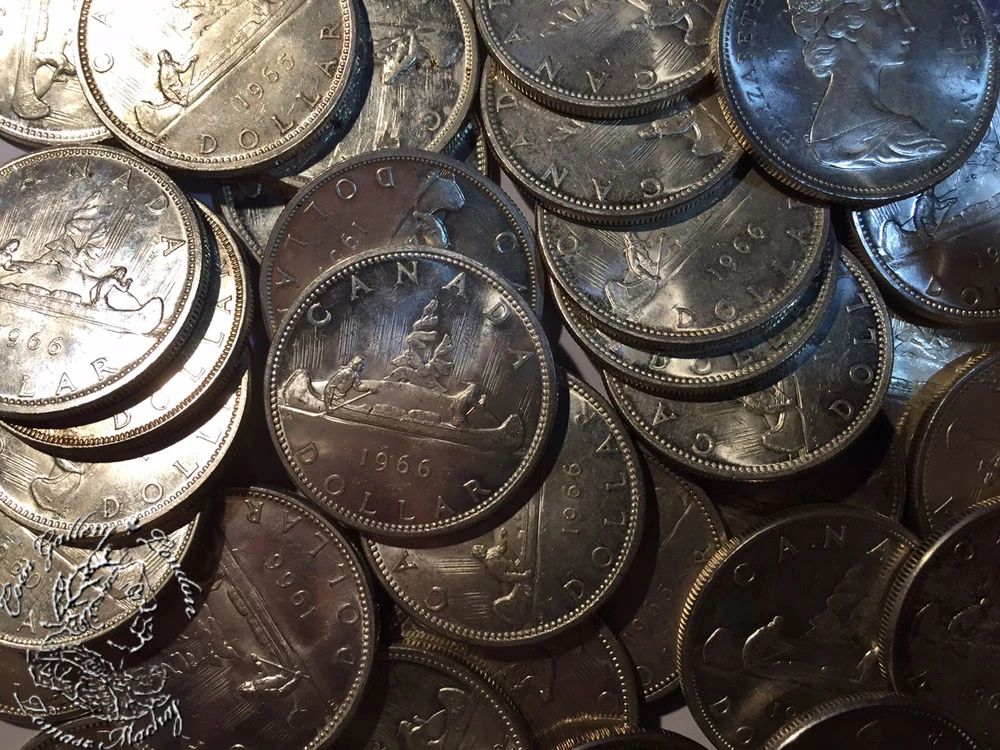
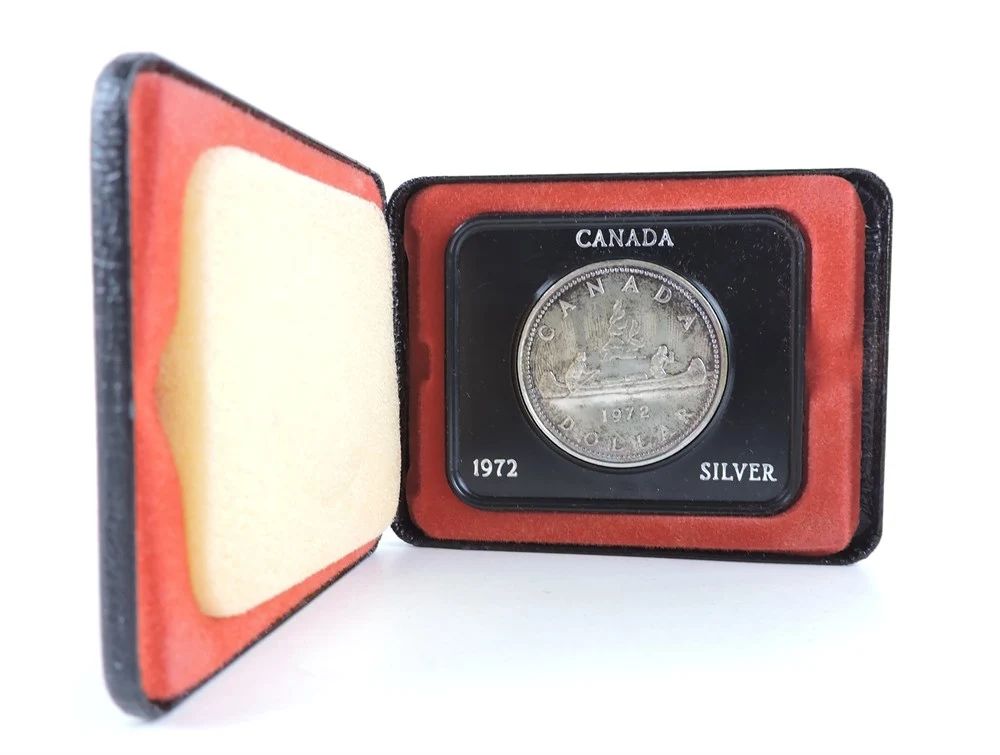
The Canadian silver dollar finally entered mass production and circulation in 1935 to mark the Silver Jubilee of King George V. The reverse design, sculpted by Emanuel Hahn, depicts a voyageur and an Indigenous person paddling a birch-bark canoe, with faint lines representing the Northern Lights in the background. This Voyageur design was used on the dollar coin until 1986. From 1935 to 1967, these coins were struck for general circulation and were composed of 80% silver and 20% copper. The year 1967 marked the end of the silver dollar as a regular business strike, or coin issued for circulation. After 1967, the regular one-dollar coin was made of nickel, except for special non-circulating commemorative issues intended for the collector market, which continued to be minted in silver. The Voyageur design was ultimately replaced in 1987 by the 1987 Canadian one-dollar coin, which features a loon and is colloquially known as the loonie.
Key Varieties and Collectible Issues
The Canadian silver dollar had many varieties during its production that are highly sought after by collectors. The year 1947 is one of the most complex for varieties. Ten distinct varieties of the 1947 Voyageur Dollar exist. These ten varieties are placed into three distinct categories which are the Pointed Seven, the Blunt Seven, and the Maple Leaf issue.
- Pointed Seven: Features a tall number 7 with the lower tail pointing back to the right. Varieties include the standard Pointed 7, Pointed 7 with a Double-Punched 4, Pointed 7 with a dot near the 7, and versions with double, triple, or quadruple punched HP (designer Thomas Paget's initials) under the king's effigy.
- Blunt Seven: Features a shorter number 7 with the lower tail pointing almost straight down. Varieties include the standard Blunt 7 and Blunt 7 with a double punched HP.
- Maple Leaf Issue: In 1948, the inscription IND:IMP: (Indiae Imperator/Emperor of India) needed removal following India's independence. Due to a delay in receiving new dies from Britain, the mint continued striking coins dated 1947 but added a small maple leaf next to the date to denote they were minted in 1948. Varieties include the standard 1947 with maple leaf and a version with a double punched HP.
Other notable varieties include the Arnprior types from the 1950s, named after an order of 2,000 coins for a firm in Arnprior, Ontario, in 1955. These coins feature partially missing water lines at the right end of the canoe due to die polishing. The 1952 dollar featured a modified reverse with all water lines deliberately removed. In 1953, two obverse varieties exist: the No Shoulder Fold and the Shoulder Fold, resulting from modifications to the relief of Queen Elizabeth II's new effigy. The year 1965 alone offered five different varieties based on bead size on the obverse and the style of the number 5.
Composition, Specifications, and Mintages
The standard circulating Canadian silver dollar minted from 1935 to 1967 had specific specifications. Each coin was composed of 80% pure silver and 20% copper. Mintages varied significantly from year to year, influencing rarity and value. For example, the 1948 dollar had a very low mintage, making it exceptionally rare. Coins from 1968 onward intended for circulation were made of nickel, not silver. However, the Royal Canadian Mint continued and continues to issue commemorative and collector dollars in silver, often in proof or brilliant uncirculated finishes. For instance, 1981 was the first year the mint issued two different qualities of silver dollars: a proof version with a frosted relief and a brilliant uncirculated version.
Understanding Value and Current Market
The value of a Canadian silver dollar is determined by two primary factors: its intrinsic melt value based on silver content and its numismatic collector value based on rarity and condition. As of mid-2026, the melt value for a standard 1935 to 1967 silver dollar, with approximately 0.6 troy ounces of pure silver, ranges between $38 and $45 CAD when silver trades around $73.94 per troy ounce. However, most circulated coins in typical condition trade within a range of $20 to $45. Collector value can far exceed melt value. Key factors driving collector premiums include the coin's condition or grade on a scale from 1 to 70, the rarity of the specific date and variety, and the presence of errors or unique features.
| Condition Grade | Description | Impact on Value |
|---|---|---|
| Good to Very Fine (G-VF) | Worn from circulation | Close to melt value |
| Extremely Fine (EF) | Light wear on high points | Moderate premium |
| Mint State (MS-60 to 70) | No wear, as struck | Significant premium |
| High Grade (MS-65+) | Perfect preservation | 50% to 500%+ over melt |
Extremely rare dates like the 1948 dollar can command prices over $2,000 even in mint condition, with higher grades reaching far more. The popular 1967 Diving Goose commemorative dollar, celebrating Canada's centennial, is highly sought after, with values for high-grade specimens exceeding $800. Professional grading by services like the International Canadian Certification Service (ICCS) or Numismatic Guaranty Company (NGC) authenticates a coin and assigns a grade, often increasing its marketability and realized price. Owners looking to sell have several avenues, including local coin dealers, specialized auction houses, online platforms, or silver bullion buyers, each with different trade-offs between speed, convenience, and final sale price.
Legacy and Place in Canadian Culture
The Canadian silver dollar holds a firm place in the nation's numismatic and cultural heritage. Its Voyageur design, celebrating Canada's fur trade history and its Indigenous peoples, is instantly recognizable. The coin's journey from a regional demand in British Columbia to a national symbol encapsulates aspects of Canadian economic history. The saga of the 1911 pattern dollar, the Emperor, highlights the deep passion for coin collecting in Canada and the importance placed on preserving cultural artifacts. While the circulating silver dollar was discontinued in 1967, its legacy continues. The Royal Canadian Mint still issues commemorative silver dollars for collectors, featuring themes from historical events and Canadians to wildlife and international sports. These modern issues continue the tradition of the silver dollar as a canvas for Canadian art and storytelling. Furthermore, the widespread ownership of these coins, often passed down through families, means they remain a tangible link to the past for many Canadians and a popular entry point into the hobby of numismatics.
Frequently asked questions
What years are Canadian silver dollars made of real silver?
Canadian silver dollars intended for general circulation and composed of 80% silver were minted from 1935 through 1967. After 1967, the dollar coin for circulation was made of nickel. The Royal Canadian Mint continued to make non-circulating commemorative issues for the collector market, which contain silver. The 1911 pattern dollars were also struck in silver but were not intended for circulation.
What is the most valuable Canadian silver dollar?
Extremely rare dates and varieties command the highest values. The 1948 silver dollar is exceptionally valuable due to its very low mintage, with mint condition examples worth over $2,000. The unique 1911 pattern silver dollars, known as the Emperor, have sold at auction for hundreds of thousands of dollars. Other high-value coins include rare varieties of the 1947 dollar, such as the Maple Leaf issue, and high-grade specimens of popular issues like the 1967 Diving Goose dollar.
How can I tell if my Canadian dollar is silver?
First, check the date. Any dollar coin dated 1967 or earlier and intended for circulation is made of 80% silver. Dollars dated 1968 and later for circulation are nickel. Commemorative silver dollars issued after 1967 for collectors will often be marked as silver or sterling, but they are not found in everyday change. The silver coins also have a distinct colour and ring compared to nickel coins, and their weight (approx.
What is a 1947 Canadian silver dollar with a maple leaf?
The 1947 silver dollar with a small maple leaf next to the date is a special variety minted in 1948. When India gained independence in 1947, the title IND:IMP: needed removal from King George VI's coins. New dies from Britain were delayed, so the Canadian Mint continued using 1947-dated dies but added a tiny maple leaf to indicate the coins were actually produced in 1948. These Maple Leaf issues are distinct from the regular 1947 dollars and are collectible.
Where is the 1911 silver dollar now?
All three known 1911 pattern dollars are now part of Canada's National Currency Collection at the Bank of Canada Museum. One silver coin has been on loan from the Royal Mint Museum since 1976. The second silver coin, known as the Emperor, was purchased by private collectors in 2018 and offered to the museum. The lead pattern coin is also in the collection, reuniting all three coins for the first time in nearly 110 years.
How much silver is in a Canadian silver dollar?
A standard Canadian silver dollar minted for circulation between 1935 and 1967 is made from 80% silver and 20% copper. These coins were business strikes issued for circulation. The silver content gives the coin a melt value that changes with the global silver price. The coin was first issued in 1935 to commemorate the Silver Jubilee of King George V. After 1967, the regular dollar coin for circulation was made of nickel, not silver. However, the Royal Canadian Mint continues to issue non circulating commemorative silver dollars for the collector market.
Sources and further reading
- Canadian silver dollar (Wikipedia) en.wikipedia.org
- Silver | The Royal Canadian Mint mint.ca
- The 1911 silver dollar bankofcanadamuseum.ca
- Canadian Silver Dollar Value Chart 2026 bwcoin.com
This article explains how things work and is not financial, tax or legal advice. Rules, limits and rates change, so check the current figures with the Canada Revenue Agency, your province or your financial institution before you act.