The Brazilian real (BRL) is the official currency of Brazil, subdivided into 100 centavos. Introduced in 1994 as part of the Plano Real economic stabilization plan, it replaced the cruzeiro real. For Canadians, the real is a relevant currency for travel, remittances, and trade, with its value fluctuating against the Canadian dollar based on global economic conditions. Understanding the real's history and exchange dynamics helps Canadians manage financial transactions with Brazil effectively.
What Is the Brazilian Real?
The Brazilian real is the legal tender of the Federative Republic of Brazil, issued and regulated by the Central Bank of Brazil. Its currency code is BRL and it is commonly symbolized by R$. The real is divided into 100 smaller units called centavos. As of April 2019, it was ranked as the twentieth most traded currency in the world. The modern real was launched on 1 July 1994 under President Itamar Franco and Finance Minister Rubens Ricupero, succeeding the short-lived cruzeiro real (CR$) as the central component of the Plano Real, a comprehensive program designed to halt hyperinflation and stabilize the nation's economy. At its inception, the real was pegged to the US dollar at a rate of one to one, a parity that has shifted significantly over the subsequent decades due to various economic pressures and policy changes.
Historical Context and Currency Evolution
Brazil has a long and complex monetary history, with the current real representing the latest in a series of currencies. Before the 1994 real, Brazil used multiple currencies, each often replaced at a rate of 1,000 to 1 to combat inflation. The currency lineage includes the old Brazilian real used from 1747 to 1942, the first cruzeiro (1942 to 1967), the second cruzeiro (1970 to 1986), the cruzado (1986 to 1989), the third cruzeiro (1990 to 1993), and finally the cruzeiro real (1993 to 1994). The 1994 reform set the conversion at 1 new real = 2,750 cruzeiros reais. When accounting for all historical currency changes since the colonial Portuguese real, the modern real equals 2.75 quintillion of the original réis. The initial years after introduction saw the real unexpectedly appreciate against the US dollar, reaching a peak of about US$1.20 = R$1. The Central Bank managed a controlled devaluation until 1998, after which a financial crisis forced a floatation of the currency, leading to a sharp drop to nearly US$1 = R$2 in early 1999.
Exchange rate volatility continued into the 2000s, influenced by political events like the election of President Luiz Inácio Lula da Silva in 2002. His administration's commitment to orthodox economic policies eventually restored confidence, and the real generally appreciated, reaching about US$1 = R$1.66 by the end of his term in 2010. Subsequent years saw fluctuations, with the real weakening to US$1 = R$4.05 by September 2015 before recovering. The COVID-19 pandemic in 2020 drove the currency to a historical low of US$1 = R$5.90. Following Lula's reelection in 2022, the rate initially improved but later deteriorated, reaching a record high of US$1 = R$6.74 by the end of 2024.
Coins and Banknotes in Circulation
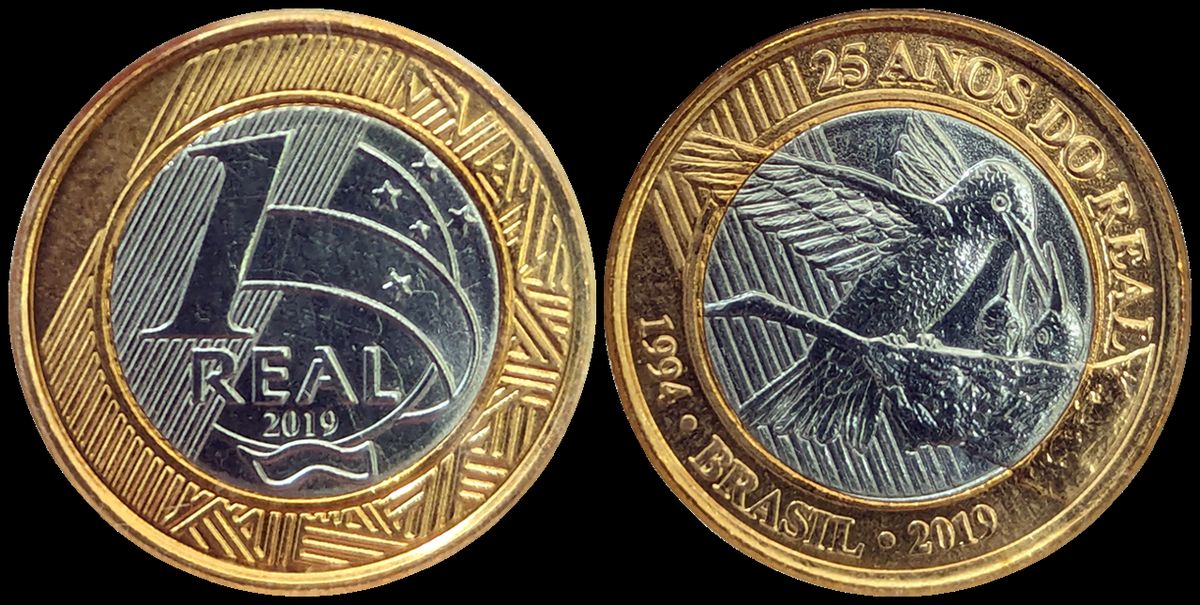
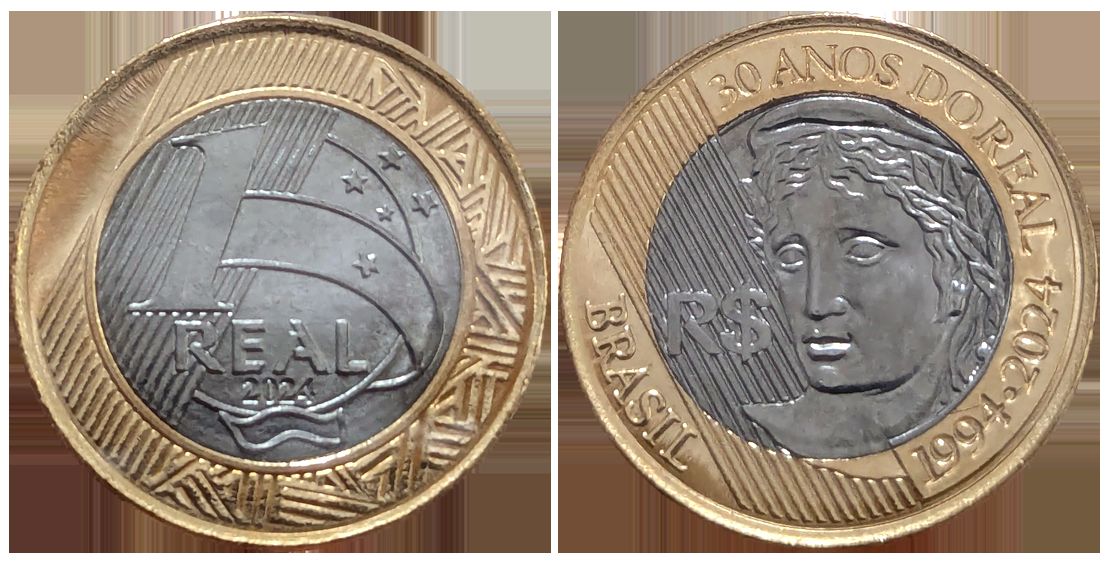
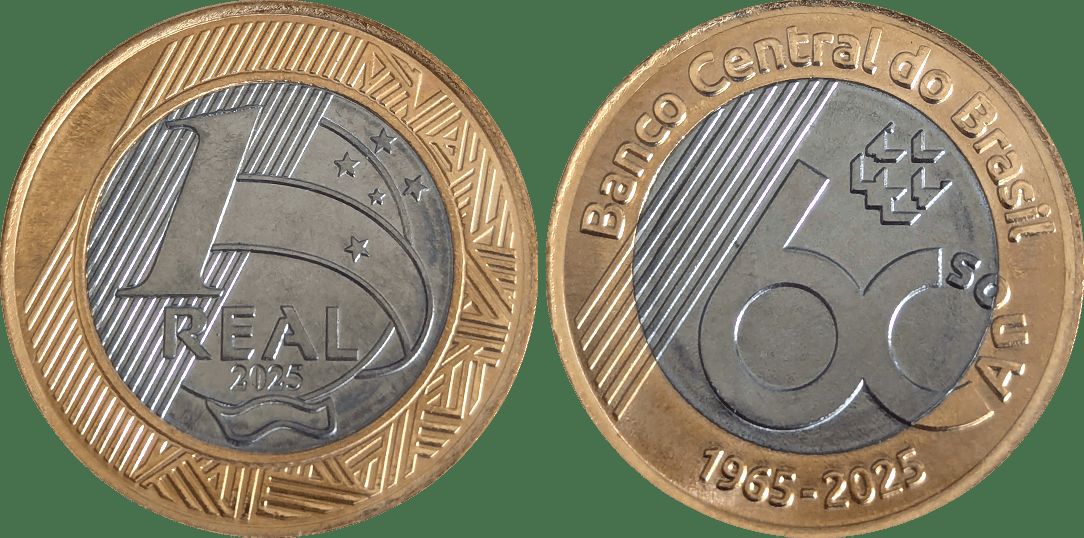
The Brazilian real is available in both coin and banknote form, with designs and security features evolving over time. The first series of coins, introduced in 1994, included denominations of 1, 5, 10, 25, and 50 centavos and 1 real, all minted in stainless steel. The original 1-real coins from 1994 were demonetized in 2003 due to counterfeiting. A second series launched in 1998 introduced new materials and designs, including a bimetallic 1-real coin. Production of the 1-centavo coin was discontinued in 2005, though existing coins remain legal tender. The Central Bank has also issued numerous circulating and non-circulating commemorative coins over the years for events like the Rio Olympics and anniversaries of the real itself.
Banknotes have undergone two major series. The first series (1994 to 2010) included notes from 1 to 100 reais, with a polymer 10-real commemorative note issued in 2000 for the 500th anniversary of Portuguese arrival. A 2-real note was added in 2001 and a 20-real note in 2002. The current second series, announced in 2010, features enhanced security elements like ultraviolet printing and varying sizes to aid the vision-impaired. This series includes denominations from 2 to 100 reais, with a new 200-real banknote added in September 2020. All banknotes from both series that have not been officially demonetized remain in circulation concurrently.
Exchanging Canadian Dollars for Brazilian Reais
For Canadians looking to obtain Brazilian reais, several methods are available, each with different costs and conveniences. The exchange rate between the Canadian dollar (CAD) and the Brazilian real (BRL) fluctuates constantly. It is crucial to understand that the rate advertised by banks or currency exchange services often includes a margin above the mid-market rate, which is the pure interbank rate. Canadians can convert currency through traditional banks, specialized foreign exchange companies, online money transfer services, or by using credit or debit cards while in Brazil. Specialist currency services in Canada, such as Interchange Financial, often promote better exchange rates than major banks and may offer home delivery of physical currency within two business days.
Online international transfer providers like Wise and Xe typically use the real mid-market rate but may charge a separate transfer fee, while services like Western Union and Remitly provide transfer options for sending money to Brazil, often for cash pickup. When comparing options, Canadians should review the total cost, which includes any transfer fees and the applied exchange rate margin, not just the advertised rate. Payment methods can also affect cost, as using a credit card for currency purchases or international transactions may incur cash advance fees and higher interest charges. To avoid these fees or for reduced fees, using a debit card or checking other payment methods is recommended.
Key Considerations for Currency Conversion
When planning a currency exchange from CAD to BRL, several practical factors influence the final amount received. Exchange rates are highly dynamic, changing throughout the day based on global financial market activity, economic data releases, and geopolitical events. Historical volatility shows the CAD/BRL pair can experience significant swings over short periods. For instance, recent 30-day data showed a high of 3.6842 and a low of 3.4921 BRL per CAD. Providers typically make money through an exchange rate margin, which is a markup added to the mid-market rate, or through a separate transfer fee, or sometimes both. It is essential to get a full quote showing all costs upfront before confirming a transaction.
- Compare the total cost (exchange rate + fees) across different providers, not just the advertised rate.
- Be aware that rates shown on Google or financial news sites are usually the mid-market rate, which consumers rarely receive.
- For cash purchases, check if there are minimum order amounts or delivery charges for home delivery.
- For money transfers, confirm the delivery method (bank deposit, cash pickup) and the estimated time for the recipient to receive funds.
- Using a Canadian debit or credit card in Brazil may trigger foreign transaction fees from your card issuer, often around 2.5%.
- Consider setting up a rate alert with a currency service to be notified when your desired exchange rate is reached.
- Always verify the security measures of any service you use, especially for online transfers.
For larger transfers, specialized international money transfer services can be beneficial as they often offer more competitive rates than retail banks. These services provide transparent pricing and can be initiated online or via mobile apps. Canadians can use these services for obtaining cash for travel or sending remittances to family in Brazil. Understanding these elements helps ensure Canadians get fair value and avoid unexpected charges.
Historical CAD to BRL Exchange Rate Trends
The value of the Brazilian real against the Canadian dollar has varied considerably, influenced by the economic conditions in both countries and global risk sentiment. The real's value is often impacted by commodity prices, political stability in Brazil, interest rate differentials, and broader emerging market trends. Periods of economic uncertainty in Brazil, such as during the 2015 recession or the 2020 pandemic, have led to significant real depreciation, meaning more reais were needed to buy one Canadian dollar. Conversely, periods of strong commodity exports and investor confidence have seen the real strengthen. The table below, based on recent data, illustrates the fluctuation range and average rates over specific periods, showing the Canadian dollar's changing purchasing power against the real.
| Period | High (BRL per CAD) | Low (BRL per CAD) | Average | Change |
|---|---|---|---|---|
| Last 30 Days | 3.6842 | 3.4921 | 3.5953 | -1.75% |
| Last 90 Days | 3.7683 | 3.4921 | 3.6574 | -0.78% |
This volatility underscores the importance of timing for currency exchanges. Predicting market movements is inherently difficult. Canadians monitoring the rate for future transactions can use tools provided by currency converters and transfer services. These tools can track trends and set personal alerts.
Risks and Economic Debates Surrounding the Real
The Brazilian real operates in a floating exchange rate regime, making it susceptible to significant volatility driven by both domestic and international factors. A primary historical debate has centred on the appropriate level of central bank intervention in the foreign exchange market. In the late 1990s, the Central Bank of Brazil actively managed the real's devaluation against the dollar, a policy abandoned during the 1999 crisis. Subsequent governments have occasionally expressed concern over a too-strong real harming export competitiveness, leading to discussions about intervention thresholds. Another persistent risk is inflation, which the Plano Real was created to conquer. The Central Bank now uses an inflation-targeting framework, but currency devaluation can import inflation by making foreign goods more expensive, creating a challenging policy balance. Political uncertainty has repeatedly triggered currency crises, as seen during election cycles in 2002 and 2022.
Investors' perceptions of fiscal policy, sovereign debt sustainability, and economic reforms can cause rapid capital outflows and real depreciation. Furthermore, the real is considered a commodity-linked currency due to Brazil's major exports of soybeans, iron ore, and oil. Thus, global commodity price swings directly affect its value. For Canadians holding or converting reais, these risks translate into exchange rate uncertainty. A sudden devaluation of the real could significantly reduce the Canadian dollar value of assets or remittances sent from Brazil. Conversely, a strengthening real could increase the cost of travel or imports from Brazil. This inherent volatility is a key consideration for any financial engagement with the Brazilian economy.
Frequently asked questions
What is the Brazilian real currency code?
The Brazilian real currency code is BRL. This three-letter code is used in international finance and currency markets to identify the currency. The symbol for the real is R$. It is subdivided into 100 centavos. The Central Bank of Brazil is the issuing authority for the currency.
Where can I buy Brazilian reais in Canada?
You can buy Brazilian reais from several sources in Canada. These include major Canadian banks, specialized foreign exchange companies with physical locations or online services, and some airport kiosks. Some services, like Interchange Financial, allow you to order reais online for home delivery anywhere in Canada within two business days. Always compare the total cost, including exchange rates and any fees, before purchasing.
When was the Brazilian real introduced?
The modern Brazilian real was introduced on 1 July 1994. It was launched under President Itamar Franco as the central element of the Plano Real, an economic stabilization plan. The real replaced the previous currency, the cruzeiro real, at a rate of 1 real = 2,750 cruzeiros reais. At its introduction, the real was pegged to be equal to one United States dollar.
What is the highest Brazilian real banknote?
The highest denomination Brazilian real banknote currently in circulation is 200 reais. This note was introduced by the Central Bank of Brazil and entered circulation on 2 September 2020. It is part of the second series of real banknotes, which started circulating in 2010 and includes enhanced security features. Other denominations include 2, 5, 10, 20, 50, and 100 reais.
Is it better to use a card or cash in Brazil?
Both cash and cards are widely used in Brazil, but there are trade-offs. Using a Canadian credit or debit card may be convenient, but your card issuer will apply its own exchange rate and may charge a foreign transaction fee, often around 2.5%. Carrying some Brazilian real cash is essential for small purchases, markets, and places that do not accept cards. For larger expenses, a card can offer security and potentially better exchange rates than cash exchange kiosks. Always inform your bank of your travel plans to avoid having your card blocked.
How much is 1 Brazilian real in Canadian dollars?
This means that one Canadian dollar would convert to roughly 3.57 Brazilian reais. The exchange rate is highly dynamic and changes frequently throughout the day. The rate offered by banks or money transfer services typically includes a margin, so the actual conversion amount may differ. For the most accurate rate, it is best to check a live currency converter before conducting a transaction.
Sources and further reading
- Brazilian real (Wikipedia) en.wikipedia.org
- CAD to BRL | Convert Canadian Dollar to Brazilian Real westernunion.com
- Canadian dollars to Brazilian reais today wise.com
- 1 BRL to CAD, Brazilian Reais to Canadian Dollars ... xe.com
- Buy Brazilian Real online, Brazil (BRL R$) interchangefinancial.com
- Convert Brazilian Reals to Canadian Dollars | BRL to CAD currency.me.uk
This article explains how things work and is not financial, tax or legal advice. Rules, limits and rates change, so check the current figures with the Canada Revenue Agency, your province or your financial institution before you act.