Qualcomm Incorporated is a global leader in wireless technology, developing the foundational semiconductors and licensing the intellectual property that powers smartphones, connected vehicles, and the Internet of Things. The company's stock is a key holding for investors seeking exposure to the growth of 5G, artificial intelligence, and ubiquitous connectivity. For Canadian investors, Qualcomm shares are accessible through both U.S. and Canadian exchanges, offering flexibility for registered accounts like TFSAs and RRSPs. Understanding Qualcomm's business segments, financial profile, and the associated risks is essential for evaluating its role in an investment portfolio.
What Qualcomm Does
Qualcomm operates through three main business segments that are central to modern wireless communication. The Qualcomm CDMA Technologies (QCT) segment is responsible for designing and selling integrated circuits and system software. These components are essential for mobile devices, automotive connectivity and digital cockpit systems, advanced driver-assistance systems (ADAS), and a wide array of Internet of Things (IoT) products. The Qualcomm Technology Licensing (QTL) segment generates revenue by licensing the company's vast portfolio of intellectual property, including patents critical to cellular standards like 3G, 4G, and 5G. This segment grants manufacturers the rights to use Qualcomm's technologies in their wireless products. The Qualcomm Strategic Initiatives (QSI) segment makes strategic investments in early-stage companies across fields such as artificial intelligence, automotive technology, cloud computing, and extended reality.
The company also provides development services and products to United States government agencies through its government technologies and data centre businesses. This diversified structure allows Qualcomm to generate revenue from product sales, high margin licensing fees, and potential gains from strategic investments. The QCT segment's products are found in millions of devices worldwide, while the QTL segment's licensing agreements cover a significant portion of all 3G, 4G, and 5G handsets sold globally. The QCT segment develops integrated circuits and system software for mobile devices, automotive systems, and IoT products. The QTL segment grants licenses for its intellectual property portfolio, including patents essential for 3G, 4G, and 5G cellular devices.
Company History and Evolution
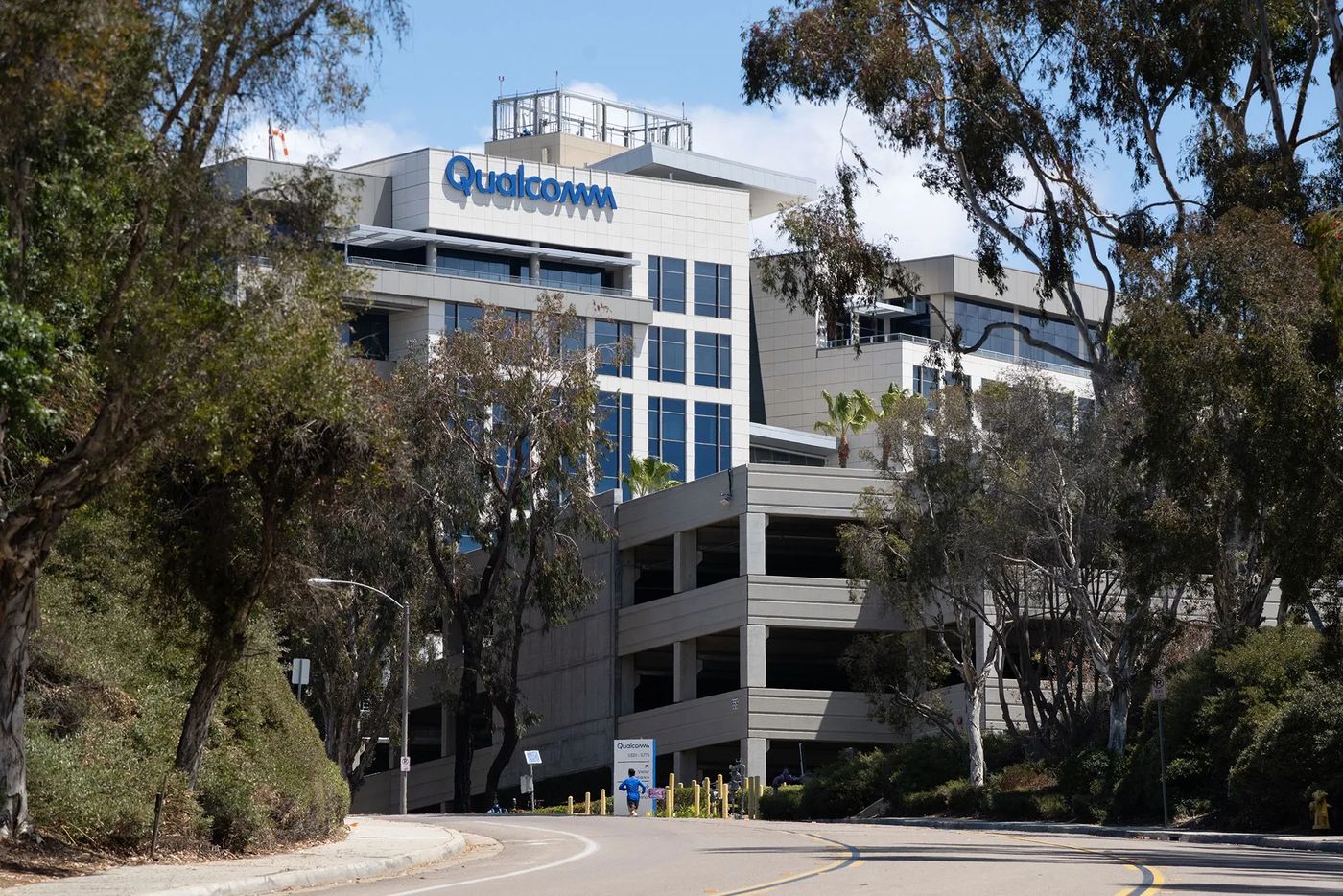
Qualcomm was founded in 1985 and has played a central role in shaping the mobile communications industry. The company's early work in Code Division Multiple Access (CDMA) technology became a foundational standard for 3G networks, establishing its licensing business model. Over the decades, Qualcomm's innovation extended into 4G LTE and now 5G, maintaining its position at the forefront of wireless technology. Its semiconductor business expanded beyond mobile phones into new growth areas like automotive and IoT. The company's strategic investments through QSI aim to foster innovation in next-generation technologies that complement its core wireless expertise. This evolution from a pioneer in cellular technology to a diversified semiconductor and licensing powerhouse defines Qualcomm's corporate journey and its ongoing adaptation to technological shifts.
Trading Details for Canadian Investors
Canadian investors have multiple avenues to gain exposure to Qualcomm stock. The primary listing is on the Nasdaq Global Select Market in the United States under the ticker symbol QCOM, where trading and dividends are in U.S. dollars. For investors preferring to trade in Canadian dollars on a Canadian exchange, Qualcomm is available through Canadian Depositary Receipts (CDRs) listed on the Toronto Stock Exchange. These trade under the tickers QCOM.TO and QCOM.NE, with QCOM.TO representing a CAD-hedged version designed to mitigate currency fluctuation risk against the U.S. dollar. Both the U.S.-listed shares and the Canadian CDRs are eligible for holding in Canadian registered accounts, including Tax-Free Savings Accounts (TFSAs) and Registered Retirement Savings Plans (RRSPs).

Financial Profile and Dividend
Qualcomm maintains a substantial market capitalization of approximately $189.89 billion USD, reflecting its size and significance in the semiconductor sector. The company trades at a trailing price-to-earnings (P/E) multiple of 20.34, which investors use to gauge its valuation relative to earnings. Qualcomm has established a record of returning capital to shareholders through a quarterly dividend, which currently provides a dividend yield of 2.06%. The company's stock has experienced significant price movement, with a 52-week trading range between $121.99 and $259.92 USD, highlighting the volatility common in the technology sector. This financial profile combines income generation through dividends with the growth potential associated with its core and emerging technology markets. The wide trading range indicates that the stock price is sensitive to earnings reports, product cycles, and broader economic conditions affecting the tech industry.
Key Investment Risks
Investing in Qualcomm involves several specific risks that shareholders must consider. The company operates in the highly cyclical and competitive semiconductor industry, where technological obsolescence is a constant threat and product cycles can be short. Qualcomm's licensing business, QTL, faces ongoing legal and regulatory challenges worldwide regarding its patent licensing practices and fees, which could impact a significant revenue stream. The company's performance is heavily tied to the smartphone market, and any slowdown in global handset sales can directly affect its QCT chipset business. Intense competition from other chip designers like MediaTek, Apple's in-house silicon development, and companies in the automotive and IoT spaces pressures market share and pricing. Macroeconomic factors, including trade tensions and export controls, can disrupt supply chains and access to key markets like China. The stock itself has demonstrated high volatility, as evidenced by its wide 52-week trading range, making it susceptible to sharp price swings based on earnings reports, product announcements, and broader market sentiment.
Business Segment Breakdown
Qualcomm's operations are segmented to clarify its diverse revenue streams and strategic focus. The Qualcomm CDMA Technologies (QCT) segment is the product engine, designing and selling system-on-chip (SoC) processors, modems, and RF front-end components. These are sold to device manufacturers for use in smartphones, automotive platforms, and IoT devices like wearables and industrial equipment. The Qualcomm Technology Licensing (QTL) segment is the intellectual property monetization arm, generating high-margin royalty revenue from its portfolio of standard-essential patents for wireless technologies. This segment's performance is less tied to unit volumes and more to the adoption of its licensed technologies in the market. The Qualcomm Strategic Initiatives (QSI) segment functions as a venture capital arm, making equity investments in promising startups that align with future technology trends such as AI and extended reality.
These investments are intended to foster ecosystems that will drive long-term demand for Qualcomm's core technologies. The relative contribution of each segment to total revenue fluctuates with market conditions and product cycles. The company's QSI segment makes strategic investments in early-stage companies in industries like 5G, artificial intelligence, and automotive. This segment holds investments in non-marketable equity securities, marketable equity securities, and convertible debt instruments.
| Business Segment | Primary Function | Key Markets |
|---|---|---|
| Qualcomm CDMA Technologies (QCT) | Designs & sells semiconductors & system software | Smartphones, Automotive, IoT |
| Qualcomm Technology Licensing (QTL) | Licenses wireless IP portfolio | 3G, 4G, 5G device manufacturers |
| Qualcomm Strategic Initiatives (QSI) | Makes strategic equity investments | AI, Automotive, Cloud, XR startups |
This structure allows investors to analyse the company's performance across its hardware, licensing, and future-growth investment activities separately. This separation is crucial for understanding the drivers of its financial results. The company operates through three main segments: Qualcomm CDMA Technologies (QCT), Qualcomm Technology Licensing (QTL), and Qualcomm Strategic Initiatives (QSI). Each segment focuses on different aspects of technology development, licensing, and strategic investment.
Frequently asked questions
What does Qualcomm do?
Qualcomm Incorporated develops and commercializes foundational technologies for the wireless industry worldwide. The company operates through three primary segments. Its Qualcomm CDMA Technologies (QCT) segment develops integrated circuits and system software for mobile devices, automotive systems, and IoT products. The Qualcomm Technology Licensing (QTL) segment grants licenses for its extensive portfolio of intellectual property, including patents essential to 3G, 4G, and 5G cellular standards. Finally, the Qualcomm Strategic Initiatives (QSI) segment makes strategic investments in early-stage companies focused on areas like artificial intelligence, automotive technology, and extended reality.
How can I buy Qualcomm stock in Canada?
Canadian investors have multiple options to purchase Qualcomm stock. The primary method is buying the U.S. listed shares under the ticker QCOM on the Nasdaq, which trades in U.S. dollars. Alternatively, investors can buy Canadian Depositary Receipts (CDRs) on the Toronto Stock Exchange. These CDRs trade in Canadian dollars and include a currency hedge. They are listed under tickers such as QCOM.TO and QCOM.NE. These CDR instruments are eligible for registered accounts like TFSAs and RRSPs, providing a convenient way for Canadian investors to gain exposure without direct foreign currency transactions.
Does Qualcomm pay a dividend?
Yes, Qualcomm pays a dividend to its shareholders. Based on recent financial data, the stock offers a dividend yield of 2.06%. The dividend is distributed quarterly. For investors who hold the U.S. listed shares (QCOM), the dividend is paid in U.S. dollars. For those who hold the Canadian Depositary Receipts (CDRs) like QCOM.TO, the dividend payment is converted to and distributed in Canadian dollars, providing a streamlined income stream for Canadian investors without the need for manual currency conversion.
What are the main risks of investing in Qualcomm?
Investing in Qualcomm carries several notable risks common to the semiconductor and technology licensing sectors. The company faces intense competition and cyclical demand within the chip industry. Its patent licensing business, a significant revenue source, is subject to ongoing legal and regulatory challenges globally. Qualcomm also has a historical reliance on the smartphone market, though it is expanding into automotive and IoT. Furthermore, the stock exhibits significant price volatility, as evidenced by its 52 week trading range between a high of $259.92 and a low of $121.99 for its U.S. listed shares.
What is the difference between QCOM and QCOM.TO?
QCOM and QCOM.TO represent two different securities for investing in Qualcomm Incorporated. QCOM is the company's primary common stock, listed on the Nasdaq exchange and priced in U.S. dollars. QCOM.TO is a Canadian Depositary Receipt (CDR) listed on the Toronto Stock Exchange. Each CDR represents an interest in the underlying U.S. share but is traded in Canadian dollars. A key feature of the QCOM.TO CDR is that it is currency hedged, which aims to mitigate the impact of exchange rate fluctuations between the Canadian and U.S. dollars for domestic investors.
Sources and further reading
- QUALCOMM Incorporated (QCOM.NE) Stock Price, News, ... ca.finance.yahoo.com
- Qualcomm: QCOM Stock Price Quote & News robinhood.com
This article explains how things work and is not financial, tax or legal advice. Rules, limits and rates change, so check the current figures with the Canada Revenue Agency, your province or your financial institution before you act.