Enbridge Inc. is a major Canadian energy infrastructure company headquartered in Calgary, Alberta. Its common shares trade under the symbol ENB on the Toronto Stock Exchange and the New York Stock Exchange. The company operates a vast network of pipelines and energy assets across North America, making it a core holding for many Canadian investors seeking income and exposure to the energy sector. Its long history of paying dividends is a key feature for shareholders.
What Enbridge Does
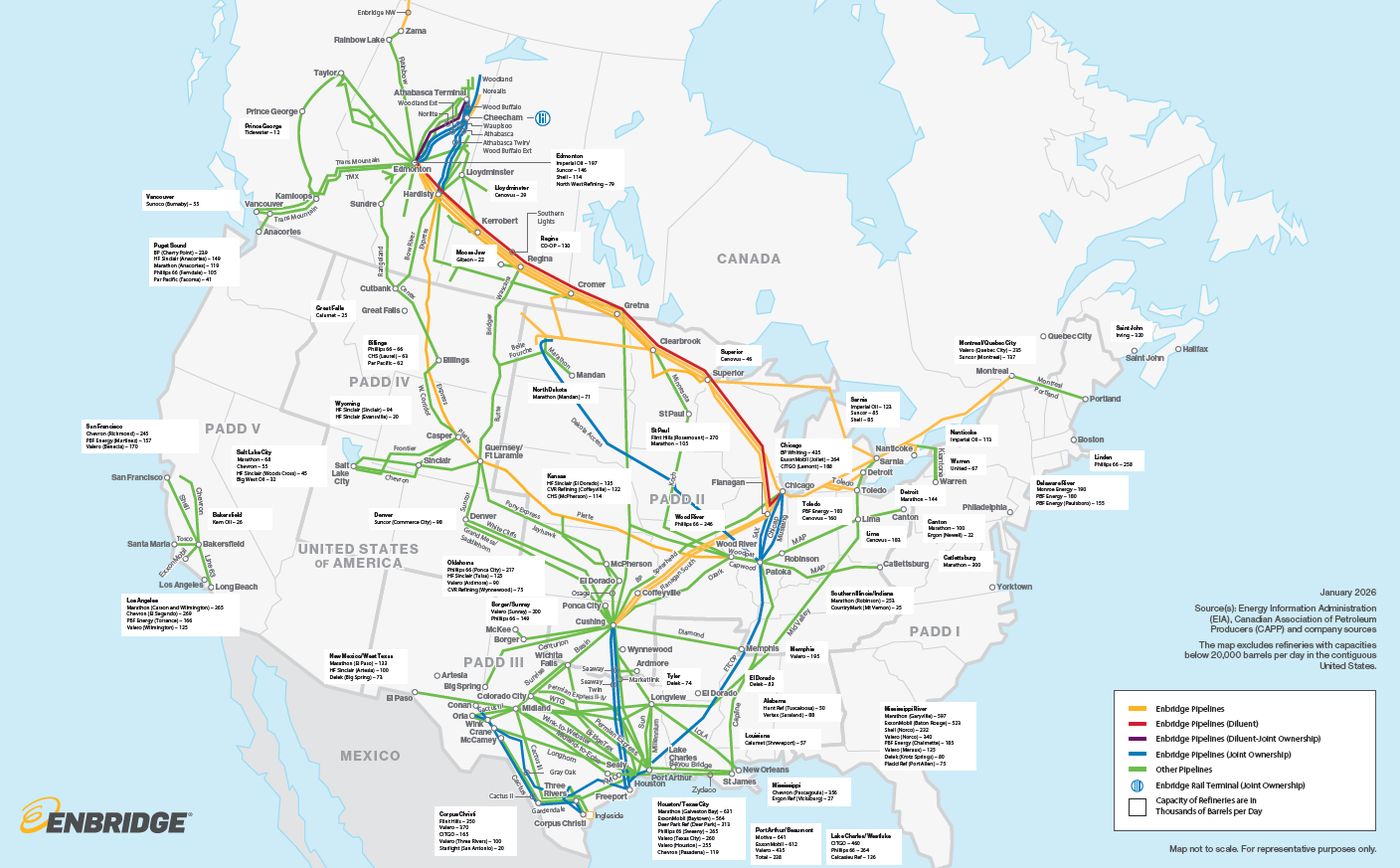
Enbridge operates as an energy infrastructure company, functioning as a critical link between energy producers and consumers. The company does not typically produce oil or gas itself but instead owns and operates the pipelines, storage facilities, and utility networks that transport and distribute these commodities. Its operations are divided into four distinct business segments that manage different parts of the energy value chain. The Liquids Pipelines segment is responsible for transporting crude oil and other liquid hydrocarbons across Canada and the United States through systems like the Mainline. The Gas Transmission segment invests in and operates natural gas pipelines and processing facilities throughout North America. The Gas Distribution and Storage segment serves as a regulated natural gas utility, delivering gas to residential, commercial, and industrial customers in Ontario and Quebec. Finally, the Renewable Power Generation segment owns and operates assets like wind, solar, geothermal, waste heat recovery, and transmission assets in North America.
Company History and Evolution
Enbridge was founded on April 30, 1949, and has grown through strategic expansion and acquisition over many decades. The company initially focused on liquid pipelines, with its core system becoming a vital artery for Canadian crude oil exports to the United States. A significant milestone occurred in October 1998 when the company, then known as IPL Energy Inc., changed its name to Enbridge Inc. This rebranding reflected its broadening scope beyond its original pipeline roots. Throughout its history, Enbridge has consistently expanded its asset base, moving into natural gas transmission, distribution, and more recently, renewable power generation. This evolution has transformed the company from a pipeline operator into a diversified energy infrastructure giant with a presence across the continent.
Main Business Segments and Operations
Enbridge's operations are organized into four primary segments, each contributing to its overall revenue and stability. The Liquids Pipelines segment includes the extensive Mainline System, the Regional Oil Sands System, and the Gulf Coast and Mid-Continent Systems, which together form one of the world's longest crude oil transportation networks. This segment also provides physical commodity marketing and logistical services, and crude oil marketing services. The Gas Transmission segment encompasses major investments in cross-border and regional natural gas pipelines, along with gathering, processing, and storage facilities in both Canada and the United States. The Gas Distribution and Storage segment operates Enbridge Gas, the largest natural gas utility in Canada, serving millions of residential, commercial, and industrial customers in Ontario, and includes distribution activities in Quebec. The Renewable Power Generation segment represents the company's strategic investment in cleaner energy, with assets located in North America that generate power from wind, solar, geothermal, and waste heat recovery sources. Enbridge Inc. is a large capitalization energy infrastructure company with a market capitalization of approximately $150.29 billion. The company operates an extensive network of pipelines and related facilities across Canada and the United States. Its operations are divided into four major business segments: Liquids Pipelines, Gas Transmission, Gas Distribution and Storage, and Renewable Power Generation.
- Liquids Pipelines: Transports, stores, and exports crude oil and other liquid hydrocarbons across North America.
- Gas Transmission: Owns interests in key natural gas pipeline systems in both Canada and the United States.
- Gas Distribution and Storage: Provides regulated natural gas utility service to residential, commercial, and industrial customers.
- Renewable Power Generation: Operates a portfolio of wind, solar, and geothermal power generation facilities.
Enbridge's business model is diversified across multiple energy infrastructure segments. The company operates crude oil and liquids pipelines, natural gas transmission and distribution systems, and renewable power generation assets. This structure means its earnings are not dependent on a single commodity price or a single type of business activity. The diversification is a strategic approach to managing business risk across different areas of the energy sector.
Stock Listings and Trading Information
Enbridge Inc. is a publicly traded company with its common shares listed on two major stock exchanges. In Canada, the shares trade on the Toronto Stock Exchange (TSX) under the ticker symbol ENB. In the United States, the shares trade on the New York Stock Exchange (NYSE) also under the symbol ENB. The TSX-listed shares trade in Canadian dollars, while the NYSE-listed shares trade in U.S. dollars. This dual listing provides flexibility for investors in both countries and increases the stock's liquidity. The company is classified as a large capitalization stock due to its market value, which is between $10 billion and $200 billion, placing it among the largest companies on the TSX. The stock's trading volume is typically in the millions of shares per day, indicating a high level of investor interest and market activity.
Dividend Record and Financial Performance
Enbridge is widely recognized for its commitment to returning capital to shareholders through dividends. The company has established a track record of increasing its dividend for many consecutive years, which is a key consideration for income-focused investors. The dividend yield is often cited as a notable feature of the stock. Financial performance can vary by segment and is influenced by factors like commodity prices, regulatory decisions, and energy demand. The company reports its financial results across its four operating segments, providing transparency into where its earnings are generated. Investors should review the company's quarterly and annual reports for detailed figures on revenue, net income, and earnings per share, which have shown periods of both increase and decrease year-over-year and quarter-over-quarter. For example, total revenue and net income have shown significant percentage increases on an annual basis in recent reporting periods, while quarterly results can show more variability.
How Canadians Can Hold Enbridge Stock
Canadian investors have several options for holding Enbridge shares within registered and non-registered accounts. The most direct method is to purchase the TSX-listed ENB shares in Canadian dollars through a brokerage account. These shares can be held in a Tax-Free Savings Account (TFSA), where any dividend income and capital gains accumulate tax-free. They can also be held in a Registered Retirement Savings Plan (RRSP), where investments grow on a tax-deferred basis. For those holding the U.S.-listed ENB shares in an RRSP, there is typically no U.S. withholding tax on dividends due to the tax treaty between Canada and the United States. However, holding U.S.-listed shares in a TFSA may subject dividends to U.S. withholding tax. Many Canadian investors choose the TSX listing for simplicity and to avoid currency exchange considerations when investing in Canadian registered accounts.
Principal Risks and Considerations
Investing in Enbridge involves exposure to several industry-specific and regulatory risks. As a pipeline and utility operator, a significant portion of its business is subject to government regulation, including the rates it can charge for transportation and distribution services. Changes in regulatory policies or delays in regulatory approvals for new projects can impact earnings and growth plans. The company's operations carry inherent environmental risks, such as the potential for spills or leaks, which can lead to significant remediation costs, fines, and reputational damage. Economic cycles that affect the demand for crude oil and natural gas can influence volumes on its pipelines. Furthermore, the long-term transition toward lower-carbon energy sources presents both a challenge and an opportunity, as seen in the company's investments in renewable power generation.
Enbridge faces several key investment risks common to its industry. The company operates in a sector subject to regulatory changes that can affect approved rates and new projects. There are inherent environmental and operational risks associated with pipeline and energy infrastructure. Furthermore, the company's financial performance can be influenced by fluctuations in energy demand and commodity prices. The long term transition of the global energy sector also presents a strategic challenge for the business.
- Regulatory Risk: Earnings are influenced by decisions from bodies like the Canada Energy Regulator and the Federal Energy Regulatory Commission.
- Environmental and Operational Risk: Potential for incidents that disrupt service, cause environmental harm, and lead to liabilities.
- Commodity Demand Risk: Volumes on pipelines can be affected by fluctuations in energy production and consumption.
- Energy Transition Risk: The shift to renewable energy may affect long-term demand for fossil fuel transportation.
- Interest Rate Risk: As a capital-intensive business, rising interest rates can increase borrowing costs.
Potential investors should carefully evaluate Enbridge's profile against their individual investment goals and risk tolerance. The company's competitors are included in the Industrial Services sector and the specific Oil and Gas Pipelines industry group. These competitors face similar market dynamics and regulatory pressures as Enbridge. Understanding this competitive landscape is important for a complete investment analysis. The company's recent financial performance has shown growth in total revenue but some quarterly declines in net income and earnings per share.
Frequently asked questions
What does Enbridge Inc. do?
Enbridge Inc. is an energy infrastructure company that operates through four segments. The Liquids Pipelines segment transports and stores crude oil and liquid hydrocarbons in Canada and the United States. The Gas Transmission and Gas Distribution segments move and deliver natural gas, including utility service to residential and commercial customers in Ontario and Quebec. The Renewable Power Generation segment operates wind, solar, and geothermal power assets in North America.
What is Enbridge's stock symbol in Canada?
Enbridge's common shares trade on the Toronto Stock Exchange under the symbol ENB. The company is also listed on the New York Stock Exchange under the same symbol, ENB. The company is headquartered in Calgary, Alberta. Its shares are a component of the S&P/TSX Composite index.
Does Enbridge pay a dividend?
Yes, Enbridge pays a dividend to its shareholders. The stock is noted for its dividend yield, which has been a feature for income seeking investors. The company has a long track record of dividend growth over many consecutive years. Dividend payments are a part of the total return potential for Enbridge investors.
Can I hold Enbridge stock in my TFSA or RRSP?
Yes, Enbridge stock can be held in Canadian registered accounts like a TFSA or RRSP. The TSX listed shares under the symbol ENB are eligible for these accounts. Holding the Canadian listed shares is a common practice for domestic investors. This simplifies the investment within the Canadian regulatory and tax deferred framework.
What are the main risks of investing in Enbridge?
The main risks include regulatory changes affecting pipeline rates and project approvals. There are operational and environmental risks associated with pipeline incidents and infrastructure safety. The company's performance is also tied to energy demand and commodity price fluctuations. Finally, the broader energy transition poses long term strategic risks to the traditional pipeline business model.
When was Enbridge founded?
Enbridge was founded on April 30, 1949. The company is headquartered in Calgary, Alberta, Canada. It was originally known as IPL Energy Inc. before changing its name to Enbridge Inc. in October 1998. Enbridge operates as a major energy infrastructure company with a focus on pipelines and utilities. Its long corporate history spans over seven decades, during which it has grown into a large capitalization company with a market value in the hundreds of billions.
Sources and further reading
- Enbridge Inc. (ENB.TO) Stock Price, News, Quote & History ca.finance.yahoo.com
- ENB Stock Quote Price and Forecast cnn.com
- Enbridge: ENB Stock Price Quote & News robinhood.com
This article explains how things work and is not financial, tax or legal advice. Rules, limits and rates change, so check the current figures with the Canada Revenue Agency, your province or your financial institution before you act.