Bank of Montreal (BMO) is one of Canada's oldest and largest financial institutions, listed on the Toronto Stock Exchange under the ticker BMO. The bank provides a comprehensive range of personal and commercial banking, wealth management, and capital markets services across North America. For Canadian investors, BMO stock is a core holding in many portfolios, known for its long history of dividend payments. Understanding its business segments, trading details, and associated risks is fundamental for those considering it as an investment.
What Bank of Montreal Does
Bank of Montreal operates as a diversified financial services provider with a major presence in Canada and the United States. Its operations are divided into four main business segments that serve millions of customers. The Canadian Personal and Commercial Banking segment offers everyday banking services like chequing and savings accounts, mortgages, loans, and credit cards to individuals and businesses. The U.S. Banking segment provides similar retail and commercial banking services through its network in the United States, including the former Bank of the West which it acquired. The Wealth Management segment delivers investment, advisory, and insurance solutions to retail investors, high net worth clients, and institutions. Finally, the Capital Markets segment offers global services in debt and equity underwriting, mergers and acquisitions advice, sales and trading, and treasury management for corporate and institutional clients.
History and Founding
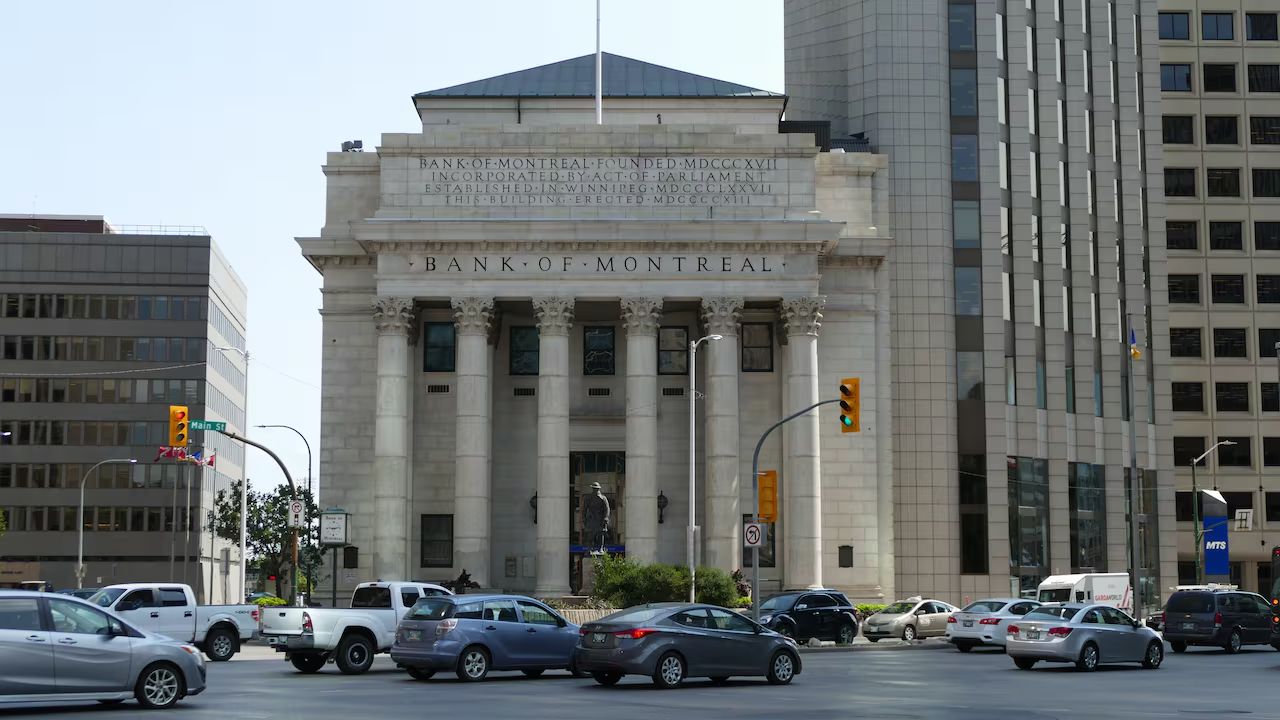
Bank of Montreal was founded in 1817, making it the first bank established in Canada and one of the oldest corporations in North America. The bank has grown over two centuries through both organic expansion and strategic acquisitions. This long history has established BMO as a systemically important financial institution in Canada. Bank of Montreal was founded in 1817 and is headquartered in Montreal, Canada. It has expanded from its foundational role in Canadian finance into the United States. This growth has been built through key acquisitions and milestones. The bank now operates primarily in North America.
Strategic acquisitions have transformed Bank of Montreal into a major North American financial services player. It now has significant scale in both Canada and the United States. The integration of Bank of the West represents its largest strategic move in recent years. The bank operates through Canadian Personal and Commercial Banking, U.S. Banking, Wealth Management, and Capital Markets segments.
Primary Business Segments and Offerings
Bank of Montreal's financial performance is driven by its four reportable segments, each serving distinct markets. The Canadian Personal and Commercial Banking division is the core domestic operation, providing a full suite of financial products to consumers and businesses across Canada. This includes digital banking platforms, payment solutions, and commercial lending. The U.S. Personal and Commercial Banking segment operates a large branch network, offering retail banking, commercial real estate lending, and business banking services, now significantly bolstered by the Bank of the West integration. The BMO Wealth Management segment is a global operation offering investment management, financial planning, and trust services. It also provides life insurance, annuities, and group insurance products. The BMO Capital Markets segment serves corporate, institutional, and government clients with advisory and capital-raising services, along with trading and research across multiple asset classes.
Bank of Montreal offers an extensive range of products and services for a wide client base. These include chequing accounts, savings accounts, loans, mortgages, and credit cards. The bank also provides investment management, insurance, and corporate banking services. Its operations span from everyday consumer products to complex institutional services.
- Chequing accounts, savings accounts, money markets and certificates of deposits.
- Debit cards, overdrafts, digital banking, credit cards, loans, and mortgages.
- Investment and retirement options, and commercial banking products.
- Treasury and payment solutions, and risk management products for businesses.
- Individual life, critical illness and annuity products, and segregated funds.
- Group creditor and travel insurance, and wealth and pension de-risking solutions.
- Debt and equity capital-raising, loan syndication, and mergers and acquisitions advice.
- Sales and trading solutions for debt, foreign exchange, equities, and commodities.
The bank's diversified portfolio generates revenue from multiple streams. This includes net interest income from lending and fee-based income from advisory and management services. The Capital Markets segment provides research and access to financial markets for institutional, corporate, and retail clients. It offers an integrated suite of sales and trading solutions related to debt, foreign exchange, equities, and commodities.

Stock Listing and Trading Details for Canadians
Bank of Montreal's primary listing is on the Toronto Stock Exchange (TSX) under the ticker symbol BMO. The stock also trades on the New York Stock Exchange (NYSE) under the same symbol, BMO, providing liquidity and access for U.S. and international investors. For Canadian investors, shares purchased on the TSX trade in Canadian dollars (CAD). This makes BMO a straightforward holding for Canadian registered accounts. Investors can hold BMO stock within a Tax-Free Savings Account (TFSA), where any capital gains and dividends are tax-free, or within a Registered Retirement Savings Plan (RRSP), where growth is tax-deferred. Analyst coverage of the stock is active, with price targets from analysts in a recent six-month period ranging from a low of $227.00 to a high of $295.00, with an average target of $259.70 based on eleven analysts.
Dividend History and Yield
Bank of Montreal has a longstanding reputation for paying dividends to its shareholders, with a record of consecutive payments spanning over a century. The bank's dividend policy is reviewed quarterly by its board of directors. As of recent data, the stock offers a dividend yield of approximately 2.88%. The dividend is typically paid on a quarterly basis in Canadian dollars to shareholders of record on specified dates. For Canadian investors, dividends received in a non-registered account are eligible for the dividend tax credit, which provides favourable tax treatment compared to interest income. The bank's ability to maintain and grow its dividend is supported by the earnings stability of its diversified business model, though dividends are never guaranteed and are subject to the board's discretion based on financial performance. The ex-dividend date for one recent distribution was listed as October 30, 2026, which is the first date a buyer of the stock would not be entitled to that specific dividend payment.
Financial Metrics and Market Data
Investors evaluate Bank of Montreal using several key financial metrics derived from its stock performance and financial statements. The company's market capitalization, a measure of its total market value, was approximately $166.34 billion based on recent trading data. The price-to-earnings (P/E) ratio, which compares the stock price to its earnings per share, was 19.51, providing insight into its valuation relative to profits. The stock's performance is often measured against a benchmark like the S&P/TSX Composite Index. These metrics, combined with the 52-week trading range between $168.92 and $259.20, help investors assess the stock's volatility and value within the broader financial sector.
Key trading and valuation metrics for Bank of Montreal stock are compiled from recent market data. The current price of BMO is 239.31 CAD. The stock's 52-week range extends from a low of 168.92 CAD to a high of 259.20 CAD. The company has a market capitalization of 166.34 billion CAD.
| Metric | Value |
|---|---|
| Market Capitalization | $166.34 billion |
| Trailing P/E Ratio | 19.51 |
| Dividend Yield | 2.88% |
| 52-Week High | $259.20 |
| 52-Week Low | $168.92 |
| Analyst Avg. Price Target (12-month) | $259.70 |
These figures provide a snapshot of the stock's current standing and investor expectations. They are subject to change with market conditions and new financial results. Analyst price targets are based on eleven analysts offering 12-month price targets for Bank of Montreal in the last six months. The average analyst price target is 259.70 CAD, with a high target of 295.00 CAD and a low target of 227.00 CAD.
Key Risks for Investors
Investing in Bank of Montreal stock involves exposure to several financial and economic risks common to major banks. Credit risk is a primary concern, as the bank could face losses if borrowers default on loans, particularly during an economic downturn that increases unemployment or lowers asset values. Interest rate risk is significant because the bank's net interest income, the difference between what it earns on loans and pays on deposits, can be squeezed by changing rate environments set by the Bank of Canada and the U.S. Federal Reserve. Operational and regulatory risks are ever-present, as the bank must comply with complex and evolving financial regulations in both Canada and the United States, and is exposed to potential cybersecurity threats. Furthermore, the success of large acquisitions, such as the integration of Bank of the West, carries execution risk, including the challenge of merging systems and cultures while realizing expected cost savings and revenue synergies.
The main categories of risk facing Bank of Montreal and its shareholders are varied and interconnected. These risks include credit risk, interest rate risk, and operational risks. Each type of risk can affect the bank's profitability and capital position. These factors can ultimately affect the bank's stock price in different ways.
- Credit Risk: Potential for loan defaults by consumers and businesses.
- Interest Rate Risk: Impact of central bank rate changes on net interest margins.
- Operational Risk: Includes cybersecurity threats and technology system failures.
- Regulatory Risk: Changes to banking, capital, and consumer protection laws in Canada and the U.S.
- Market Risk: Exposure to fluctuations in foreign exchange rates, equity prices, and commodity prices.
- Strategic Risk: Challenges in integrating acquisitions and achieving growth targets.
- Reputational Risk: Damage to brand and client trust from operational failures or misconduct.
These risks are managed through the bank's internal controls, capital reserves, and risk management frameworks. They can never be fully eliminated and directly impact the bank's profitability and stock price. The Capital Markets segment provides risk management and advisory services for client hedging strategies. These strategies are related to interest rates, foreign exchange rates, and commodities prices.
Frequently asked questions
What is the ticker symbol for Bank of Montreal stock in Canada?
Bank of Montreal's primary ticker symbol on the Toronto Stock Exchange is BMO. It is also listed on the New York Stock Exchange under the same symbol, BMO. The stock is frequently referenced as BMO.TO in financial data sources. Real time price updates for this instrument are tracked as BMO-T. Trading on the TSX is conducted in Canadian dollars, which is the currency used for the reported prices and market capitalization.
Does BMO pay a dividend?
Yes, Bank of Montreal pays a dividend. The company has an ex dividend date noted as October 30, 2026. Dividend payments are a component of the stock's trailing total returns. The dividend policy and specific amounts are determined by the bank's board of directors.
What are the main business areas of Bank of Montreal?
Bank of Montreal operates through four primary business segments. These are Canadian Personal and Commercial Banking, U.S. Banking, Wealth Management, and Capital Markets. Their services include chequing accounts, loans, mortgages, investment management, and insurance products. The company also provides capital raising, mergers and acquisitions advice, and sales and trading solutions for institutional clients. It is a diversified financial services provider primarily in North America.
When was Bank of Montreal founded?
Bank of Montreal was founded in 1817. It is headquartered in Montreal, Canada. This makes it the oldest bank in Canada and one of the oldest financial institutions in North America. The company has grown from its founding to become a major provider of diversified financial services across personal, commercial, wealth, and capital markets sectors.
What are the risks of investing in BMO stock?
Investing in BMO stock involves market risks reflected in its price volatility, as shown by its 52 week range from a low of $119.84 to a high of $187.22 in one data set. The stock price is influenced by the bank's financial performance across its operating segments. Analyst price targets vary, indicating differing views on future performance, with a low target of $227.00 and a high of $295.00. The company's performance is tied to broader economic conditions in North America which affect its banking and capital markets activities.
Sources and further reading
- Bank of Montreal (BMO.TO) Stock Price, News, Quote & ... ca.finance.yahoo.com
- Bank of Montreal: BMO Stock Price Quote & News robinhood.com
This article explains how things work and is not financial, tax or legal advice. Rules, limits and rates change, so check the current figures with the Canada Revenue Agency, your province or your financial institution before you act.