TORONTO
The rate of mortgage arrears in Ontario has nearly tripled from pre-pandemic levels and is approaching its peak during the 2008 financial crisis, a new report from TD Economics says.
The province's arrears rate reached 0.34 percent in August, up from a pre-pandemic average of 0.12 percent, according to the report.
That equates to roughly one in every 300 households falling behind on mortgage payments for three or more months.
The rate is approaching the 0.43 percent peak recorded during the 2008-09 financial crisis.
"Ontario is one of the weakest economies in Canada currently with pressure coming from U.S. tariffs, and it is seeing a higher unemployment rate," said TD economist Maria Solovieva.
"There is a combination of income shock and payment shock from higher interest rates."
Economists and credit experts say the number of households in the province falling behind is expected to increase through 2027, with more interest rate increases likely leading to more forced property sales.
They say Ontario is faring much worse than the rest of the country because mortgage balances in the province are so large, which has left many consumers with little room to cope with interest rate increases.
Although mortgage arrears have also been rising quickly in British Columbia, the pace of increase there has slowed, while Ontario's has not, the TD report noted.
TD expects the Bank of Canada to raise its policy rate again in January, following its 25-basis-point increase in October.
That would put additional pressure on variable-rate borrowers, who now account for 35 percent of outstanding mortgages, a historically high share.
"Every quarter-point increase starts to put added financial pressure on homeowners," said Rebecca Oakes, vice-president of advanced analytics at credit reporting agency Equifax Canada.
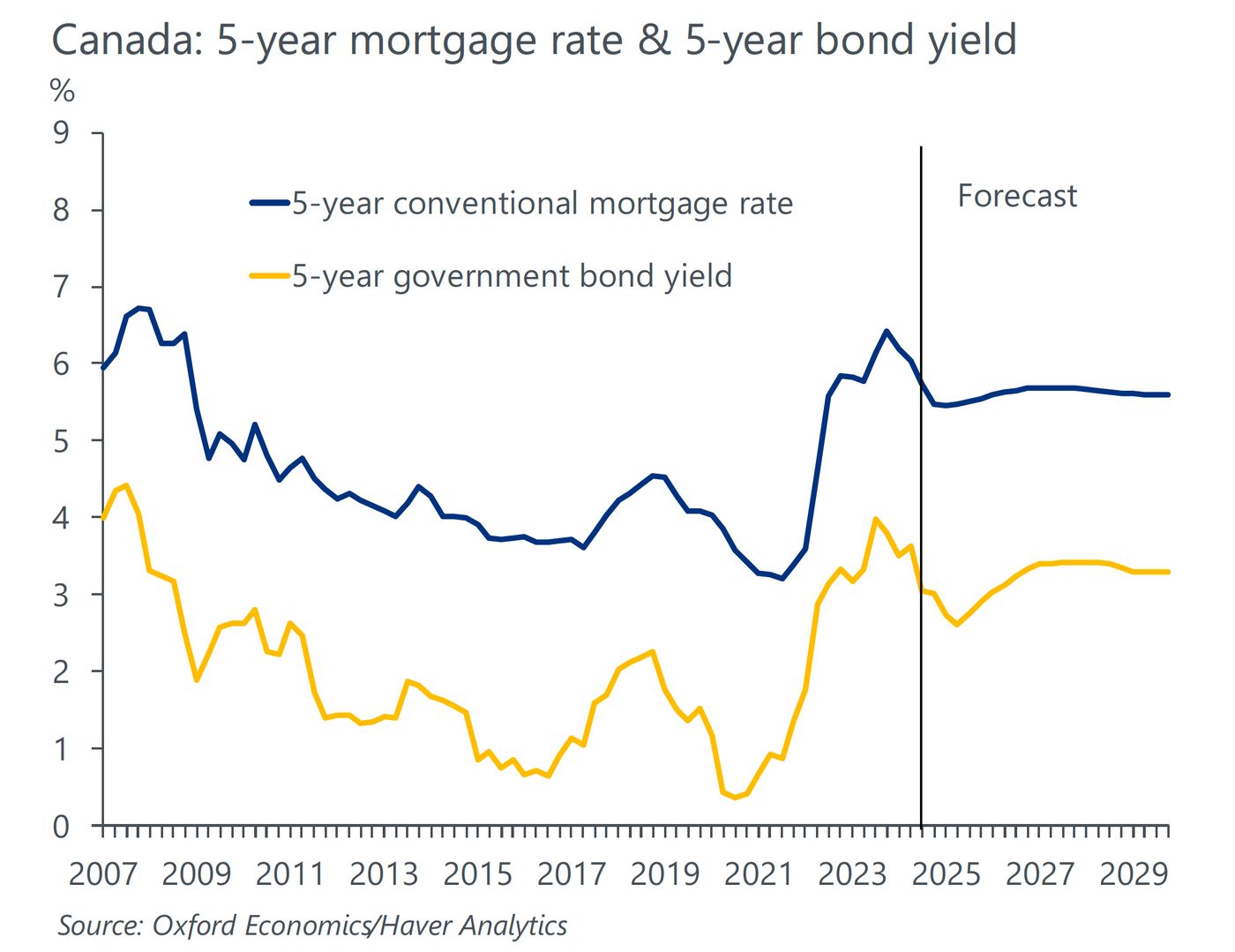
Fixed-rate borrowers are also facing higher costs, with the five-year Government of Canada bond yield rising roughly 60 basis points this year, putting upward pressure on mortgage rates.
TD estimates that higher borrowing costs will add about $115 a year to the average Canadian household's mortgage servicing costs in 2027 compared with its previous forecast.
In Ontario, the additional cost is estimated at $140 annually, on top of mortgage servicing costs already substantially higher than the national average.
Doug Hoyes, a licensed insolvency trustee and co-founder of Hoyes, Michalos and Associates in Toronto, said he is noticing a higher number of clients who are having a lender force a power-of-sale, in which a mortgage provider forces a sale of the borrower's property to recover funds.
Realtors have said these kinds of sales are becoming increasingly common in the Toronto-area market.
Mr. Hoyes said lenders often wait months or even a year to force a sale, because a sale in the current housing market downturn often fetches prices significantly lower than the value at which the property was appraised when the mortgage was issued.
Among Ontario's struggling borrowers are also scores of real estate investors who purchased preconstruction condos and are finding themselves unable to secure a mortgage because property values have dropped below the price they agreed to pay, Mr. Hoyes said.
The Ontario market is also seeing a larger housing market downturn, particularly in small condos that were generally purchased by investors.
In cities such as Hamilton and Oshawa, higher rates of unemployment in the manufacturing sector tied to the U.S. trade war are compounding the problem.
Solovieva cited Statistics Canada figures from October that found 35 percent of people living in households in Oshawa, Windsor and Hamilton reported difficulties meeting their financial needs, the highest level among Canada's largest cities.
Ontario's unemployment rate reached 7.3 percent in October, compared with 6.7 percent nationally.
TD notes that mortgage arrears typically lag changes in unemployment by two to three quarters, meaning recent labour market weakness could continue to affect payment performance next year.
Despite the pressures, TD expects Ontario's mortgage arrears rate to stabilize around mid-2027 before gradually declining as economic and labour market conditions improve.
She expects delinquencies will continue to increase until the second quarter of 2027, when TD Bank is forecasting the economy and employment rates will begin to improve.
"Despite these vulnerabilities, we see little reason to sound the alarm bell over a broader deterioration in household credit performance," Solovieva writes.
However, TD warns that if weak hiring gives way to widespread job losses, mortgage arrears could continue rising and remain raised for longer.
Solovieva added that a prolonging of the trade war could delay a recovery for Canadian household balance sheets.
"If we have more pressure coming from [the trade war] and it impacts employment and there are layoffs, then we could see unemployment rates rising and more deterioration."
e2gold.ca reported in November that the recent U.S. midterm election results have opened a new door for Canada to push for an end to the trade war.
This story was written by the e2gold.ca newsroom from reporting by The Globe and Mail and Canadian Mortgage Trends. Quotes are checked word for word against that reporting.