ALLISTON
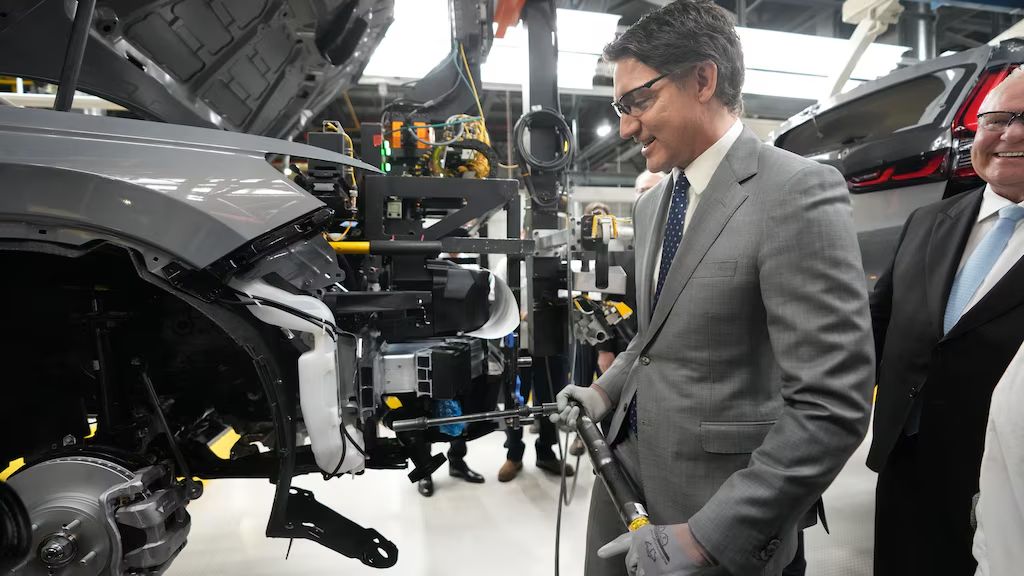
Honda Canada is investing $166 million to retool its Alliston, Ont., plant to expand hybrid and gas vehicle production, part of an $867-million commitment announced Monday.
The investment will restart the plant's engine shop and help maintain 4,000 jobs, the automaker said.
"This renewed investment reinforces Canada’s critical role in Honda’s North American growth and hybrid-electric vehicle strategy and helps position our operations for long-term competitiveness and future opportunities," said Honda Canada president and CEO Dave Jamieson in a news release.
The federal government is contributing $313 million to the total, while Ontario is providing $156 million.
"This investment will strengthen our automotive supply chains, support thousands of well-paying jobs in Ontario and across the country, and help build a strong Canadian auto sector where workers build the cars of the future," said Industry Minister Mélanie Joly in a statement.
Ontario Premier Doug Ford called the investment "a clear vote of confidence in the 4,000 world-class Ontario auto workers employed at the plant."
The funding comes as Honda recently indefinitely suspended its plans for a $15-billion Canadian electric vehicle complex due to dwindling demand.
Meanwhile, Ford Motor Co.'s assembly plant in Oakville, Ont., has reopened to make pickup trucks after closing for retooling in 2024.
About 2,000 people are back on the job at the plant, which turned out 3,488 trucks in October, according to analyst Michael Ward of Citi Research.
"They have ramped up nicely," said Sam Fiorani, an analyst at Pennsylvania-based consultancy AutoForecast Solutions.
The plant, with annual capacity of 100,000 units, makes large versions of Ford’s best-selling F-Series pickups, including the F-250 and F-350.
Ford says it has invested $5 billion at the plant, in addition to a $464-million grant from the federal government.
The plant made the Ford Edge until it closed in mid-2024 to be retooled to make electric vehicles, a plan that was cancelled amid slowing U.S. demand for EVs.
Ford and the Unifor union agreed in recent collective bargaining talks to bring back all laid-off Oakville workers by next July.
The agreement also includes a renewed "no closure" clause for all Ford facilities.
"This is a good news story," said Fraser Johnson, a business professor at Western University.
Industry observers say Ford made the investment in Oakville with the belief that tariffs aren't forever, and because the F-Series is in high demand.
"Given the margins on the product, Ford is able to some extent withstand the tariff costs, at least in the short term until there’s some resolution of the trade dispute with the U.S.," Johnson said.
U.S. President Donald Trump has imposed tariffs of 25 per cent on cars made in Canada, a move opposed by the North American auto industry.
In Canada, General Motors and Stellantis responded to the tariffs by reducing production and laying off workers.
Ford's F-Series trucks are the best-selling vehicles in the U.S. and Canada.
Canadians bought more than 138,000 of the trucks in 2025, beating the Toyota RAV4 SUV, according to DesRosiers Automotive Consultants Inc.
"The F-Series is a tremendous product, with amazing customer loyalty and the ability to shrug off many of its would-be competitors," said Andrew King, managing partner of DesRosiers.
Shahin Alizadeh, owner of dealership Downtown Ford Toronto, said sales of F-Series trucks have grown to comprise 25 to 30 per cent of his sales.
"We’re excited about the local production," Alizadeh said. "I don’t know if Ford is, if the tariffs keep going."
Alicia Boler Davis, president of Ford Pro, the company's work-truck division, said the Oakville plant will help the automaker catch up to demand from large commercial buyers and rental companies.
"We’re excited about Oakville and that capacity because that’s going to allow us to really grow," she said.
This story was written by the e2gold.ca newsroom from reporting by The Globe and Mail and CityNews. Quotes are checked word for word against that reporting.