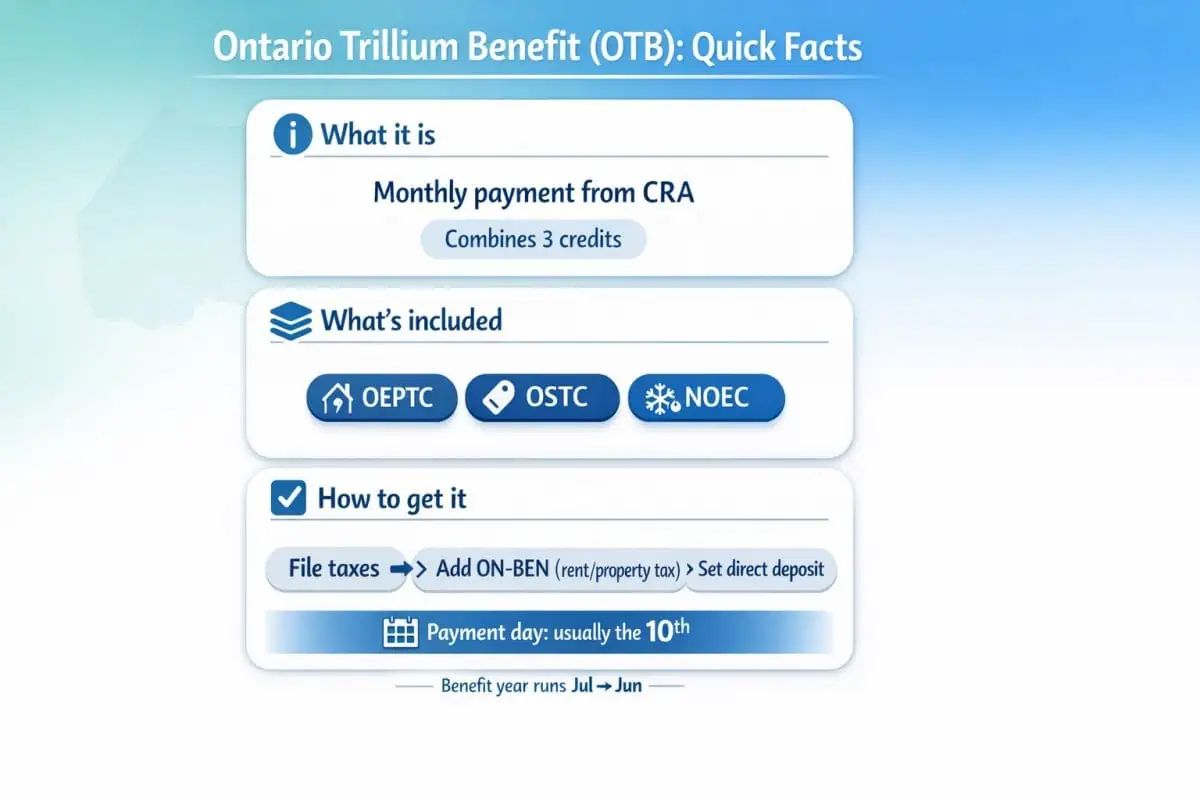
The Ontario Trillium Benefit (OTB) is a monthly, tax-free payment issued to eligible Ontario residents to help with energy costs, sales tax, and property taxes. Payments are typically sent on the 10th day of each month, from July to June of the following year, with adjustments made if that date falls on a weekend or holiday. Your eligibility and payment amounts are automatically determined when you file your annual income tax return. Understanding the schedule and rules is key to receiving this important financial support.
What is the Ontario Trillium Benefit?
The Ontario Trillium Benefit is a refundable tax credit that combines three provincial credits into one consolidated payment. It is funded by the Province of Ontario but administered on its behalf by the federal Canada Revenue Agency. The three component credits are the Ontario Energy and Property Tax Credit, the Northern Ontario Energy Credit, and the Ontario Sales Tax Credit. You only need to be eligible for at least one of these three credits to receive the OTB. The benefit is adjusted each year for inflation using the Ontario Consumer Price Index to help it keep pace with the cost of living. The OTB is a tax-free payment, meaning the amounts you receive are not considered taxable income and do not need to be reported on your return. Although the CRA handles the payments, the program rules and credit amounts are set by the Ontario Ministry of Finance.
Standard OTB Payment Schedule and Dates
The OTB is issued monthly, with the benefit year running from July of one year to June of the next calendar year. This schedule exists because payments are calculated based on your previous year's income tax return. The standard rule is that payments are issued on the 10th day of each month. If the 10th falls on a weekend or a statutory holiday, the payment is issued on the last working day before the 10th. For example, an August payment might be issued on the 8th if the 10th is a Saturday. Payments sent by mail may take a few additional days to arrive compared to direct deposit. It is important to wait five to ten business days before contacting the CRA about a missing payment. Wildfires or other postal disruptions can also delay the delivery of a small number of benefit cheques sent by mail.
For the 2026 benefit year, which is based on your 2025 tax return, several specific payment dates have been confirmed. The payment for October 2026 is scheduled for October 9, as the 10th falls on a Saturday. The next payments are then scheduled for November 10 and December 10. The schedule for the first half of the 2026 benefit year, starting in July 2025, included payments on July 10, August 8, and September 10. This pattern of issuing on the 10th or the preceding business day continues throughout the entire benefit year. If you file your 2025 tax return by April 30, 2026, you can expect to start receiving your monthly OTB payments beginning in July 2026. The CRA offers a benefit and credit payment reminder service you can sign up for to get a notice about one week before a scheduled payment is issued.
Monthly Versus Single Payment Options
In most cases, your total annual OTB entitlement is divided into twelve equal monthly installments. There are, however, important exceptions to this monthly payment structure. If your calculated annual OTB amount is $360 or less, you will automatically receive the entire sum in a single lump-sum payment. Furthermore, if your annual benefit is $360 or more, you have the choice to opt for a single annual payment instead of receiving monthly installments. You make this choice when filing your tax return by ticking box 61060 in the area called Choice for delayed single OTB payment on Form ON-BEN. This choice applies to the entire combined benefit amount, not to individual credits.
Choosing the single payment option means you will not receive any monthly payments from July 2026 to June 2027. Instead, you will receive one lump sum at the end of the benefit year, in June 2027. This can be a useful budgeting tool for some recipients. It is also important to note a special rule regarding very small payments. If your calculated monthly OTB amount is more than $2 but less than $10, the CRA will increase the payment to $10. You will not receive any payment if the calculated amount is $2 or less for the year. This minimum payment rule ensures that administrative costs do not outweigh the value of the benefit issued. The single payment is only available for the OTB as a whole. You cannot choose a single payment for just one of the component credits like the OSTC.

Detailed Eligibility Requirements for the Three Credits
Eligibility for the OTB depends on meeting the criteria for at least one of its three constituent credits. General requirements include being a resident of Ontario on December 31 of the previous tax year and being at least 19 years old, though there are exceptions for 18-year-olds. You must also file a personal Income Tax and Benefit Return each year, even if you have no income to report. The specific rules for each credit are distinct and determine who receives the payment within a household. For the OEPTC and NOEC, the payment is issued to the person who applied by completing Form ON-BEN. For the OSTC, the payment is made to the person whose tax return is assessed first. The total household payment remains the same regardless of which spouse applies.
- Ontario Energy and Property Tax Credit (OEPTC): To qualify, you must have paid property tax or rent for your principal residence in Ontario, paid living expenses for a nursing home, paid energy costs while living on an Ontario reserve, or lived in a designated post-secondary school residence in the prior year. In 2025, you must also have lived in Ontario and been a Canadian citizen, permanent resident, protected person, or temporary resident who lived in Canada throughout 2024.
- Northern Ontario Energy Credit (NOEC): This credit is for residents of Northern Ontario to help with higher energy costs. You must be a resident of Northern Ontario on December 31 and live in an eligible northern community such as Algoma, Cochrane, or Thunder Bay. Your eligibility for each month depends on where you live on the 1st of that month. If you are single, you could receive a maximum of $189 from this credit.
- Ontario Sales Tax Credit (OSTC): This is a payment to help with sales tax paid. You must be an Ontario resident and at least 19 years old, or have a spouse or common-law partner, or be a parent living with your child. You may receive an additional credit of up to $378 for a spouse or common-law partner and for each child under 19. This credit does not affect your separate federal GST/HST credit payments.
If you turn 18 before June 2027, you should apply by filing your 2025 tax return by April 30, 2026. If you qualify, you will receive the next scheduled OTB payment after you turn 18. Your eligibility for the OEPTC and NOEC for any given month is based on your residence on the first day of that payment month. For example, if you live in Sudbury on November 1 and move to London on November 30, you are eligible for the November NOEC payment but not for December.
How to Apply, Calculate, and Receive Your Payments
You do not need to submit a separate application for the Ontario Trillium Benefit. You are automatically considered for it when you file your annual personal Income Tax and Benefit Return. The crucial step is to complete and enclose the ON-BEN Application Form that is included in your tax return package. The deadline to file your return is April 30 each year. If your return is assessed on June 20 or later, your first OTB payment may be delayed by four to eight weeks from the assessment date. If you are unable to prepare your tax return yourself, the Community Volunteer Income Tax Program may be able to provide you with free help.
Your payment method is tied to how you receive your income tax refund. If you get your refund by direct deposit, your OTB payments will also be deposited directly into your bank account. These deposits may appear as Canada PRO in your account activity. If you do not use direct deposit for your refund, you will receive your OTB payments by mailed cheque on the 10th of each month, starting in July. You can estimate your potential OTB entitlement using the CRA's child and family benefits calculator online, which considers your age, marital status, number of children, and adjusted family net income. The exact amount you receive depends on these factors plus whether you paid rent or property tax, and for the NOEC, where in Northern Ontario you live.
Important Considerations, Scams, and Troubleshooting
Several factors can affect the timing and receipt of your OTB payments. Moving within or out of Ontario is a key consideration. For the OEPTC and NOEC, your eligibility for a given month's payment depends on where you live on the 1st of that month. If you move out of Ontario on November 10, for instance, you would still be eligible for the November payment but not for any subsequent payments. Always ensure your address is up to date with the CRA to avoid missing cheques. The CRA offers a benefit and credit payment reminder service you can sign up for, which sends a notice about one week before a scheduled payment. You can also check your next payment date and amount securely through the CRA My Account portal.
It is also vital to be aware of scams. The Government of Ontario will not send text messages or instant messages asking for personal information or to click a link to receive a benefit payment. Fraudulent messages may mimic official communications, using text like 'Your Ontario Trillium Benefit (OTB) refund notification' and direct you to fake websites. You should only access your benefit information through the secure CRA My Account portal. If you are unable to prepare your tax return yourself, you may be able to get free help through the Community Volunteer Income Tax Program. Finally, if you turn 18 before June of the benefit year, you should file a tax return to be considered for the OTB for the months after your birthday. If you are experiencing a disruption like a wildfire and cannot access a mailed cheque, you can call 1-800-387-1193 for immediate assistance.
Related Federal and Provincial Benefit Payment Dates
While receiving the OTB, you may also be eligible for other federal and provincial benefits with their own payment schedules. Knowing these dates can help you manage your household budget. The Canada Child Benefit, which includes related provincial programs, is typically paid on the 20th of each month, with remaining 2026 dates on November 20 and December 11. The Canada Groceries and Essentials Benefit, formerly the GST/HST credit, is paid quarterly on dates like January 5, April 2, July 3, and October 5, 2026. This benefit includes related provincial and territorial programs and a one-time top-up payment is expected in spring 2026 no later than June.
| Benefit | October 2026 Date | Frequency | Notes |
|---|---|---|---|
| Ontario Trillium Benefit | October 9 | Monthly | Based on 2025 tax return. |
| Advanced Canada Workers Benefit | October 9 | Quarterly (Final 2026) | Other 2026 dates were January 9, February 10, March 10, April 10, May 8. |
| Canada Groceries & Essentials Benefit | October 5 | Quarterly | Formerly GST/HST credit. |
| Canada Child Benefit | October 20 | Monthly | Includes provincial programs. |
| Newfoundland & Labrador Disability Benefit | October 23 | Varies | Remaining 2026 dates: November 27, December 23. |
| Canada Pension Plan / Old Age Security | October 28 | Monthly | Administered by Service Canada. |
Other notable payments include the Newfoundland and Labrador Disability Benefit on October 23 and the Advanced Canada Workers Benefit, which also has a payment on October 9, 2026. Service Canada administers CPP and OAS payments, which are both scheduled for October 28. The Canada Carbon Rebate does not have a payment scheduled for October 2026, but eligible taxpayers can still receive credits by filing outstanding returns for the 2021 to 2024 tax years. The Alberta Child and Family Benefit also has no October 2026 payment scheduled, with the next one due November 27.
Key Tax Deadlines and Their Impact on the OTB
Meeting key tax deadlines is crucial to ensure you receive your OTB payments on time and avoid penalties. The main deadline for most individuals to file their 2025 personal income tax return and pay any taxes owed is April 30, 2026. If you or your spouse are self-employed, the filing deadline is extended to June 15, 2026, but any taxes owed are still due by April 30. To reduce your taxable income for the 2025 tax year, you must make contributions to your Registered Retirement Savings Plan by March 2, 2026. Filing your return by April 30 means the CRA can assess your eligibility and calculate your OTB amount in time for payments to begin in July 2026.
If you miss the April 30 filing deadline, your OTB payments may be delayed. The CRA states that if your tax return is assessed on June 20, 2026, or later, your first OTB payment will be issued within four to eight weeks of that assessment date. This could mean you miss several scheduled monthly payments. Furthermore, you must file a return every year to continue receiving the benefit, even if you had no income. The ON-BEN form must be completed each year as part of your return. Eligibility is not carried over automatically from one year to the next. Staying organized and filing on time is the most reliable way to secure the benefit payments you are entitled to receive.
Frequently asked questions
What day of the month is the Ontario Trillium Benefit paid?
The Ontario Trillium Benefit is paid on the 10th day of each month. If the 10th falls on a weekend or a statutory holiday, the payment is issued on the last working day before the 10th. For example, in October 2026 the payment is scheduled for October 9 because the 10th is a Saturday. Payments are made monthly from July to June of the following year. This schedule is known as the benefit year and payments are based on your previous year's tax return.
Do I need to apply for the Ontario Trillium Benefit?
No, you do not need to submit a separate application. You are automatically considered for the OTB when you file your annual personal Income Tax and Benefit Return. The essential step is to complete the ON-BEN Application Form included in your tax return package. You must file your return even if you had no income in the year. Filing by the April 30 deadline helps ensure your payments start on time in July. If you are eligible, the CRA will notify you and begin issuing payments.
Can I get my OTB in one lump sum instead of monthly?
Yes, there are two ways to receive a single payment. If your total annual OTB amount is $360 or less, it is automatically paid as a single lump sum. If your benefit is more than $360, you can choose to receive it as a single annual payment by ticking box 61060 on Form ON-BEN when you file your taxes. If you choose this option, you will receive one payment in June instead of monthly payments from July to June. This choice must be made each year on your tax return.
What happens if I move out of Ontario?
Your eligibility for the OEPTC and NOEC components depends on where you live on the first day of each payment month. If you move out of Ontario on November 10, you would still be eligible for the November payment but not for any payments in December or later months. You must update your address with the CRA to ensure any final cheques are mailed to the correct location. For the OSTC, you must be an Ontario resident at some time before June 1 of the benefit year to qualify at all.
Why did I not receive an OTB payment?
There are several common reasons. You will not receive a payment if your calculated annual benefit is $2 or less. If your return was assessed very late, after June 20, your first payment may be delayed by four to eight weeks. Not filing your tax return or not completing the ON-BEN form will also make you ineligible. If you are expecting a payment, wait five to ten business days after the scheduled date before contacting the CRA, as mailed cheques take longer. Also, verify your banking information is correct if using direct deposit.
How is the OTB payment amount calculated?
The amount is based on the combined value of the three credits you qualify for: the OEPTC, NOEC, and OSTC. It depends on factors like your age, marital status, number of children, adjusted family net income, and whether you paid rent or property tax. You can use the CRA's child and family benefits calculator online to get an estimate. The benefit is adjusted annually for inflation using the Ontario Consumer Price Index. For the NOEC, living in an eligible northern community can provide a maximum of $189 for a single person.
Sources and further reading
- Ontario Trillium Benefit payment dates: October OTB drops ... moneysense.ca
- Ontario Trillium Benefit ontario.ca
- Ontario Trillium Benefit: Eligibility & Payment Dates turbotax.intuit.ca
- Benefit payment dates and Canadian tax deadlines. hrblock.ca
- CRA Benefits Payments in October 2026 - Immigration.ca immigration.ca
This article explains how things work and is not financial, tax or legal advice. Rules, limits and rates change, so check the current figures with the Canada Revenue Agency, your province or your financial institution before you act.