Ontario's income tax brackets and rates determine how much provincial tax you pay on your earnings each year. The province uses a progressive tax system with five brackets, meaning your tax rate increases as your income rises. For 2026, these rates range from 5.05% to 13.16% and are applied on top of federal income tax. Understanding these brackets is essential for Ontario residents to accurately estimate their tax liability and plan their personal finances.
How Ontario's Progressive Tax System Works
Canada, including Ontario, uses a progressive income tax system where higher portions of your income are taxed at higher rates. Your taxable income is divided into segments, each falling into a specific provincial tax bracket with its own rate. For example, only the portion of your income that exceeds a bracket's threshold is taxed at the next higher rate. This system means that moving into a higher tax bracket never results in all your income being taxed at that higher rate, so a raise or additional income will not reduce your take home pay. Your total provincial tax payable is the sum of the tax calculated on each successive segment of your income. The federal government uses an identical progressive system for its own tax calculation, which runs in parallel to the provincial calculation. All provinces except Quebec use the federal definition of taxable income, which is your total gross income from all sources minus eligible deductions. Provincial and territorial taxes are calculated on the federal return and collected by the federal government, except in Quebec where it is filed separately.
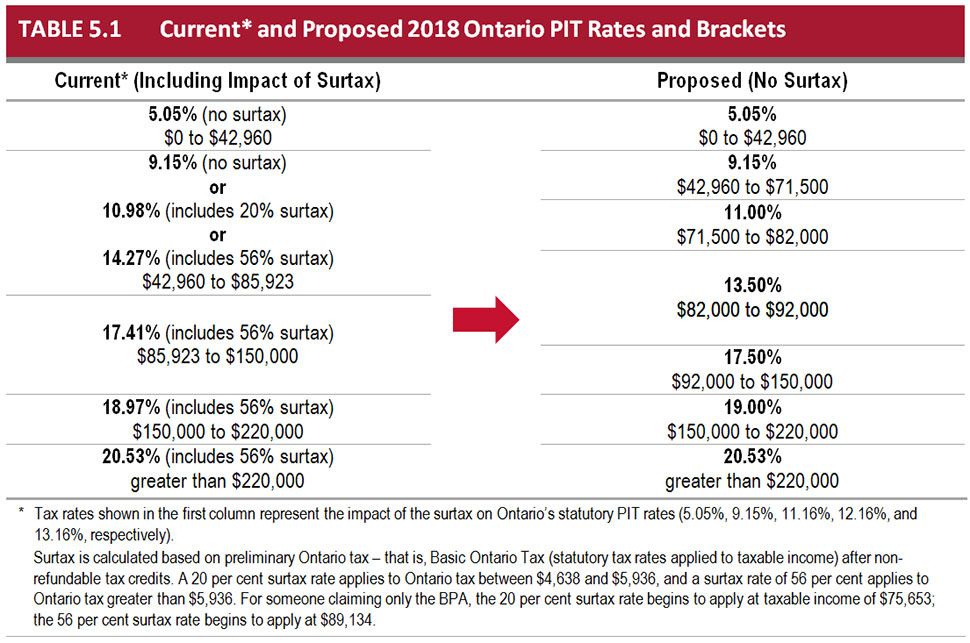
Ontario Provincial Tax Brackets and Rates for 2026
The Ontario government sets its own tax brackets and rates, which are indexed annually for inflation. For the 2026 tax year, the indexation factor is 1.019, representing a 1.9% increase. It is important to note that the $150,000 and $220,000 bracket thresholds are not indexed. The following table outlines the five income brackets and the corresponding tax rates that apply to taxable income for Ontario residents in 2026.
| Taxable Income Bracket | Tax Rate |
|---|---|
| $53,891 or less | 5.05% |
| Over $53,891 up to $107,785 | 9.15% |
| Over $107,785 up to $150,000 | 11.16% |
| Over $150,000 up to $220,000 | 12.16% |
| Over $220,000 | 13.16% |
These rates are applied to your taxable income after all federal and provincial deductions have been claimed. The brackets for the 2025 tax year are slightly lower due to indexation, with the first bracket at $52,886 or less taxed at 5.05%, the second from $52,887 to $105,775 at 9.15%, and the third from $105,776 to $150,000 at 11.16%. The provincial tax is calculated separately from federal income tax, and both amounts are combined to determine your total tax liability before credits. The federal tax brackets for 2026 are also indexed, with a factor of 1.02, and the lowest federal marginal rate is 14% applied to the first $58,523 of taxable income.
Federal Tax Brackets and Combined Calculation
As an Ontario resident, you must calculate both federal and provincial taxes. The federal government also uses a progressive system with its own brackets. To estimate your total tax, you first calculate federal tax using these federal brackets, then calculate Ontario tax using the provincial brackets, and finally add the two amounts together. From this combined total, you subtract any applicable tax credits, such as the basic personal amount. The federal basic personal amount for 2026 is $16,129, while the Ontario basic personal amount for 2025 is $12,747. These credits reduce your tax payable but do not combine into a single total. Each reduces its respective federal or provincial tax. For example, the federal basic amount reduces federal tax by applying the lowest federal rate of 14% to the $16,129 amount. Similarly, the Ontario basic amount reduces provincial tax by applying the lowest Ontario rate of 5.05% to the $12,747 amount.
For a concrete example, consider a taxable income of $60,000 in 2026 with only the basic personal credits. The first $58,523 would be taxed federally at 14%, resulting in $8,193.22. The remaining $1,477 is taxed at 20.5%, adding $302.79, for a federal total of $8,496.01. For Ontario tax, the first $53,891 is taxed at 5.05% ($2,721.50), and the next $6,109 is taxed at 9.15% ($558.97), for a provincial total of $3,280.47. The combined tax before credits is $11,776.48. Applying the basic personal credits would then lower the final amount payable. The federal credit would be $16,129 multiplied by 14%, which is $2,303.28, and the Ontario credit would be $12,747 multiplied by 5.05%, which is $655.94. This example illustrates the cumulative nature of tax calculation in a progressive system.
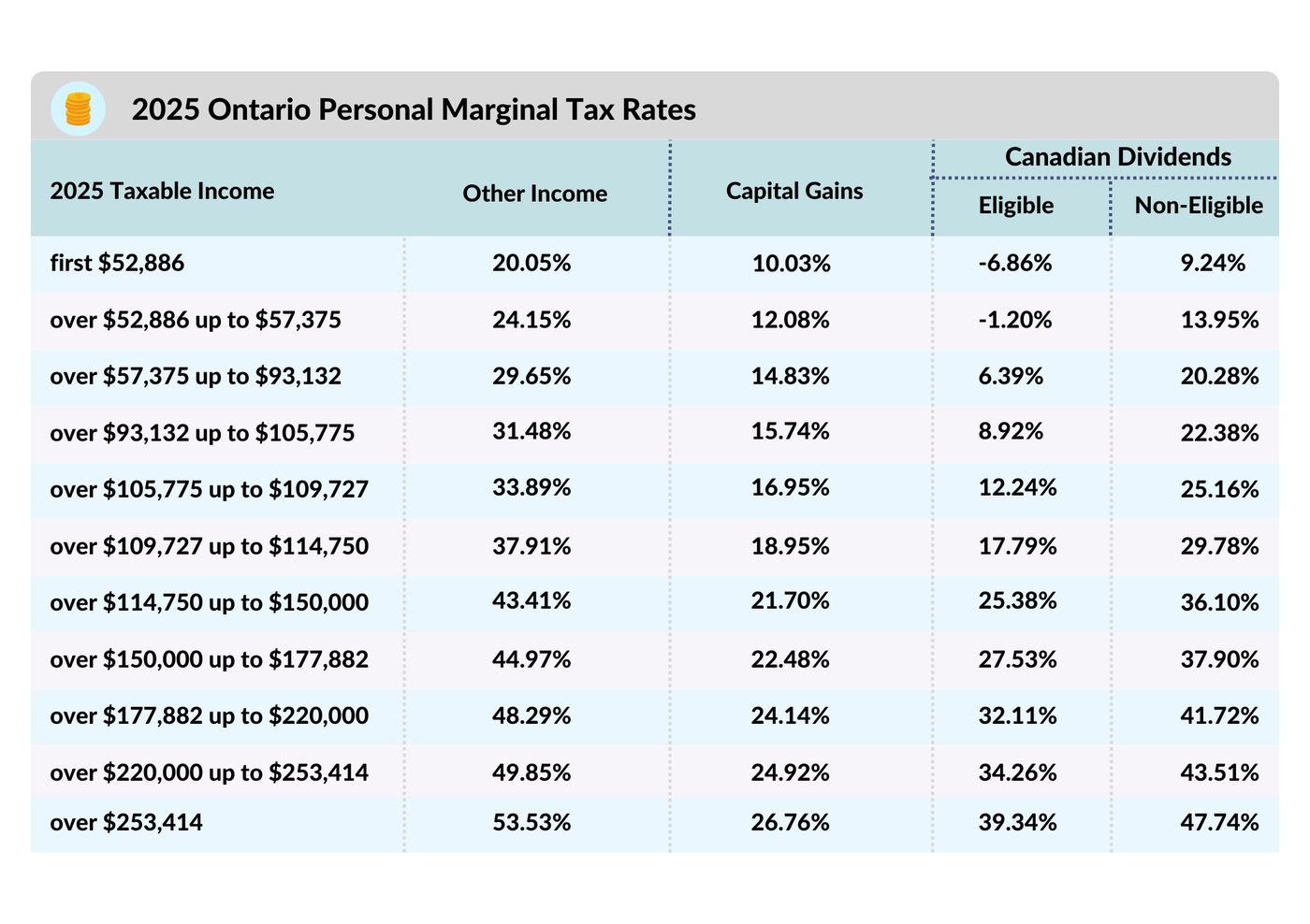
Key Concepts: Marginal Rate vs. Average Rate
Two critical numbers describe your tax situation: your marginal tax rate and your average tax rate. Your marginal tax rate is the rate applied to your next dollar of income, representing the highest bracket your income reaches. For an Ontario resident, this is the sum of the top federal and provincial rates on that additional income. Your average tax rate is the total tax you pay divided by your total income, which is always lower than your marginal rate because your first dollars are taxed at the lowest rates. For instance, if your Ontario income reaches the second provincial bracket, your marginal provincial rate is 9.15%, but your average provincial rate will be a blend of the 5.05% and 9.15% rates applied to the respective portions of your income. Understanding the difference between these rates helps in financial planning, as it clarifies that only income within a higher bracket is taxed at that higher rate. This is why earning more money never leaves you worse off financially. Your marginal rate is crucial for evaluating the tax impact of additional income, such as a bonus, overtime pay, or investment returns. Your average rate is useful for understanding your overall tax burden as a percentage of your total earnings for the year.
The Ontario Surtax and Other Important Details
In addition to the standard provincial tax rates, Ontario applies a surtax that increases the effective tax burden for higher earners. A surtax is an extra charge calculated on the provincial tax you already owe, not directly on your income. This surtax is automatically calculated on your tax return and is included in the effective top marginal rate of 13.16%. Your province of residence for tax purposes is determined as of December 31 of the tax year. If you move to Ontario during the year, you will be subject to Ontario income tax for the entire year, in addition to federal taxes. All provinces except Quebec use the federal definition of taxable income, and provincial taxes are calculated on the federal return and collected by the Canada Revenue Agency. Provincial and territorial taxes are not deductible when computing federal, provincial, or territorial taxable income. It is also important to be aware of federal measures like the Alternative Minimum Tax (AMT) and the 'kiddie tax' on split income, which can affect high-income individuals and families using private corporations for income sprinkling.
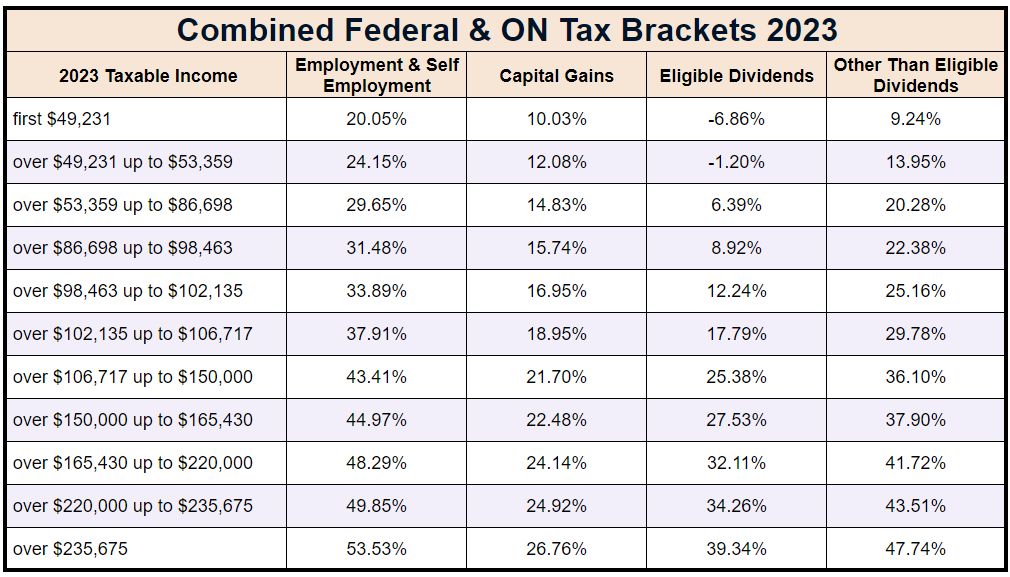
Common Mistakes and Planning Considerations
Several common misunderstandings can lead to errors in estimating Ontario taxes. One major mistake is believing that moving into a higher tax bracket causes all income to be taxed at the higher rate, which is not how a progressive system works. Another error is overlooking the Ontario surtax, which can significantly increase the tax payable for middle and high income earners. People also sometimes forget that tax brackets and credit amounts are indexed annually, so using the previous year's figures will yield an incorrect estimate. When planning, consider that your marginal tax rate is crucial for decisions like evaluating the tax impact of a bonus or an RRSP contribution. It is also important to remember that tax credits like the basic personal amount reduce tax payable to zero but do not generate a refund if your income is below the threshold. Knowing your after tax income is vital for budgeting, comparing job offers between provinces, and setting realistic savings goals.
- Assuming your entire income is taxed at your top marginal rate.
- Forgetting to account for the Ontario surtax in higher income estimates.
- Using outdated tax brackets and credit amounts that are not indexed.
- Not applying the basic personal amount correctly to both federal and provincial tax separately.
- Miscalculating tax after a mid year move between provinces.
- Overlooking that provincial tax is based on residency on December 31.
- Not considering the impact of the Alternative Minimum Tax (AMT) on certain deductions.
- Ignoring that provincial taxes are not deductible for federal tax purposes.
To avoid mistakes, you should use up to date tax calculators that incorporate current federal and provincial tax rates, brackets, and surtax details. You must always verify your province or territory of residence as of December 31st. It is important to keep track of any moves between provinces during the year. For complex situations involving investment income, corporate dividends, or international income, consulting a tax professional is recommended to ensure accurate filing and compliance with all rules.
Annual Changes and Indexation
Both federal and Ontario tax brackets, along with credit amounts like the basic personal amount, are adjusted each year for inflation through a process called indexation. For 2026, the federal indexation factor is 1.02, while the Ontario indexation factor is 1.019. This means most bracket thresholds and credit values increase by these percentages to maintain their real value. However, certain thresholds, like Ontario's $150,000 and $220,000 brackets, are fixed by law and are not indexed. The federal government also adjusts its basic personal amount independently, with the 2026 amount set at $16,129. These annual changes mean that the specific dollar amounts for brackets and credits are different each tax year. Taxpayers should always refer to the Canada Revenue Agency's confirmed figures for the specific year they are filing to ensure accurate calculations. The annual indexation helps prevent 'bracket creep,' where inflation pushes taxpayers into higher brackets without an actual increase in real purchasing power.
Federal and Provincial Tax Credits
Beyond the basic personal amount, several other tax credits can reduce your Ontario and federal tax payable. Personal tax credits, miscellaneous tax credits, and the dividend tax credit are subtracted from tax to determine the final federal tax liability. In Ontario, the basic personal tax credit is the primary provincial credit, calculated by applying the lowest provincial rate to the basic personal amount. It is crucial to understand that these credits reduce tax payable to zero but do not create a refund if the credit amount exceeds the tax owed. The dividend tax credit is available for dividends from Canadian corporations and reduces tax to account for corporate taxes already paid. Disability tax credits and foreign tax credits are other examples that can be claimed. All these credits are non refundable, meaning they can only reduce your tax liability to zero. Provincial and territorial taxes are not deductible when computing federal, provincial, or territorial taxable income, which is a common point of confusion. The tax system also includes measures like the Alternative Minimum Tax (AMT), which requires a separate calculation to ensure high income individuals with significant deductions still pay a minimum amount of tax.
Frequently asked questions
What are the Ontario tax brackets for 2025?
For the 2025 tax year, Ontario's provincial income tax brackets are as follows. Income of $52,886 or less is taxed at a rate of 5.05 percent. Income from $52,887 to $105,775 is taxed at a rate of 9.15 percent. Income from $105,776 to $150,000 is taxed at a rate of 11.16 percent. Income from $150,001 to $220,000 is taxed at a rate of 12.16 percent. Income over $220,000 is taxed at the top rate of 13.16 percent.
How do I calculate my take home pay in Ontario?
To estimate your take home pay, first add up your total gross income from all sources. Calculate your federal tax using the federal brackets and rates, then calculate your Ontario provincial tax using the provincial brackets. Subtract the federal and provincial basic personal amounts from their respective tax totals. Finally, subtract the combined federal and provincial tax, plus Canada Pension Plan (CPP) and Employment Insurance (EI) premiums, from your total income. This provides an approximate after tax income, though it does not include other potential deductions or credits like RRSP contributions, moving expenses, or medical costs.
What is the basic personal amount for Ontario?
The Ontario basic personal amount for the 2025 tax year is $12,747. This means you do not pay any Ontario provincial income tax on your first $12,747 of taxable income. This credit works alongside the federal basic personal amount of $16,129 for 2026. Each amount reduces its own tax payable federally and provincially to zero. They are not combined into a single total and do not generate a refund if income is below the threshold.
What happens if I move to Ontario during the tax year?
Your province of residence for tax purposes is determined as of December 31. If you move to Ontario during the year, you will be considered an Ontario resident for the entire tax year and will be subject to Ontario income tax rates, in addition to federal taxes. You must file your return using Ontario's brackets and rates. This rule applies to all provinces and territories in Canada.
What is the difference between marginal and average tax rate?
Your marginal tax rate is the rate you pay on your next dollar of income. This is the combined federal and provincial rate of the highest tax bracket your income reaches. Your average tax rate is your total tax paid divided by your total income. The average rate is always lower than your marginal rate because your initial income is taxed at lower brackets.
Does Ontario have a surtax?
Yes, Ontario applies a surtax on provincial tax owed. This surtax increases the effective tax rate for many taxpayers and is included in the top marginal provincial rate of 13.16%. The surtax is calculated on the provincial tax amount, not directly on income. This means it is an extra charge applied after the basic provincial tax is calculated using the standard income brackets and rates.
Sources and further reading
- 2025-26 Ontario Income Tax Calculator, TurboTax® Canada turbotax.intuit.ca
- Ontario Tax Brackets for 2026: Rates, Credits & Deductions wealthsimple.com
- Canada, Individual, Taxes on personal income taxsummaries.pwc.com
- Ontario 2025 and 2026 Tax Rates & Tax Brackets taxtips.ca
- How do marginal tax rates work in Canada? - TD Stories stories.td.com
This article explains how things work and is not financial, tax or legal advice. Rules, limits and rates change, so check the current figures with the Canada Revenue Agency, your province or your financial institution before you act.