Income tax in Canada is a mandatory payment on your earnings, collected by the Canada Revenue Agency (CRA) to fund public services like healthcare and education. Both the federal government and your province or territory levy income tax, creating a combined tax rate. The Canadian system uses progressive marginal tax brackets, meaning higher portions of your income are taxed at higher rates. Filing an annual tax return is required to report your income, calculate your tax owing, and claim eligible credits and deductions.
The Canadian Tax System and the CRA
The Canada Revenue Agency (CRA) is the federal body responsible for administering tax laws and collecting income taxes across Canada. It collects all federal personal income taxes and, on behalf of all provinces and territories except Quebec, it also collects provincial and territorial personal income taxes. For corporate taxes, the CRA collects on behalf of all provinces and territories except Alberta and Quebec. The tax system operates on the principle of self-assessment, where taxpayers are responsible for accurately reporting their total annual income and calculating the tax they owe. The CRA enforces compliance through audits and can reassess returns, levy penalties for errors, and pursue prosecution for tax evasion. The funds collected finance essential public services and social programs, including healthcare, education, infrastructure, and benefits like child benefits and old age security.
Federal Income Tax Brackets and Marginal Rates
Canada uses a progressive marginal tax system where your taxable income is divided into portions, each taxed at an increasing rate. Your marginal tax rate is the rate applied to your last dollar of income, not your entire income. The federal tax brackets are indexed annually for inflation. For the 2026 tax year, which you report on in spring 2027, the federal brackets are as follows. The first $58,523 of taxable income is taxed at 15 percent. The next $58,522, bringing the total to $117,045, is taxed at 20.5 percent. Income from $117,045 up to $181,440 is taxed at 26 percent. Income from $181,440 up to $246,752 is taxed at 29 percent. Any income above $246,752 is taxed at the top federal rate of 33 percent. It is a common misconception that moving into a higher bracket causes all your income to be taxed at that higher rate. Only the income within that specific range is taxed at the higher rate.
To illustrate how the marginal system calculates tax, consider an individual with a taxable income of $246,752 for the 2026 tax year. The tax calculation proceeds step by step through each bracket. The first $58,523 is taxed at 15%, resulting in $8,193.22. The next $58,522 (from $58,523 to $117,045) is taxed at 20.5%, resulting in $11,997.01. The next $64,395 (from $117,045 to $181,440) is taxed at 26%, resulting in $16,742.70. The remaining $65,312 (from $181,440 to $246,752) is taxed at 29%, resulting in $18,940.48. The total federal tax payable would be the sum of these four amounts. This example clearly shows that the 29% rate applies only to the final portion of income, not the entire $246,752.
Provincial and Territorial Income Tax
In addition to federal tax, you must pay income tax to the government of the province or territory where you reside on December 31 of the tax year. All provinces and territories have their own tax brackets and rates, which are applied to your taxable income after federal tax is calculated. The CRA collects and remits these taxes for every province and territory except Quebec, which administers its own personal income tax through Revenu Québec. Your combined marginal tax rate is the sum of your federal and provincial rates on a given portion of income. In some provinces, this combined rate can exceed 50 percent for top income earners. Provincial tax credits, like a provincial Basic Personal Amount, also exist and can reduce your overall provincial tax payable. The amount of tax you ultimately pay depends on your income level and where you live, as each jurisdiction has a different rate structure.
Key Dates, Deadlines, and Penalties
Understanding tax deadlines is crucial to avoid penalties. For most employed individuals, the deadline to file your income tax return and pay any amount owing is April 30. If this date falls on a weekend, the deadline moves to the next business day. Self-employed individuals and their spouses or common-law partners must pay any taxes owed by April 30, but they have until June 15 to file their return. The CRA imposes significant penalties for late filing. The standard penalty is 5 percent of your balance owing for the year, plus an additional 1 percent for each full month your return is late, up to a maximum of 12 months. Repeat offenders face higher penalties. If you were charged a late-filing penalty in 2022, 2023, or 2024 and received a formal demand to file, your 2025 penalty rises to 10 percent of the balance owing plus 2 percent per month, up to 20 months.
Filing on time is critical not only to avoid penalties but also to ensure you receive benefits. The CRA recommends filing a return even with no income to access several government programs. Filing is necessary to receive the Canada Child Benefit (CCB). You must file to receive the Goods and Services Tax/Harmonized Sales Tax (GST/HST) credit. Provincial and territorial benefit programs often require a filed tax return for eligibility. Filing establishes your RRSP contribution room for the following year. It allows you to carry forward unused tuition credits. Filing can trigger the calculation of Canada Pension Plan (CPP) benefits. Missing the deadline can delay these important financial benefits and trigger costly charges from the CRA.
Reducing Tax Owing: Credits and Deductions
Taxpayers can reduce the amount of tax they owe through two primary mechanisms: tax credits and tax deductions. Tax credits directly reduce the amount of tax you pay on your taxable income. They can be refundable, meaning you can receive a payment even if you owe no tax, or non-refundable, which can only reduce your tax payable to zero. Examples include the Canada Training Credit, which is refundable, and the Digital News Subscription Credit, which is non-refundable. The Basic Personal Amount is a major non-refundable tax credit available to all Canadians. For the 2026 tax year, the federal amount is $16,452. Tax deductions are amounts you subtract from your total income, thereby lowering your taxable income. A lower taxable income means less income is subject to tax. Common deductions include contributions to registered retirement savings plans and certain employment expenses. It is important to check for both federal and provincial credits and deductions when filing, as they directly affect your final tax bill.
Historical Context and Tax Evolution
The modern Canadian income tax system has its roots in the First World War. Before 1917, Canada had no federal income tax and relied on customs duties and the sale of natural resources for government revenue. In 1917, Finance Minister Sir Thomas White introduced the Income Tax Act as a temporary measure to fund war expenses, intending for it to be reviewed after the conflict. The tax became permanent. When first introduced, the system was far simpler and less burdensome. The personal exemption was equivalent to $29,757 in today's dollars for a single person and $59,514 for a married person, with a tax rate of just 4 percent applied to income above those amounts. Today, the federal personal exemption, known as the Basic Personal Amount, is $16,452 for all individuals for 2026, and the top federal tax rate is 33 percent. When combined with provincial rates, the total marginal rate for high earners can exceed 50 percent, representing a significant evolution from its origins as a temporary wartime measure.
How to File and Pay Your Taxes
You must file an Income Tax and Benefit Return each year to report your income from all sources, calculate your tax liability, and claim benefits. The CRA provides several filing options, including paper forms, certified tax software, and free online services for eligible individuals. Even if you had no income, filing a return is recommended as it is necessary to receive benefit payments like the GST/HST credit or the Canada Child Benefit. To pay any taxes owing, the CRA offers multiple methods such as online banking, pre-authorized debit, and payments at financial institutions. It is your responsibility to ensure your payment is received by the CRA on or before the April 30 deadline to avoid interest charges. You can check the status of your refund or account balance through the CRA's My Account online portal.
If you need assistance obtaining the correct forms or have specific questions, the CRA provides resources. You can request a T1 income tax package by phone. The process for obtaining forms includes specific contact numbers. From within Canada, you can call 1-855-330-3305 to request a tax package. If you are calling from outside Canada, the number to request a package is 1-613-940-8495. You can also access all necessary forms and guides directly from the CRA website. Authorized tax software automatically includes the current year's forms and calculation protocols. Using these resources ensures you have the correct documents to complete an accurate return.
Common Mistakes and Important Considerations
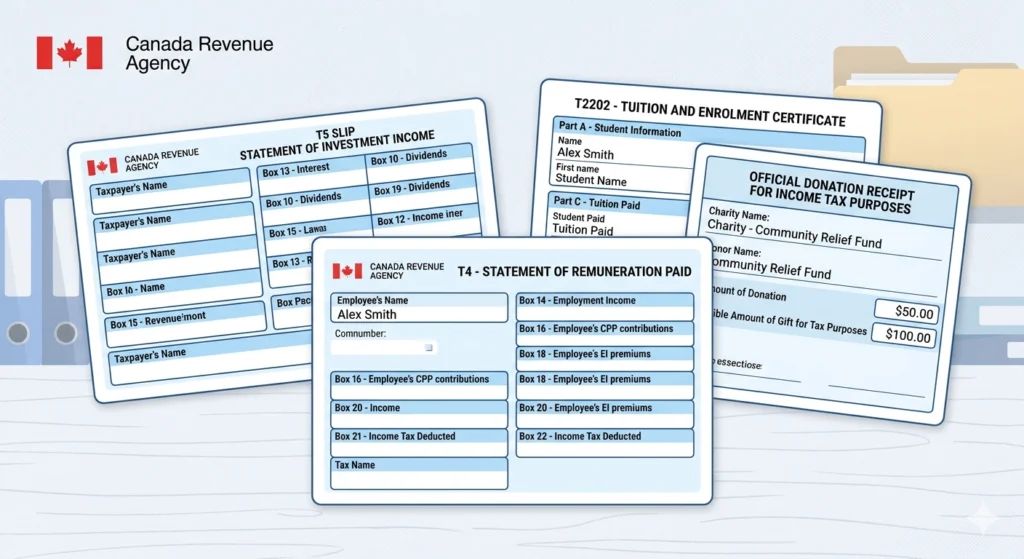
A frequent error is misunderstanding the marginal tax system and believing a higher bracket causes a disproportionate tax hike on total income. Another common oversight is missing the filing deadline, especially for self-employed individuals who may not realize their payment is still due April 30 even though their filing deadline is June 15. Failing to report all income sources, including side gigs or investment income, can lead to reassessments and penalties. Not claiming all eligible deductions and credits, such as the Basic Personal Amount or provincial credits, leaves money unclaimed. Forgetting that Quebec, Alberta, and for corporate taxes Quebec, have separate collection agencies can lead to confusion about where to file. Keeping organized records of income slips, receipts, and prior year notices is essential for accurate filing and addressing any CRA inquiries.
To operate within the system correctly, it is vital to understand the specific rules that apply to your situation. Key considerations that affect your tax obligations include the following points. Your province of residence on December 31 determines your provincial tax rates for the entire year. Taxable income is your total income from line 15000 of your return, minus any deductions. The CRA primarily relies on self-reporting, but it receives information from employers and financial institutions to verify income. International income and treaties may affect your filing if you earn money outside Canada. Major changes to tax laws are typically introduced in the federal government's annual budget. Quebec residents must file a separate provincial return with Revenu Québec in addition to their federal return. Being aware of these factors helps ensure full compliance and optimizes your tax position each year.
Frequently asked questions
How are Canadian income tax brackets and rates applied?
Canada uses a marginal tax system with progressive brackets. Each portion of your taxable income is taxed at the rate for its specific bracket. For the 2026 tax year, federal rates start at 15 percent on income up to $58,523 and rise to 33 percent on income over $246,752. Your entire income is not taxed at a single rate. Only the income within each bracket is taxed at that bracket's rate.
Do I pay provincial income tax as well as federal tax?
Yes. You pay income tax to both the federal government and the government of the province or territory where you live on December 31 of the tax year. Each province sets its own brackets and rates. The CRA collects provincial tax for all provinces and territories except Quebec, which collects its own through Revenu Québec.
What is the deadline to file my income tax return in Canada?
For most employed individuals, the deadline to file your tax return and pay any amount owing is April 30 each year. If April 30 falls on a weekend, the deadline moves to the next business day. Self-employed individuals have until June 15 to file their return, but any taxes owed for the tax year must still be paid by the April 30 deadline. The Canada Revenue Agency administers these tax laws and sets the filing dates. It is important to meet these deadlines to avoid potential penalties and interest charges.
What is the Basic Personal Amount for 2026?
The federal Basic Personal Amount for the 2026 taxation year is $16,452. This is a non-refundable tax credit that applies to all Canadians and reduces the amount of federal tax you owe. The Basic Personal Amount is a key component of the personal income tax system administered by the Canada Revenue Agency. Most provinces and territories also have their own Basic Personal Amount that further reduces your provincial tax payable. This credit is claimed when you file your income tax and benefit return.
What happens if I file my tax return late?
The Canada Revenue Agency charges a late-filing penalty. For the 2025 tax year, the penalty is typically 5 percent of your balance owed, plus an additional 1 percent for each full month your return is late, up to a maximum of 12 months. If you were charged a late-filing penalty in 2022, 2023, or 2024 and were formally demanded to file, your 2025 penalty rises to 10 percent of your balance owing plus 2 percent for each full month you are late, up to 20 months. These penalties are part of the CRA's enforcement of tax law.
Who collects corporate income taxes in Canada?
The Canada Revenue Agency collects federal corporate income taxes. On behalf of all provinces and territories except Alberta and Quebec, the CRA also collects provincial and territorial corporate income taxes. Alberta and Quebec administer their own provincial corporate income tax collection processes. This structure is part of the overview of the Canadian tax system where the federal government generally controls tax collection. The CRA then remits the relevant provincial or territorial revenues to the participating jurisdiction.
Sources and further reading
- Federal Tax Brackets & Rates, TurboTax® Canada turbotax.intuit.ca
- Canadian income tax explained: brackets, rates, and ... wealthsimple.com
- Overview of the Canadian tax system legalline.ca
This article explains how things work and is not financial, tax or legal advice. Rules, limits and rates change, so check the current figures with the Canada Revenue Agency, your province or your financial institution before you act.