Google Finance and other online tools display live mid-market exchange rates, which serve as a key benchmark for currency values. For Canadians, understanding this rate is the first step in converting money, but the actual rate received from banks or transfer services will differ. Financial institutions apply a retail exchange rate, which includes a margin, and may add fees for transactions. Knowing how exchange rates are set and the costs involved helps Canadians make informed decisions when sending money abroad or exchanging cash for travel.
What the Google Exchange Rate Represents
The exchange rate shown on Google Finance and similar currency converters is the mid-market rate, also known as the interbank or wholesale rate. This rate is the midpoint between the global buy and sell prices that large financial institutions use to trade currencies among themselves. It is a pure benchmark that does not include any fees or margins. Services like Wise also use this mid-market rate as their reference point. For individual Canadians, this rate is primarily for information and comparison purposes. You will not receive this exact rate when conducting a transaction with a bank, credit union, or foreign exchange kiosk. The mid-market rate is highly volatile, changing continuously throughout the trading day based on global supply and demand. The rate you see is a snapshot, and the Bank of Canada's published daily average is an indicative rate obtained from averages of aggregated price quotes from financial institutions.
How Official and Retail Exchange Rates Are Set
The Bank of Canada publishes daily average exchange rates for informational use, derived from averages of aggregated price quotes from financial institutions. These rates are indicative only and apply to non-cash transactions up to $9,999. The actual value of the Canadian dollar is determined by the foreign exchange market, with the Bank of Canada noting it very rarely intervenes. When Canadians convert currency through a bank, they are quoted a retail exchange rate. This rate is based on the wholesale mid-market rate but includes a margin or spread that constitutes the bank's revenue from the transaction. Financial institutions set these retail rates and they can only be guaranteed at the moment a purchase or sale is conducted. The rate can vary between providers and even between different types of transactions at the same institution.
There is a significant distinction between rates for cash and non-cash instruments. Non-cash rates are applied to paper instruments like cheques and drafts, as well as to electronic wire payments and other electronic transactions. These instruments do not require physical storage or movement, incurring less time and cost for processing. Therefore, a more favourable rate is applied to non-cash transactions. Exchange rates for cash transactions include shipping, handling, and security charges, making them less favourable. It is often more beneficial to convert Canadian dollars to a destination's local currency before leaving Canada, as banks, foreign exchange kiosks and hotels in other countries charge commission or service charges in addition to exchange rates that are often higher.
The Bank of Canada also publishes monthly average exchange rates, typically on the last business day of the month, and annual averages on the last business day of the year. For broader economic analysis, the Canadian Effective Exchange Rate index replaced the older Canadian-Dollar Effective Exchange Rate index in January 2018. This CEER index is a weighted average of bilateral exchange rates for the Canadian dollar against the currencies of Canada’s major trading partners. The Bank updates its data feeds if and when it intervenes in foreign exchange markets, though such interventions are very rare.
Methods for Canadians to Convert Currency
Canadians have several options for converting currency, each with different processes and cost structures. Major banks like RBC, TD, and Scotiabank offer foreign exchange services both online and in branch. Clients can often place orders for foreign currency cash online or via app for branch pickup within three to seven business days. For immediate needs, some TD Foreign Exchange Centres and bank branches keep popular currencies like US dollars, euros, and pounds sterling on hand. Banks also facilitate wire transfers and allow clients to hold foreign currency deposits. Using a debit or credit card for purchases or ATM withdrawals outside Canada involves a different process where the bank does not set the exchange rate directly. The card network's rate is used, and additional foreign transaction fees are typically applied.
- Online/Bank App: Order currency for branch pickup in 3-7 business days (e.g., TD EasyWeb or app).
- In Branch: Purchase US dollars, euros, or pounds immediately at most TD branches.
- Foreign Exchange Centres: Over 50 currencies and precious metals available on hand at specialized TD centres.
- By Phone: Call a service line (e.g., TD at 1-866-222-3456) to order currency for later branch pickup.
- Wire Transfers: Electronic transfers converted at the bank's retail rate when funds are deposited.
- Debit/Credit Cards: Use abroad with rates set by card networks, plus fees as per cardholder agreements.
- Specialist Transfer Services: Companies like Xe offer international money transfers to 190+ countries in 130+ currencies.
Specialist international money transfer services compete with traditional banks by advertising bank-beating rates and transparent fees. These services allow transfers to over 190 countries in more than 130 currencies and provide real-time tracking and upfront pricing. For services where the bank sets the rate, such as wire transfers or cash purchases, they will quote their applicable exchange rate and the client may choose whether to proceed. When funds in a foreign currency are deposited into a Canadian-dollar account via an incoming wire, the bank converts them at its applicable rate in effect when the deposit is posted. Commercial and corporate customers can access more advanced services like ScotiaFX for live quotes and trade execution.
Detailed Fee Structures and Cost Comparisons
The total cost of converting currency is the combination of the exchange rate margin and any explicit fees. The margin is the difference between the mid-market rate and the retail rate offered to you. This spread is how banks and exchange services make money on the transaction, and it is not usually disclosed as a separate line item. In addition to this built-in margin, providers may charge explicit fees. For cash transactions, fees are embedded in the less favourable rate. For wire transfers, banks may charge a flat fee for sending or receiving funds. It is crucial to review the agreements governing card services for details on these fees.
| Service Type | Typical Cost Components | Additional Notes |
|---|---|---|
| Bank Cash Purchase | Retail exchange rate (includes margin) + possible service charge | Cash rates include shipping/handling. US dollars, euros, pounds often on hand. |
| Bank Wire Transfer | Retail exchange rate + outgoing/incoming wire fees | Rate used is the bank's applicable rate when the transaction posts. |
| Specialist Transfer Service | Advertised margin near mid-market rate + possible transfer fee | Services like Xe show all pricing upfront and track transfers in real time. |
Savings from using one provider over another are highly situational and calculated based on specific examples. A comparison for a single transfer of 20,000 GBP to USD on a given date may show savings, but different amounts, currency types, dates, and times will yield different results. These comparisons may not include all costs and charges and are for guidance only. Canadians should always get a full quote showing the final amount in Canadian dollars, including all margins and fees, before committing to any currency conversion or transfer. The difference between providers can be clear when comparing bank-beating rates and no hidden fees against traditional bank offerings.
Tracking Rates, Volatility, and Historical Data
Canadians who need to convert money can monitor exchange rates to identify favourable moments. Tools like the Bank of Canada's website provide daily, monthly, and annual average rates for historical reference. The daily averages are published each business day by 16:30 Eastern Time. If you select a weekend date, the search will display rates from the preceding Friday. The Canadian Effective Exchange Rate index is a weighted average against major trading partners' currencies, useful for broader economic analysis. For live tracking, Google Finance and currency converter apps show the current mid-market rate. Many services, including Xe, offer rate alert functions where you can set a target rate for a currency pair and receive a notification when the mid-market rate reaches that level.
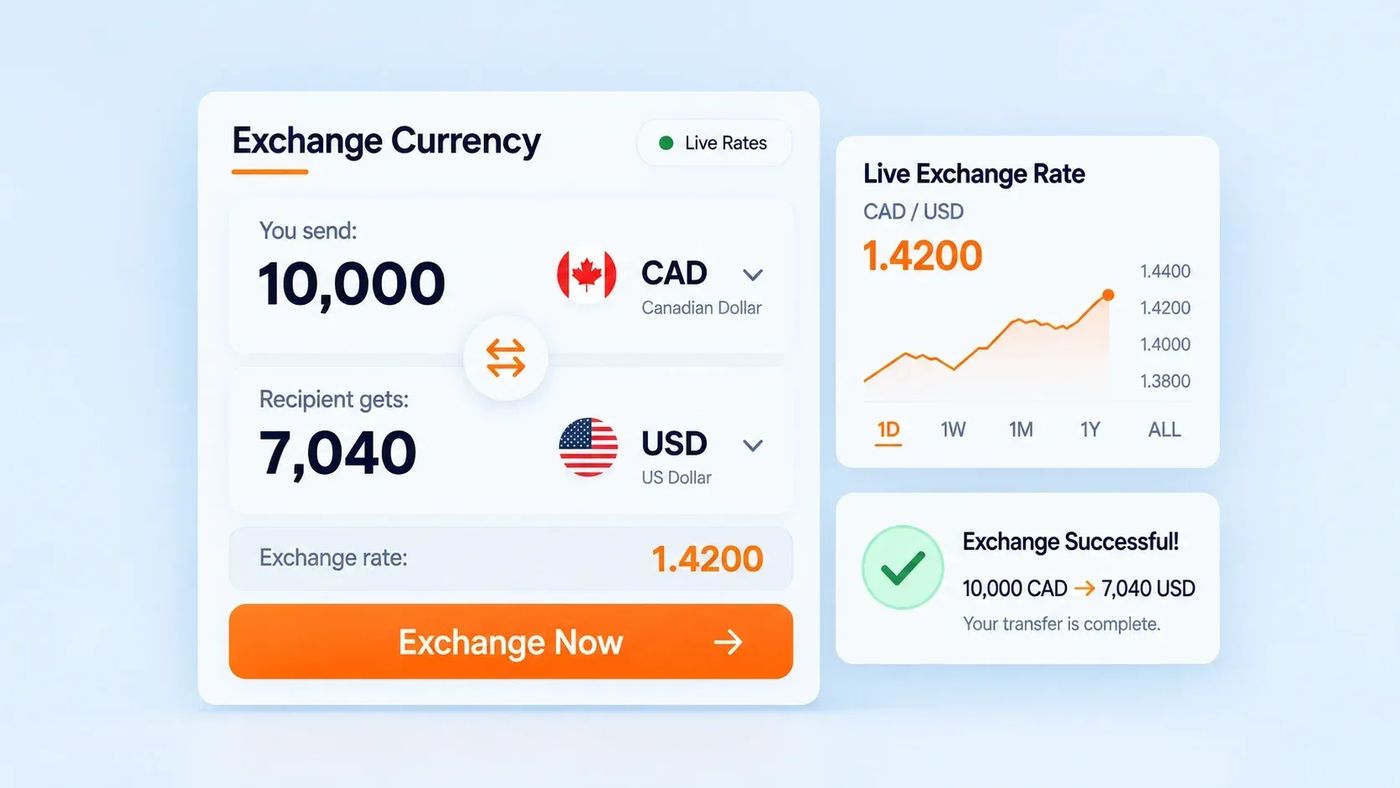
Volatility is a constant factor in foreign exchange markets. Over recent periods, the USD to CAD rate has shown specific ranges and averages. Over the last 7 days, it moved between 1.4106 and 1.4280 with an average of 1.4177. Over the last 30 days, the range was 1.3990 to 1.4280 with the same average but higher volatility. Over 90 days, the range widened to 1.3763 to 1.4280 with an average of 1.4011. This volatility means the retail rate you are quoted can change significantly between the time you check and the time you complete a transaction. Banks only guarantee a rate at the time the purchase or sale is conducted, and up-to-the-minute rates may be obtained by contacting a branch.
Historical data is available but readers should note which series are active. The Bank of Canada's legacy noon and closing rates data was last updated on 28 April 2017 using the old calculation methodology and is not updated. Historical Canadian-Dollar Effective Exchange Rate index data was last updated in January 2018 and was replaced by the CEER index. For planned expenses like property purchases or tuition payments abroad, some banks offer forward contracts or other foreign exchange risk management solutions as part of commercial and corporate services to lock in a rate. You can subscribe to Bank of Canada feeds to get the latest exchange rate data automatically.
Practical Considerations for Canadian Consumers
When planning to convert currency, Canadians should consider the timing, method, and total cost. Since retail rates are only guaranteed at transaction time, it can be difficult to time the market perfectly. Using rate alerts for the mid-market rate can provide a signal, but the final retail cost will still include the provider's margin. For travel, ordering foreign cash online from your bank often provides a better rate than waiting until you arrive at your destination. Banks emphasize that foreign currency cash transactions are available to clients only, such as RBC clients, and may require you to be a customer to complete a transaction. You can also scan a QR code with a smartphone to place an order for foreign currency cash with some providers.
For non-cash transactions like wire transfers, the process is clearly defined. When you send money abroad, the bank will quote its exchange rate. When you receive foreign funds into a Canadian-dollar account, the bank automatically converts them at its rate when the deposit posts. It is important to understand that media-reported exchange rates are the wholesale rates used by banks to trade amongst themselves, not the retail rates for client transactions. Client transactions are for much smaller amounts and require additional processing, hence the different pricing. Rates and dollar limits are provided for information purposes only and are subject to change at any time.
Finally, while comparing providers is wise, the best option depends on the specific transaction. A specialist transfer service may offer better rates for large international transfers, while your bank's online order system may be most convenient for travel cash. Always verify the full cost, check for any minimum or maximum limits (like the common $9,999 reference for non-cash rates), and understand the delivery method and timing, whether it's a wire transfer arriving in days or cash ready for branch pickup. TD Bank Group, for example, notes that third-party sites hyperlinked from their pages have different privacy policies and they are not responsible for their content.
Frequently asked questions
Is the Google exchange rate the rate I will get from my bank?
No, you will not receive the Google mid-market rate from your bank. The rate shown on Google Finance is the wholesale benchmark. Banks apply a retail exchange rate, which includes a margin on top of the mid-market rate. This retail rate is how banks make money on currency conversion, and it will always be less favourable than the pure mid-market rate you see online. The rate quoted in the media is the wholesale rate, while client transactions use a retail rate.
What is the difference between a cash and a non-cash exchange rate?
Non-cash rates are used for electronic wire payments, cheques, and drafts. They are more favourable because these instruments do not require physical handling, storage, or movement, incurring less time and cost. Cash rates, used when you buy or sell paper currency, are less favourable. The difference covers costs like shipping, security, storage, and processing associated with physical cash. Banks clearly distinguish between these two rate types for transactions.
Can I lock in an exchange rate for a future transaction?
For large or commercial transactions, some banks offer foreign exchange risk management solutions like forward contracts. These allow you to lock in a specific exchange rate for a future date, protecting you from market volatility. For standard retail transactions like buying travel cash or sending a wire transfer, the rate is only guaranteed at the exact moment the transaction is executed and cannot be locked in beforehand through regular channels. Specialist transfer services may also offer rate holding features.
Why does the Bank of Canada publish exchange rates if they don't set them?
The Bank of Canada publishes indicative average rates for information and reference purposes. These rates are calculated from aggregated quotes from financial institutions and are published daily by 16:30 ET. They serve as a reliable benchmark for businesses, accountants, and individuals tracking currency values over time. The bank also publishes monthly and annual averages. The bank explicitly states these rates are for information only and the foreign exchange market determines the Canadian dollar's value, with the Bank very rarely intervening.
Are there limits on how much currency I can convert?
Banks often cite that their published rates apply to non-cash transactions up to $9,999. For larger amounts, you may need to contact the bank directly for a quote. There may also be daily limits on ATM withdrawals or card purchases abroad, which are governed by your account or cardholder agreements. When ordering foreign cash, banks may have minimum order amounts or limits based on branch inventory. Foreign exchange cash transactions are typically available only to existing clients of the bank.
Is it better to exchange money in Canada or abroad?
It is generally more beneficial to convert your Canadian dollars to the local currency before leaving Canada. Many banks, foreign exchange kiosks and hotels in other countries charge additional commissions or service fees on top of exchange rates that are often higher than those available domestically. Exchange rates applied to cash transactions in Canada include shipping and handling charges, making the cash rate less favourable than the non cash rate for instruments like cheques or wire transfers. Retail exchange rates used for client transactions differ from wholesale market rates quoted in the media due to additional processing for smaller amounts. Therefore, planning your currency exchange in advance within Canada can result in better value compared to converting funds after arrival at your destination.
Sources and further reading
- Exchange rates bankofcanada.ca
- Foreign Currency Exchange Rates scotiabank.com
- Foreign Exchange Currency Converter, RBC Royal Bank apps.royalbank.com
- 1 USD to CAD, Convert US Dollars to Canadian Dollars xe.com
- Currency Converter & Live Exchange Rates td.com
This article explains how things work and is not financial, tax or legal advice. Rules, limits and rates change, so check the current figures with the Canada Revenue Agency, your province or your financial institution before you act.