The euro to Hong Kong dollar exchange rate is a key financial metric for Canadians engaged in business, travel, or sending money to Hong Kong. The rate determines how many Hong Kong dollars one euro will buy and fluctuates based on global market forces. Understanding this rate, its history, and the costs of conversion helps Canadians make informed financial decisions when dealing with these two major currencies. This article explains the fundamentals of the EUR/HKD pair and the practical aspects of currency conversion from a Canadian perspective.
Understanding the Euro and Hong Kong Dollar
The euro is the official currency of the Eurozone, a monetary union of twenty European Union member states. It is one of the world's most traded currencies and serves as a major global reserve currency, often used as a benchmark for international payments. The Hong Kong dollar is the official currency of the Hong Kong Special Administrative Region and its issuance is managed by the Hong Kong Monetary Authority. It operates under a linked exchange rate system pegged to the US dollar within a specific band, which provides stability but also means its value against the euro is influenced by EUR/USD movements. For Canadians, interactions with these currencies often occur through international trade, investment, travel, or personal remittances. The most direct conversion for a Canadian would be from Canadian dollars to euros and then to Hong Kong dollars, though many services allow direct EUR to HKD transactions. The euro is considered the world's most traded currency, while the Hong Kong dollar remains a leading currency in global markets with regular demand for conversions.
How the EUR to HKD Exchange Rate is Determined
The most commonly referenced rate is the mid-market rate, which is the midpoint between the global buy and sell prices. This rate is a pure benchmark and reflects the relative value of the two currencies based on supply and demand. Financial institutions and money transfer services do not typically offer the mid-market rate to retail customers. Instead, they apply a margin or spread above or below this rate, which forms part of their revenue. The rate quoted to Canadians will therefore be the mid-market rate plus or minus this service margin, and it is crucial to understand this difference when comparing offers. Several key factors influence the movement of the EUR/HKD exchange rate. Changes in interest rate differentials between the European Central Bank and the Hong Kong Monetary Authority can drive capital flows and affect currency values. Economic data releases from the Eurozone and Hong Kong, such as GDP growth, employment figures, and inflation reports, also cause fluctuations. Furthermore, broader global market sentiment, risk appetite, and geopolitical events impact both currencies. It is important to note that the Hong Kong dollar's peg to the US dollar adds another layer, as movements in the EUR/USD pair will indirectly affect the EUR/HKD rate. The performance of the rate over specific periods, such as 30 or 90 days, is measured by its high, low, average, and percentage change, quantifying recent volatility for analysis.
Historical Performance and Volatility Analysis
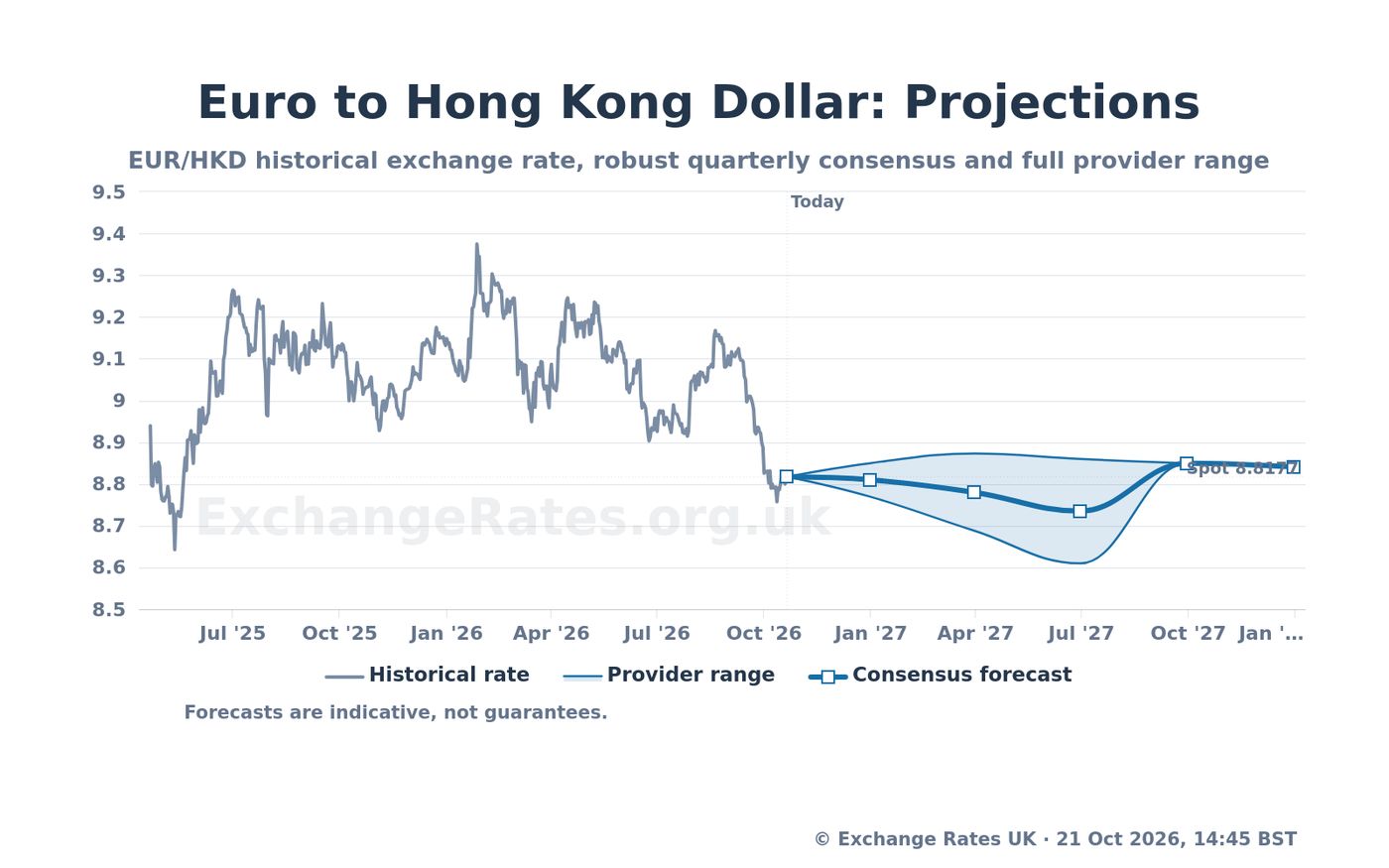
The EUR/HKD exchange rate has experienced significant volatility over the years, influenced by European debt crises, changes in monetary policy, and global economic shifts. Historical data provides insight into the long-term relationship between these two currencies and helps identify patterns, though it is not a predictor of future performance. For instance, analysis of related currency pairs shows that volatility over a 90-day period can see a high and low with a calculated average and a net change, which helps quantify market movements. Reviewing past performance helps in understanding potential patterns and spotting favourable moments to convert currency. The rate has seen both prolonged periods of relative stability and sharp movements driven by specific economic events. For Canadians looking to convert funds, historical context can inform decisions but should be combined with current market analysis and tools like rate alerts. The European Central Bank publishes a daily euro reference exchange rate for the Hong Kong dollar, which serves as an official benchmark. Long-term charts can display data for over 20 years, broken down by daily, monthly, and yearly periods, offering a comprehensive view of the pair's historical trajectory.
How Canadians Convert Currency: Banks, Cards, and Transfer Services
Canadians have several options for converting euros to Hong Kong dollars, each with different cost structures and features. Traditional banks offer currency exchange services both for cash and for international wire transfers. Banks typically apply a significant markup to the mid-market exchange rate, which can be several percentage points, and often charge additional fixed wire transfer fees. Using a credit or debit card for purchases or ATM withdrawals in Hong Kong is another common method. Credit card use for a money transfer may also trigger cash advance fees and interest charges from the card issuer. Specialized money transfer services and online foreign exchange platforms generally provide more competitive rates for larger transfers. Companies like Western Union, Wise, MTFX, and Venn operate in this space. These services typically show the exchange rate and any transfer fees upfront before a transaction is confirmed. They make money from a margin on the exchange rate and sometimes a separate transfer fee. The total cost is the combination of these two elements. It is crucial for Canadians to compare the total amount of Hong Kong dollars that will be received after all costs, not just the advertised exchange rate. Some online platforms promote using the real mid-market rate with no hidden mark-up, while others are transparent about making money from currency exchange.
- Banks: Apply a markup on the exchange rate and charge wire transfer fees. Convenient for existing customers.
- Credit/Debit Cards: Use network rates with a margin and add foreign transaction fees. Simple for travel spending.
- Online Transfer Services (e.g., Wise, MTFX): Often offer rates closer to the mid-market rate with low, transparent fees.
- In-Person Services (e.g., Western Union): Provide cash pickup options at agent locations with associated exchange rate margins and fees.
- Multi-Currency Accounts (e.g., Venn, Vault): Allow holding euros and Hong Kong dollars, converting when rates are favourable.
When choosing a service, Canadians should look for full transparency where the exchange rate applied and any transfer fee are shown separately. Some platforms allow users to set rate alerts to be notified when the EUR/HKD rate reaches a desired level. For business transfers, some services offer integration with accounting systems and support for same-day transfers to over 190 countries. The best option depends on the transfer amount, desired speed, payment method, and the total cost quoted. Providers often support various payment methods including bank account, debit card, or cash in-store.
Detailed Fee Structures and Cost Comparisons
The total cost of converting euros to Hong Kong dollars is rarely just the exchange rate. Providers build in charges through exchange rate margins, fixed fees, or a combination of both. An exchange rate margin is the difference between the mid-market rate and the rate actually offered to the customer. A fixed fee is a separate charge for processing the transaction. Some providers advertise low or zero fees but compensate with a less favourable exchange rate. Canadians must review the entire pricing structure to understand the true cost, which is the combination of the exchange rate margin and any separate fees. For example, a bank might quote an exchange rate that is 3% worse than the mid-market rate and also charge a $30 wire fee. For a large transfer, the online service would likely be cheaper despite its flat fee. Payment method can also affect costs. Using a credit card for a money transfer may incur cash advance fees and interest from the card issuer, in addition to the transfer service's charges. Debit cards or bank account payments usually avoid these extra costs. Western Union fees can vary depending on the amount sent, payment method, destination, and payout option, and they show an estimated rate and fee before confirmation.
| Provider Type | Typical Cost Components | Key Features and Considerations |
|---|---|---|
| Major Canadian Banks | Large exchange rate margin, wire transfer fee | Costs are often high but convenient for existing customers. Used for wire transfers. |
| Credit/Debit Card Networks | Network exchange rate margin, foreign transaction fee (2-3%) | Simple for travel spending and ATM withdrawals. Expensive for large amounts. |
| Online FX Platforms (e.g., Wise, MTFX) | Small exchange rate margin, low transparent fee | Often the most cost-effective for transfers. Offer rate alerts and upfront pricing. |
| Money Transfer Operators (e.g., Western Union) | Exchange rate margin, variable transfer fee | Useful for cash pickup services. Fees vary by destination, amount, and payout method. |
| Multi-Currency Account Providers | Competitive FX rates, possible account fees | Allow holding and converting currencies. Can integrate with business accounting systems. |
Savings from using a non-bank provider are calculated by comparing the exchange rate including margins and fees provided by each service on the same day. These savings are based on specific examples and may not include all costs, and different transfer amounts, currency types, dates, and times will result in different comparison savings. Therefore, the results are indicative for guidance only and highlight the importance of getting a real-time quote for your specific transaction. Always verify current rates directly with the provider as they are subject to change without notice.
Security, Regulations, and Consumer Protection
When converting and transferring currency, security and regulatory compliance are paramount. Reputable money transfer providers use encryption and fraud prevention measures to help protect international money transfers. Canadians should only send money to people they know and trust, check receiver details carefully, and keep transaction tracking numbers private. Providers operating in Canada must be registered as a money service business with the Financial Transactions and Reports Analysis Centre of Canada (FINTRAC), which monitors financial transactions for money laundering and terrorist activity financing. For instance, some platforms are registered under a specific FINTRAC number. Funds held in certain multi-currency accounts may be eligible for deposit insurance. For example, account balances held at a partner Canadian chartered bank are eligible for Canada Deposit Insurance Corporation (CDIC) deposit insurance up to applicable limits. This provides an additional layer of security for business or personal funds held within the platform. It is important to understand that the technology company providing the transfer service is often not a bank itself but partners with licensed financial institutions. Consumers should be aware of scam warning signs and never share personal financial information in response to unsolicited requests. Tracking your transfer using a provided MTCN (Money Transfer Control Number) after it has been sent is a standard security practice offered by many services.
Practical Steps for Converting EUR to HKD
To convert euros to Hong Kong dollars, a Canadian should first check the current mid-market rate as a benchmark using a reliable financial data source or currency converter. The next step is to get quotes from several different providers, including banks, online transfer services, and card networks if applicable. Each quote should clearly state the exchange rate being offered and any applicable fees, allowing for a calculation of the total Hong Kong dollars that will be received. It is important to confirm the transfer timeline and the delivery method, such as bank deposit or cash pickup. Many services provide a currency calculator where you enter the amount in euros and see the estimated HKD amount based on a live rate. Before confirming any transaction, review all details carefully. Ensure the recipient's information for a bank transfer is completely accurate, as errors can cause delays and extra charges. Understand the provider's policy on rate guarantees. Some services allow you to lock in a rate when you initiate the transfer, while others use the rate at the time the transfer is processed. For recurring transfers, some platforms offer hedging tools or scheduled transfers. Always keep a record of the transaction confirmation, including the expected delivery date and any tracking number provided. Setting a rate alert can help you monitor the market and execute a transfer when the rate is favourable, though there is no single 'best' day to exchange as rates move continuously with market conditions.
- Check the live mid-market EUR/HKD rate as a reference point.
- Use online calculators from multiple providers to get real-time quotes showing the rate and fees.
- Compare the total HKD amount you will receive after all costs from each provider.
- Select your preferred provider and payment method (bank account, debit card, etc.).
- Enter accurate recipient details and review the final exchange rate, fee, and delivery estimate.
- Confirm the transfer, save the confirmation and tracking details, and monitor its progress.
For businesses, platforms may offer additional features like opening free local accounts in EUR and other currencies. These accounts can be used to send and receive payments via methods like EFT, ACH, SEPA, or Interac. This functionality can streamline processes such as international payroll and supplier payments. The key is to have all costs shown upfront with no sneaky mark-ups. This transparency ensures you can make an informed decision for every currency conversion.
Frequently asked questions
What is the mid-market exchange rate?
The mid-market rate is the benchmark exchange rate calculated as the midpoint between the global buy and sell prices for a currency pair. It is the rate you see on financial data platforms and currency converters and is published daily by institutions like the European Central Bank as a reference. Money transfer services and banks do not typically offer this exact rate to customers. They add a margin to it. The mid-market rate serves as a fair reference point for comparing the rates actually offered by different currency conversion providers.
How can I get the best EUR to HKD exchange rate?
To secure a favourable rate, compare offers from multiple providers, including online foreign exchange specialists, banks, and transfer services. Online platforms often have lower margins than traditional banks. Check the total cost by calculating how many Hong Kong dollars you will receive after all fees, not just the advertised rate. Consider setting a rate alert with a service to be notified when the market rate reaches your target level, allowing you to time your conversion. Always verify current rates directly with the provider before transacting.
Are there hidden fees when converting currency?
Fees can be hidden within a poor exchange rate margin. A provider may advertise 'no fees' but offer an exchange rate significantly worse than the mid-market rate. Always look for services that show the exchange rate they are applying and any separate transfer fee upfront before you commit. Transparent providers will display both figures clearly, allowing you to see the total cost of the transaction and compare it effectively with other options. Watch out for platforms that hide fees in the exchange rate.
Is it better to use a bank or a specialist transfer service?
For large international transfers, specialist online transfer services typically offer better exchange rates and lower overall costs compared to traditional banks. Banks are convenient and may be suitable for small amounts or customers who prioritize existing relationships, but they generally apply higher margins and fees. Comparison savings based on specific transfer examples show that non-bank providers can offer significant value. The best choice depends on the amount, urgency, and your preference for features like rate alerts or multi-currency accounts offered by specialists.
Can I lock in an exchange rate in advance?
Many money transfer services and some banks offer a 'rate lock' or 'forward contract' feature. This allows you to secure a specific exchange rate for a future transfer, typically for a period ranging from a few days to several months. This can be useful for budgeting and protecting against adverse market movements between the time you get a quote and when your transfer is completed. There may be specific terms or minimum amounts required for this service. Not all providers offer this, so it's important to check.
What should I know before sending money to Hong Kong?
Before sending money, verify the recipient's full name and accurate bank account details if it's a bank transfer. Understand the total cost, including the exchange rate margin and any fees, and know the expected delivery time. Use only trusted money transfer providers and be wary of unsolicited requests for transfers. Keep your transaction receipt and any tracking number, such as an MTCN, to monitor the transfer's progress and resolve any issues. Ensure the provider uses security measures like encryption and is registered with FINTRAC in Canada.
Sources and further reading
- 1 CAD to HKD, Convert Canadian Dollars to Hong Kong ... xe.com
- Hong Kong dollars to Canadian dollars Exchange Rate. ... wise.com
- CAD to HKD | Convert Canadian Dollar to Hong Kong Dollar westernunion.com
- EUR to HKD Live Currency Converter mtfxgroup.com
- Convert Euro to Hong Kong Dollar Today venn.ca
This article explains how things work and is not financial, tax or legal advice. Rules, limits and rates change, so check the current figures with the Canada Revenue Agency, your province or your financial institution before you act.