A GIC calculator is an online tool that helps you estimate the future value of a Guaranteed Investment Certificate based on your initial deposit, the interest rate, and the term length. It allows you to compare different GIC types, such as those paying interest at maturity versus those providing regular income, to see how your money can grow. For Canadians, using a GIC calculator is a practical step in financial planning, as it provides clarity on the safe, predictable returns offered by these CDIC-insured products. It helps you make informed decisions about locking in your savings for a set period to meet specific goals.
What a GIC Calculator Does
A GIC calculator projects the growth of your deposit in a Guaranteed Investment Certificate. You input your initial investment amount, the annual interest rate, and the term length. The calculator then computes your total estimated value at maturity, showing the split between your original principal and the interest earned. This projection helps you visualize the outcome of a safe investment before you commit your funds. Financial institutions like CIBC and Scotiabank offer these calculators on their websites to help clients compare their GIC products.
The core function is to apply either simple or compound interest mathematics based on your chosen interest payment option. If you select regular interest payouts, the calculator uses simple interest, meaning your principal remains constant and you receive periodic payments. If you choose to have all interest paid at maturity, the calculator uses compound interest, where interest earns interest, leading to a larger final sum. The calculator automates the formulas, saving you from manual calculations and potential errors.
Advanced calculators, like the Income Builder GIC Calculator, allow for more specific planning. You can input a desired regular payment amount and a target amount to remain at the end of the term. The tool then works backward to determine the required initial investment or the effective interest rate needed to meet that income goal. This is particularly useful for retirees or anyone using a GIC to create a predictable income stream from their savings.
Ultimately, a GIC calculator is a decision-support tool. It enables you to test different scenarios, such as comparing a one-year GIC rate against a five-year rate, or seeing the difference between monthly and annual payouts. By adjusting the inputs, you can align the GIC's performance with your personal financial timeline and cash flow requirements. The results are directional and for informational purposes, with final figures confirmed at the point of purchase.

Key Inputs and How They Affect Your Result
Every GIC calculator requires a few essential pieces of information to generate a projection. The initial investment amount is the principal sum you deposit. Financial institutions typically have minimums, often $500 or $1,000, and maximums, which can be as high as $5 million per customer. A larger initial investment directly leads to greater absolute interest earnings, assuming all other factors are equal. Some rates are tiered, meaning a deposit of $25,000 or more might qualify for a higher interest rate.
The annual interest rate is the percentage return offered by the financial institution for the GIC term. This rate is usually fixed for the entire term and is based on market conditions and the Bank of Canada's policy. Entering a higher rate will obviously produce a larger final value. It is crucial to enter the rate as a decimal in manual calculations. For example, a 4% rate should be entered as 0.04 in the compound interest formula A = P(1 + r/n)^nt.
The term length is the duration you agree to lock in your money, measured in years. Common terms are 1, 2, 3, 4, and 5 years, with some institutions offering short-term options like 3 or 6 months. Generally, longer terms offer higher interest rates but reduce your liquidity. Extending the term in a calculator, especially with compound interest, significantly increases the ending balance due to the effect of time on compounding growth.
The interest payment frequency is a critical choice that changes the calculation method. If you choose payments at maturity, interest compounds. The compounding frequency, often annually, is factored into the formula. If you choose regular payouts, such as monthly or annually, simple interest is used. For monthly income, the annual interest is divided by 12, though banks may use a day-count fraction, causing slight monthly fluctuations. Your selection here determines whether you receive cash flow during the term or a lump sum at the end.
- Initial Investment: The principal amount deposited. Higher amounts yield more interest.
- Annual Interest Rate: The fixed percentage return. A higher rate increases final value.
- Term Length: The investment duration in years. Longer terms usually mean higher rates and more compounding.
- Payment Frequency: Choice of at maturity (compound interest) or regular payouts (simple interest).
- Compounding Frequency: For at-maturity GICs, how often interest is added to the principal (e.g., annually).
- Target Income (Advanced Calculators): Desired regular payment amount, which influences the required deposit.
- Remaining Principal (Advanced Calculators): The amount you wish to have left at term end, up to 90% of the initial investment.
For income-focused calculators, additional inputs come into play. You specify a payment amount you desire to receive regularly. You also define a residual amount, which is the portion of your initial investment you want to remain at the end of the term, up to a maximum of 90%. These inputs let the calculator determine the depletion rate, which is the percentage of the investment paid out over the term. Changing any of these variables will recalculate the required initial investment or the effective interest rate.
Types of GICs and Their Calculation Differences
GICs in Canada are categorized by their liquidity, interest calculation, term, currency, and tax treatment. The most fundamental distinction is based on how easily you can access your money before maturity. Non-redeemable GICs do not allow early withdrawal without a significant penalty, and calculators for these assume you will hold for the full term. Cashable or redeemable GICs offer some liquidity, but their calculators may incorporate lower interest rates or specific conditions for early redemption, which are typically not displayed in a standard future value calculation.
The method of interest calculation defines the two main categories for calculator purposes. Simple interest GICs provide periodic payouts. The math is straightforward: annual interest equals the principal multiplied by the annual rate. For a $10,000 GIC at 4% with annual payouts, you receive $400 each year. For monthly income, that $400 is divided by 12, resulting in approximately $33.33 per month. Your principal remains $10,000 throughout the term.
Compound interest GICs pay all accumulated interest at maturity. Interest is earned on the initial principal and on the interest from previous periods. The standard formula is A = P(1 + r/n)^(nt), where 'n' is the compounding frequency per year. For annual compounding, n=1. This compounding effect causes your money to grow faster over time compared to simple interest, especially with longer terms. A calculator using this formula will show a higher final value than a simple interest calculation for the same rate and term.
Other specialized GICs include equity-linked or market-linked GICs. Their returns are based on the performance of a stock index, like the S&P/TSX 60, with a guaranteed minimum return. Calculators for these, like the RBC Equity-Linked GICs Return Calculator, provide approximate current values based on index performance and are distinct from fixed-rate GIC calculators. Foreign currency GICs earn interest in a foreign currency, and calculators must account for exchange rate fluctuations, which adds complexity beyond a standard tool's scope.
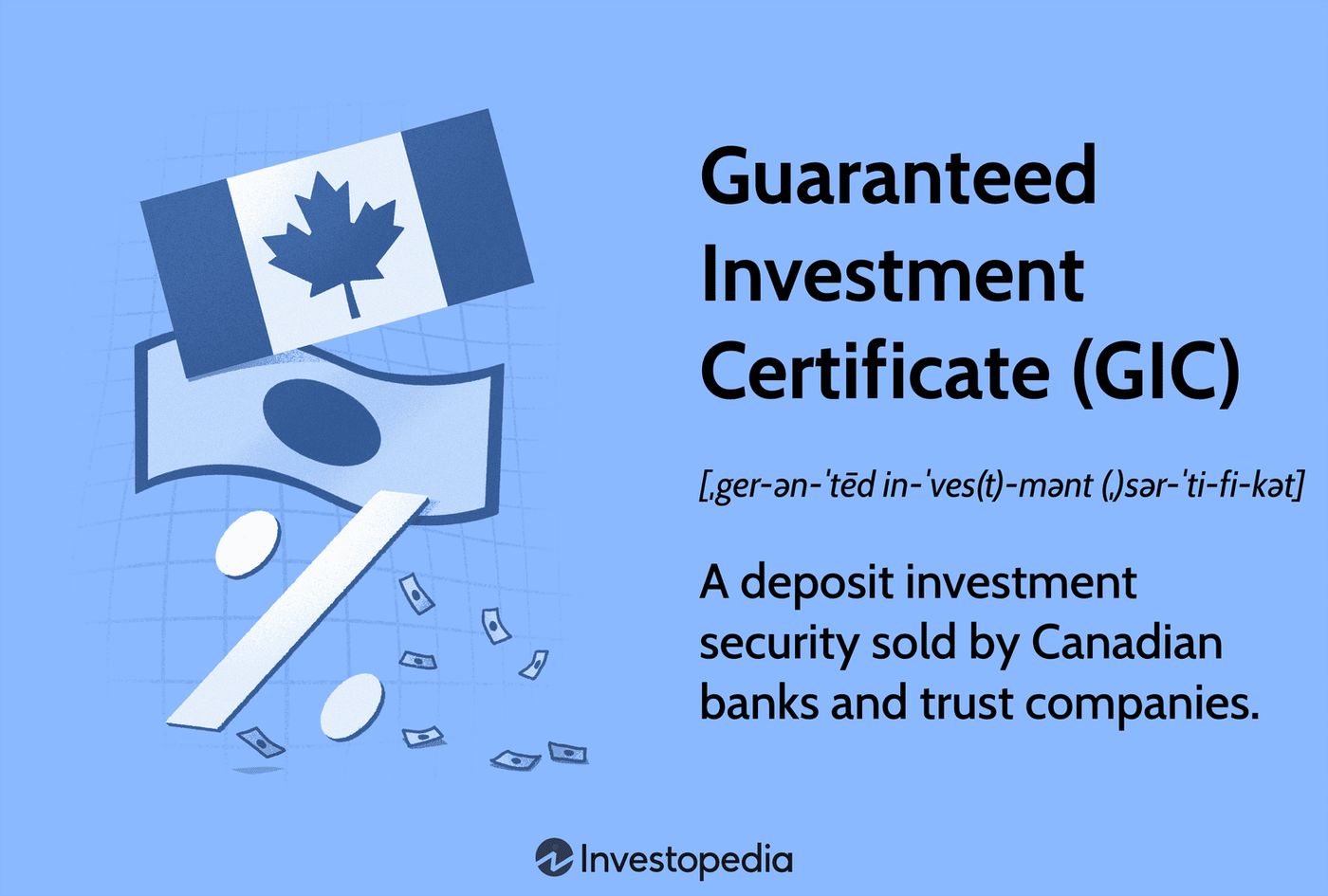
Canadian Rules, Rates, and Protections
GICs issued by Canadian banks, trust companies, and credit unions are protected by deposit insurance. This means your GIC principal and interest are safe up to that limit if the issuer fails. This protection is a foundational reason for the popularity of GICs as a low-risk savings vehicle in Canada, and it is a key point highlighted by financial institutions in their terms. Interest rates for GICs are set by each financial institution and are influenced by the broader interest rate environment, including the Bank of Canada's policy rate. Rates are typically tiered based on the investment amount and the term. For example, a deposit of $25,000 or more might earn a higher rate than a smaller deposit. As confirmed by WOWA.ca in 2026, the highest non-promotional HISA rate was 3.00% for balances meeting that tier. GIC rates are generally higher than savings account rates, compensating for the loss of liquidity.
GICs can be held in various registered plans, which affects their tax treatment but not the fundamental calculation of interest. Purchasing a GIC within a Registered Retirement Savings Plan (RRSP) allows tax-deferred growth. A Tax-Free Savings Account (TFSA) GIC shelters all interest earned from taxes. A Registered Retirement Income Fund (RRIF) can hold GICs to provide retirement income. The calculator does not compute taxes, but it projects the gross growth within these shelters.
Specific rules govern the operational details of GICs. Interest is accrued daily from the issue date. If a maturity date falls on a Sunday, the term extends to the following Monday, with interest paid for the extra day. For GICs paying interest during the term, the final payment is made at maturity. These rules ensure precise interest calculation, which is built into the financial institutions' back-end systems, though basic online calculators may use simplified assumptions.
Worked Example Using Standard Figures
Consider a straightforward example of a non-redeemable GIC held within a non-registered account. You invest a $10,000 initial deposit into a 3-year GIC with a fixed annual interest rate of 4%. The first decision is how you want to receive interest. If you choose annual payouts, the bank uses simple interest. Each year, you will receive an interest payment of $400, calculated as $10,000 multiplied by 0.04. At maturity, your account will still hold the original $10,000 principal.
If you instead opt for monthly payouts from the same GIC, the calculation adjusts slightly. Your annual interest remains $400. The bank would then divide this by 12 to determine your monthly payment, resulting in approximately $33.33 per month. Note that the bank may use a precise day-count method, so actual monthly deposits could vary by a few cents depending on the number of days in the month.
Now, consider the compound interest scenario where you select "interest paid at maturity. Assuming annual compounding, you would use the formula A = P(1 + r)^t. Here, P is $10,000, r is 0.04, and t is 3 years. The calculation is A = 10000 * (1 + 0.04)^3. Comparing the two methods shows the power of compounding. This difference becomes much more pronounced with larger principal amounts, higher interest rates, and longer terms. This example illustrates why a GIC calculator is valuable: it instantly performs these comparisons, helping you choose the option that best suits your financial needs.

Using Advanced Income Builder Calculators
Income Builder GIC calculators, like the one offered by RBC, are designed for investors seeking to create a regular income stream. Instead of starting with an initial deposit and seeing the resulting payments, you often start with your income goal. You enter the payment amount you desire to receive regularly. You then specify how often you want those payments: monthly, semi-annually, or annually. This reverses the standard calculation to determine the necessary investment parameters.
A key input in these calculators is the amount of your initial investment you wish to have remaining at the end of the term, known as the residual or remaining principal. You can specify that you want to keep a portion, up to 90% of your initial investment. For example, if you invest $50,000 and want $10,000 remaining at term end, you enter 10000. This means 80% of your initial investment will be paid out to you over the term. If you enter 0, you plan to use all of your initial investment as payments, which results in a higher payment amount but no principal returned at maturity.
The calculator uses these inputs to determine a depletion rate, which is the percentage of the investment paid out over the term. If you invest $50,000 and receive $25,000 in total payments, the depletion rate is 50%. In practice, when purchasing with an advisor, this rate is rounded to the nearest whole number. The tool then calculates the required interest rate or confirms the projected rate based on the current offerings for your chosen term and payment frequency. The results from an Income Builder calculator are directional and help you explore scenarios and understand the relationship between payment size, term length, and remaining principal.
Income Builder GIC calculators use verified inputs such as initial investment and payment amount. These tools help you discover investment options that can meet your goals. They are designed for planning specific income needs, making them useful for retirement planning. The focus is on cash flow planning rather than just projecting a final value. This makes them a step beyond basic GIC calculators.
Comparison of Common GIC Terms and Features
Available GIC terms and features vary by financial institution in Canada. Most financial institutions offer GICs with specific terms like 1-year, 2-year, 3-year, 4-year, and 5-year GICs. There are also short-term GICs, such as 3-month GICs and 6-month GICs. Common patterns exist across the Canadian market for these offerings. Most major banks offer a standard set of term lengths with specific features.
| GIC Type / Term | Common Minimum Investment | Typical Interest Payment Options | Notes |
|---|---|---|---|
| 1-Year GIC | $500 | Annual, Semi-annual, Monthly (min $5,000 non-registered), At Maturity | Most common term. Competitive rates. |
| 2 to 5-Year GIC | $500 | Annual, Semi-annual, Monthly (min $5,000 non-registered), At Maturity | Longer terms generally have higher rates. Non-redeemable standard. |
| Market-Linked GIC (e.g., 3-year) | $500 | Interest paid at maturity | Return linked to an index (e.g., S&P/TSX 60) with a guaranteed minimum. |
| Income Builder GIC | Varies | Monthly, Semi-annual, Annual payouts | Allows specification of payment amount and remaining principal. |
Short-term GICs have maturity dates typically one year or less. They provide flexibility but usually offer lower interest rates than long-term GICs. These GICs may be cashable, but this often comes with a rate reduction or a specific holding period. They are suitable for savings you might need in the near future. A GIC calculator for a short-term GIC will show modest growth due to the short duration and lower rate.
Long-term GICs, with terms greater than one year up to five years, are the mainstay for investors seeking higher, guaranteed returns. They are generally non-redeemable, meaning you cannot access the funds before maturity without a significant penalty. The calculators for these products demonstrate the benefit of locking in a rate, especially in a rising interest rate environment. The power of compound interest is most evident with these longer terms when the interest is paid at maturity.
Specialty GICs, like equity-linked or foreign currency GICs, have unique calculation methods. Equity-linked GICs provide a return based on the performance of a stock index, capped at a maximum, and guarantee the return of your principal. Their calculators are often separate tools that estimate returns based on hypothetical index growth. Foreign currency GICs involve exchange rate risk, and their value in Canadian dollars can fluctuate, which is a factor not captured by a standard fixed-rate GIC calculator.
Tips for Maximizing GIC Returns
To get the most from your GIC investment, strategic use of a calculator and understanding of product features are essential. Starting early and choosing a longer term when possible is a fundamental strategy. A GIC will often provide higher returns the longer it is invested, as longer terms typically come with higher advertised interest rates. Furthermore, if you opt for compound interest paid at maturity, the extended time allows the compounding effect to work more powerfully, significantly increasing your final payout compared to a series of shorter-term GICs.
Selecting the appropriate interest payment option is crucial. If you do not need regular cash flow, choosing to have interest paid at maturity to benefit from compounding will yield a higher total return. If you require income, monthly or annual payouts provide predictability. Be aware that for monthly payouts, some banks require a higher minimum investment, such as $5,000 for non-registered accounts, to set up the payment stream. Use the calculator to compare the total interest earned under each payment scenario for your specific situation.
Consider using registered accounts for tax efficiency. Holding a GIC within a TFSA means all interest earned is tax-free, which effectively increases your net return compared to a non-registered GIC where interest income is taxable. Within an RRSP, growth is tax-deferred, allowing your investment to compound without annual tax drag. A calculator shows gross returns, so for accurate after-tax comparisons, you may need to factor in your marginal tax rate for non-registered holdings.
Finally, shop around and compare rates from different institutions. Online banks and trust companies sometimes offer higher rates than the big five banks. Use a GIC calculator to input the different rates you find for the same term and principal. Always confirm that the institution is CDIC or provincial credit union insured to ensure the safety of your deposit.
Frequently asked questions
What is the difference between simple and compound interest in a GIC?
Simple interest is paid out periodically on the original principal only. If you choose annual payouts on a $10,000 GIC at 4%, you get $400 each year. Compound interest is paid at maturity, where interest earns interest. The calculator applies the correct formula based on your selection of payout frequency.
Can I withdraw money from a GIC before it matures?
It depends on the GIC type. Non-redeemable GICs generally do not allow early withdrawal without a significant penalty, if at all. Cashable or redeemable GICs permit early access, often after a minimum holding period like 30 or 90 days, but usually at a reduced interest rate. Equity-linked GICs are typically non-redeemable. The calculator assumes you hold the GIC to maturity, so early withdrawal scenarios are not modeled.
Are GIC interest rates guaranteed?
Yes, for standard fixed-rate GICs, the interest rate is locked in for the entire term once you purchase the certificate. The rate is set by the financial institution based on market conditions and is stated as an annual rate. Calculators use this fixed rate for projections. Rates for variable-rate or equity-linked GICs are not fixed in the same way. They may have a guaranteed minimum return but a variable final return based on an index.
What is the minimum amount needed to invest in a GIC?
Minimum investments vary by institution and product. Common minimums are $500 or $1,000. Some products, like monthly-payout GICs in non-registered accounts, may require a higher minimum, such as $5,000. Specialty GICs or those within certain registered plans often have a $500 minimum. You should check the specific terms of the GIC you are considering before using a calculator to model your investment.
How does a GIC calculator work for income payments?
An Income Builder GIC calculator works backwards from your income goal. You input the payment amount you want, how often you want it, and how much of your initial investment you want to remain at the end (up to 90%). The calculator then determines the required initial investment or shows the payment schedule based on current interest rates. It calculates a depletion rate, which is the percentage of your investment paid out over the term.
Are GICs covered by deposit insurance in Canada?
This covers both your principal and any accrued interest. Credit unions offer similar protection through provincial deposit insurance corporations. This safety is a key feature of GICs, making them a low-risk investment. The calculator projects your growth, knowing that the underlying deposit is protected.
Sources and further reading
- GIC Calculator wowa.ca
- GIC Calculator cibc.com
- Compound Interest Calculator ratehub.ca
- Income Builder GIC Calculator online.royalbank.com
- GIC Interest rates | Scotiabank Canada scotiabank.com
This article explains how things work and is not financial, tax or legal advice. Rules, limits and rates change, so check the current figures with the Canada Revenue Agency, your province or your financial institution before you act.