A reverse mortgage is a loan for Canadian homeowners aged 55 or older that allows them to convert a portion of their home equity into tax-free cash without selling their home or making monthly mortgage payments. The loan, plus accumulating interest, is repaid when the homeowner sells, permanently moves out, or passes away. This financial tool is designed to provide retirement income flexibility while allowing seniors to remain in their homes. In Canada, reverse mortgages are offered by specialized lenders and include consumer protections such as a no negative equity guarantee.
What Is a Reverse Mortgage
A reverse mortgage is a type of mortgage loan secured by a residential property that enables older homeowners to access the equity they have built up. Unlike a traditional mortgage where the homeowner makes payments to the lender, with a reverse mortgage the lender pays the homeowner. The borrower receives funds either as a lump sum, regular monthly payments, a line of credit, or a combination of these options. No monthly mortgage payments are required, though borrowers remain responsible for property taxes, homeowner's insurance, and home maintenance. The loan, plus all accrued interest and fees, becomes due and payable when the borrower dies, sells the home, or permanently moves out. Because there are no required payments, interest is added to the loan balance each month, causing the total debt to increase over time.
How Reverse Mortgages Work in Canada
In Canada, reverse mortgages are specifically tailored for homeowners aged 55 and older. The maximum amount a homeowner can borrow, known as the loan-to-value, is up to 59% of the home's current appraised value, though some lenders advertise up to 55%. The exact amount available depends on the borrower's age, the property's value, its location, and the lender's specific program. The funds received are considered a loan, not income, and are therefore tax-free. This means the money does not affect government benefits like Old Age Security or the Guaranteed Income Supplement. A critical feature of Canadian reverse mortgages is the no negative equity guarantee, which ensures the borrower or their estate will never owe more than the fair market value of the home when the loan is repaid, provided all mortgage obligations are met.
The application process involves an appraisal of the property and a review of the homeowner's age and existing mortgage balances. Lenders do not require proof of income or a credit check for approval, which makes these products accessible to retirees on fixed incomes. However, a mandatory consumer protection is that all applicants must seek Independent Legal Advice (ILA) from a lawyer not associated with the lender before finalizing the loan. This step is designed to ensure the borrower fully understands the terms, conditions, and long-term implications of the contract. Once approved, homeowners can choose how to receive their funds, and they continue to own and live in their home as long as they meet their obligations for taxes, insurance, and upkeep.
Eligibility and Application Process
To qualify for a reverse mortgage in Canada, homeowners must meet several specific criteria. The primary requirement is that all borrowers listed on the property title must be at least 55 years of age. The property must be the borrower's primary residence, and it must meet a minimum value threshold, which some lenders set at $200,000. Existing mortgage balances on the home are typically allowed, but they are usually paid off using the proceeds from the reverse mortgage, leaving it as the sole debt secured against the property. The property types that qualify generally include detached homes, condominiums, and some manufactured homes, depending on the lender's guidelines.
The application process typically begins with an online estimate tool on a lender's website, which provides a preliminary idea of the available loan amount. A formal application then requires a professional appraisal to determine the home's current market value. Lenders will assess the age of the youngest borrower, the property's condition and location, and any existing liens. A unique aspect of the Canadian process is the mandatory Independent Legal Advice. Borrowers must consult with an independent lawyer who reviews the mortgage documents to confirm the borrower understands the commitment and is not under any pressure to sign. Once all conditions are satisfied and the legal advice is documented, the funds can be disbursed according to the chosen payment plan.
Providers, Rates, and Costs
The Canadian reverse mortgage market is served by a small number of specialized financial institutions, as most major banks do not offer these products directly. The three main providers are HomeEquity Bank, which offers the nationally available CHIP Reverse Mortgage, Equitable Bank, which offers products primarily in Ontario, British Columbia, Alberta, and Quebec, and Bloom Financial. These lenders operate both directly and through mortgage brokers. Interest rates for reverse mortgages are typically higher than those for conventional mortgages, reflecting the lender's risk due to the deferred repayment structure. Rates generally range from about 6% to 10%, and can be either fixed or variable.
In addition to interest, borrowers may incur various one-time fees that are often rolled into the loan balance, meaning they also accrue interest over time. Common costs include an application or setup fee, which can be up to $995, as well as fees for property appraisal, legal services, and mortgage registration. Some lenders may also charge a monthly service fee. Equitable Bank has a rate matching policy, where if a competitor posts a lower rate for a comparable product on the date of application, they will offer a better rate. The following table illustrates typical interest rate ranges from two major Canadian providers.
| Lender | Product Example | Interest Rate Range |
|---|---|---|
| HomeEquity Bank | CHIP Reverse Mortgage | Approx. 7% - 10% |
| Equitable Bank | Reverse Mortgage Flex | Approx. 6% - 9% |
A reverse mortgage does not require monthly mortgage payments. Instead, the interest is added to the loan balance each month. This means the total cost of the loan depends heavily on how long the borrower lives in the home because the interest compounds on the growing balance over time. Borrowers do have the option to make voluntary prepayments toward the principal or interest, subject to the lender's specific conditions. Making such prepayments can help manage the long-term cost of the loan.
Key Rules and Consumer Protections
Canadian reverse mortgages are governed by a framework of rules and consumer protections designed to safeguard older homeowners. A standard and vital feature of this framework is the no negative equity guarantee. This guarantee ensures that the borrower or their estate will never owe more than the fair market value of the home at the time of repayment, as long as property taxes and insurance are kept current and the home is maintained. This protects heirs from being responsible for a loan balance that exceeds the home's value. Another vital protection is spousal protection, which allows a surviving spouse who was a co-borrower to remain in the home without having to requalify for the loan or repay it immediately after the other borrower's death. The mandatory Independent Legal Advice requirement is a critical regulatory step that ensures an unbiased legal professional explains the contract's long-term implications, including the impact on the homeowner's estate.
The money received from a reverse mortgage is considered a loan and not taxable income. This treatment preserves the borrower's eligibility for federal income-tested benefits like Old Age Security. Borrowers are still fully responsible for all homeowner obligations, including property taxes and homeowner's insurance. Failure to pay these costs or to maintain the property can constitute a default on the loan. Such a default can potentially lead to foreclosure, similar to other types of mortgages.
Uses, Advantages, and Potential Drawbacks
Homeowners use reverse mortgage funds for a wide variety of purposes to improve retirement cash flow and quality of life. Common uses include supplementing pension income to cover daily living expenses. Funds are also used to pay off an existing conventional mortgage to eliminate monthly payments. Other common uses are financing home renovations or repairs and covering healthcare costs. The money can also be used for helping family members with financial gifts or down payments and for funding travel.
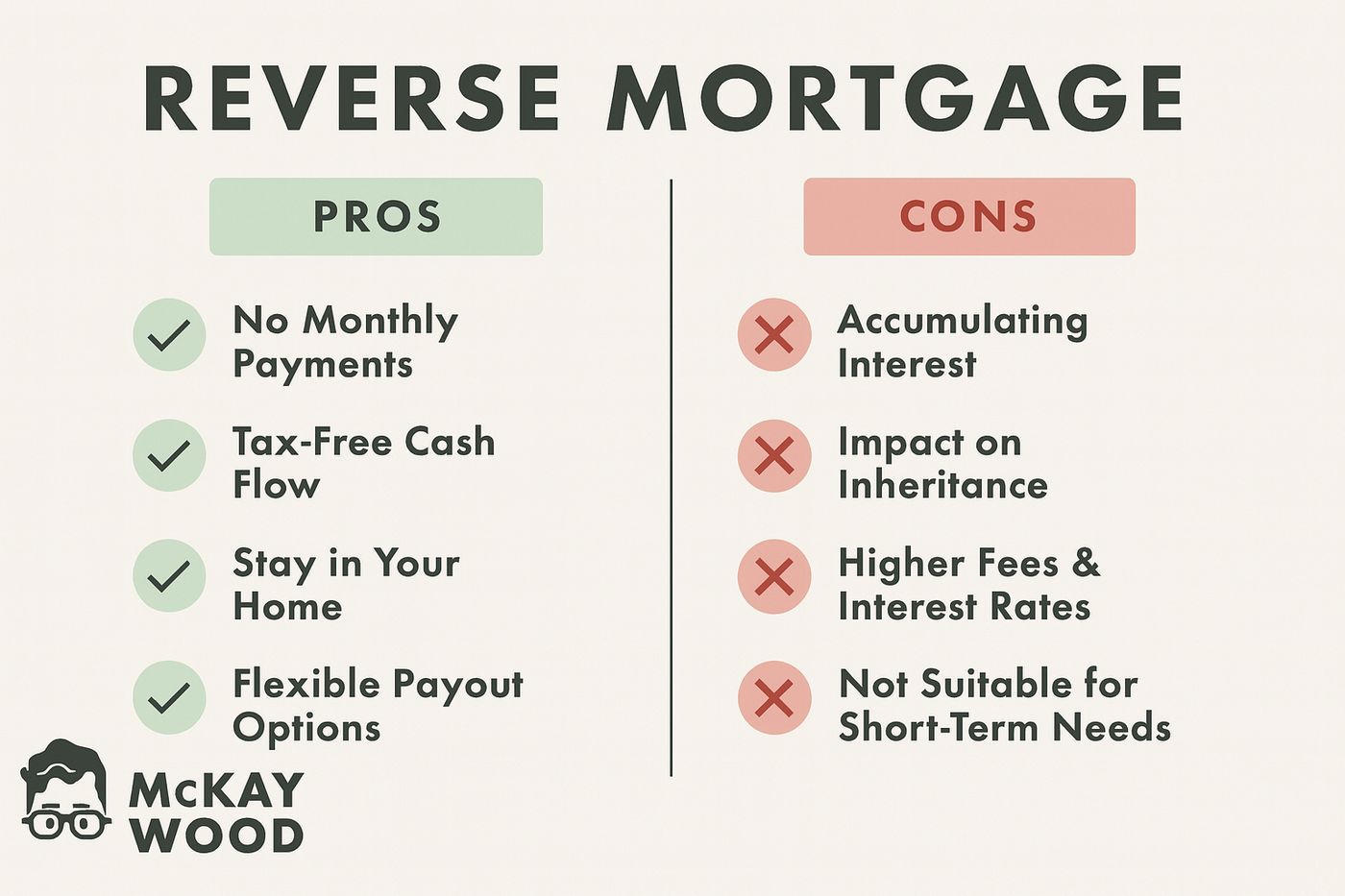
The primary advantages of a reverse mortgage are the access to tax-free cash without monthly payments and the ability to remain in one's home. It provides financial relief for retirees on fixed incomes who may not qualify for other loans due to income requirements. However, there are significant potential drawbacks to consider. The compounding interest causes the loan balance to grow over time, which can substantially reduce the equity left in the home for heirs. Interest rates are higher than on traditional mortgages. Furthermore, by reducing home equity, the borrower has less financial cushion for future needs. The decision involves a trade-off between immediate financial flexibility and long-term wealth transfer, making careful consideration and financial advice essential.
Comparison with Other Countries and Market Context
Reverse mortgage structures and regulations differ notably between Canada and other countries like the United States and Australia. In the United States, the primary product is the FHA-insured Home Equity Conversion Mortgage (HECM), available to borrowers aged 62 and older. The HECM includes federal mortgage insurance, which protects the borrower from negative equity but charges an upfront premium of 2% of the home's value. The US also mandates counseling from a HUD-approved counselor before application. In Australia, reverse mortgages are regulated by the National Consumer Credit Protection Act and the Australian Securities & Investments Commission, with a no negative equity guarantee mandated for all contracts written since September 2012. Australian loans cannot have fixed interest rates under current rules.
In Canada, reverse mortgages are not government-insured. The product is offered by private sector lenders, and the regulatory focus is on the mandatory legal advice and the contractual no negative equity guarantee. The Canadian model emphasizes consumer protection through legal oversight rather than a government insurance pool. This approach shapes the product's costs, risks, and accessibility within the retirement planning landscape.
Frequently asked questions
Can I lose my home with a reverse mortgage?
You will not lose your home for as long as you live in it and meet the loan obligations, which include paying property taxes and insurance and maintaining the property. You retain ownership. The loan becomes due if you sell, permanently move out, or pass away. Failure to pay taxes or insurance can lead to default and potential foreclosure, as with any mortgage.
What happens to my reverse mortgage when I die?
When the last borrower passes away, the reverse mortgage becomes due. Your estate will need to repay the loan balance, including all accrued interest, typically from the sale of the home. Due to the no negative equity guarantee, your estate will never owe more than the home's fair market value. Any remaining equity after the loan is repaid belongs to your heirs.
What are the main risks of a reverse mortgage?
The main risks include the compounding interest, which grows the loan balance and reduces your home equity over time, potentially leaving less inheritance for heirs. Interest rates are higher than on conventional mortgages. There is also a risk of default if you fail to pay property taxes or insurance. Carefully reviewing the terms and seeking independent advice is crucial to understanding these risks.
Do I have to make monthly payments on a reverse mortgage in Canada?
No, reverse mortgages in Canada do not require monthly mortgage payments. This is a defining feature of this loan product, allowing borrowers to access home equity without ongoing principal or interest payments. The interest accrues and is added to the loan balance each month, which compounds over time. The full loan amount, including all accumulated interest and fees, only becomes due and payable when the borrower dies, sells the property, or permanently moves out of the home. However, borrowers are still legally responsible for all ongoing homeownership costs, including property taxes, homeowner's insurance, and property maintenance, to avoid potential default.
Will a reverse mortgage affect my Old Age Security (OAS) benefits?
No, a reverse mortgage will not affect your Old Age Security or Guaranteed Income Supplement benefits. The funds received from a reverse mortgage are legally considered a loan advance, not taxable income. Therefore, this money is not counted as income under the government's Income Test for these specific benefit programs. This allows Canadian seniors to access their home equity for cash flow without jeopardizing these crucial income support entitlements. It is important to note that this tax-free treatment applies to the loan proceeds themselves, though any interest earned on invested proceeds could potentially be considered income.
How much can I borrow with a reverse mortgage?
The amount you can borrow with a reverse mortgage in Canada depends on several key factors. The maximum loan amount is primarily determined by your age, the current appraised market value of your home, and its geographic location. Lenders typically allow borrowers to access up to 55% of their home's value, with some plans advertising maximums up to 59% or 60%. Generally, the older the youngest borrower is and the higher the property value, the larger the available loan amount. The specific percentage is calculated using a formula that considers these factors along with current interest rates to determine the principal limit.
Sources and further reading
- Reverse mortgage (Wikipedia) en.wikipedia.org
- Reverse Mortgage Pros & Cons | Equitable Bank eqbank.ca
- How Does a Reverse Mortgage Work innovationcu.ca
- What is a reverse mortgage? ratehub.ca
- How does a reverse mortgage work in Canada? wise.com
- What Is a Reverse Mortgage? wowa.ca
This article explains how things work and is not financial, tax or legal advice. Rules, limits and rates change, so check the current figures with the Canada Revenue Agency, your province or your financial institution before you act.