A Registered Retirement Savings Plan (RRSP) is a government-registered investment account designed to help Canadians save for retirement. Contributions to an RRSP are tax-deductible, reducing your taxable income for the year, and investment earnings within the plan grow tax-deferred. Funds can be withdrawn at any time, but are taxed as income, with exceptions for programs like the Home Buyers' Plan. RRSPs are a fundamental part of retirement planning in Canada, offering significant tax advantages for individuals with earned income.
How RRSPs Work and Their Tax Benefits
The primary function of an RRSP is to provide a tax-advantaged environment for retirement savings. When you contribute money to an RRSP, you can deduct that amount from your taxable income for that year, which can lower your income tax payable or increase your refund. The investments held inside the RRSP, such as interest, dividends, or capital gains, are not taxed as long as the money remains in the plan. This tax-deferred growth allows savings to compound more efficiently over time. Withdrawals from an RRSP are treated as taxable income in the year the money is taken out. The fundamental tax benefit arises if you withdraw the funds during retirement when you are likely in a lower tax bracket than during your peak earning years. This structure provides a permanent benefit from tax-free profits on after-tax savings, similar to a Tax-Free Savings Account (TFSA). There is also a potential bonus or penalty depending on whether your tax rate at withdrawal is lower or higher than your rate at the time of contribution.
Business income earned from trading qualified investments within an RRSP, such as from day trading stocks, is not taxed while it remains in the plan. This treatment is specific to RRSPs and Registered Retirement Income Funds (RRIFs) and differs from TFSAs, where business income is taxable. All withdrawals are subject to withholding tax at the time of the transaction, which is applied against your final tax liability for the year. The two major exceptions to the standard withdrawal rules are the Home Buyers' Plan and the Lifelong Learning Plan, which allow for tax-free borrowing from an RRSP under specific conditions. The tax reduction from a contribution can be viewed as the government investing alongside the saver, with the withdrawal tax representing the return of the government's share of the account's growth.
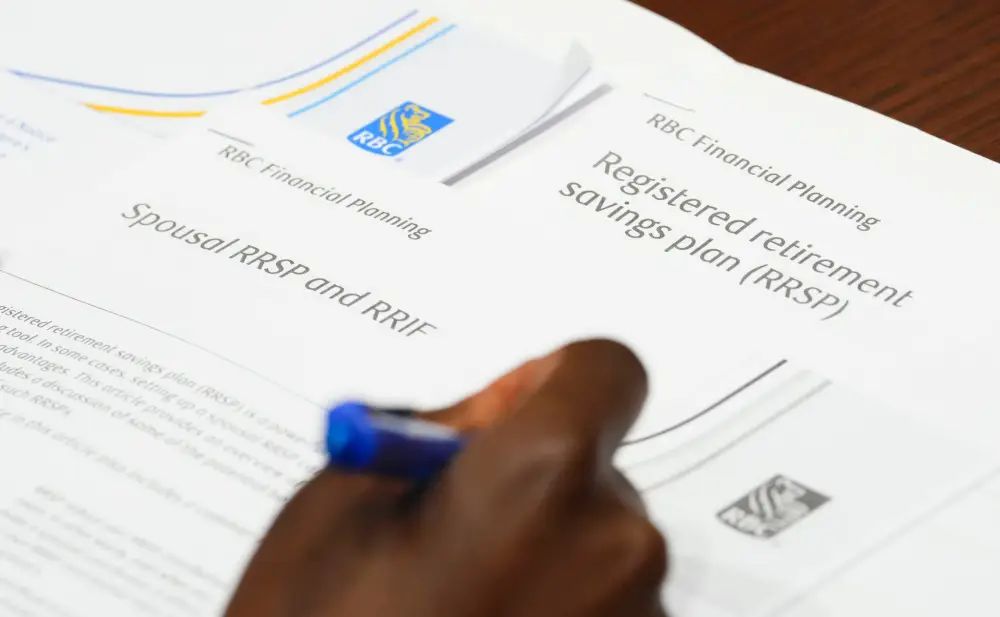
RRSP Contribution Rules and Limits
Any Canadian resident who has filed a tax return for the previous year and has earned income can contribute to an RRSP. Contributions can be made until December 31 of the year the annuitant turns 71 years old. The annual contribution limit is calculated as 18% of your earned income from the previous year, up to a specified annual maximum. Unused contribution room can be carried forward indefinitely to future years. Your personal deduction limit, which is the maximum you can contribute without penalty, is reported by the Canada Revenue Agency (CRA) on your Notice of Assessment and is calculated by adding the current year's new contribution room to any unused room from past years, then subtracting any pension adjustment. Contributions for a given tax year can be made up to 60 days after December 31, making early March the typical annual deadline.
For example, contributions for the 2025 tax year can be made until March 2, 2026. It is crucial not to over-contribute beyond your deduction limit. A buffer of $2,000 is allowed over a lifetime, but any over-contribution beyond that amount is subject to a penalty tax of 1% per month until it is withdrawn. Prior to 1991, contribution rules were different, with limits set at 20% of income and lower maximums for those with employer pension plans, and unused room could not be carried forward. The maximum annual contribution limit is indexed to the average wage and has increased over time, with the limit for the 2026 tax year set at $33,810.
- The contribution formula is 18% of previous year's earned income.
- Unused contribution room carries forward indefinitely.
- Contributions are allowed until age 71.
- The annual contribution deadline is 60 days after December 31.
- A $2,000 lifetime over-contribution buffer is permitted.
- Over-contributions beyond $2,000 face a 1% monthly penalty tax.
- The CRA provides your deduction limit on your Notice of Assessment.
The RRSP contribution limit is calculated as a percentage of the prior year's reported earned income. Since 1991, this calculation has been set at 18% of earned income, up to an annual maximum amount. This annual maximum limit has been increasing over time. Since 2010, the maximum limit has been indexed to rise with the annual increase in the average wage.
| Year | Maximum Contribution Limit |
|---|---|
| Pre-1991 (no pension plan) | $7,500 |
| Pre-1991 (with pension plan) | $3,500 |
| 1991 onward | 18% of income, with a rising cap |
| 2010 onward | Indexed annually to average wage |
| 2026 | $33,810 |
Types of RRSP Accounts and Structures
RRSPs can be established in different formats to suit individual needs. An Individual RRSP is associated with and contributed to by a single account holder. A Spousal RRSP allows a higher-earning spouse or common-law partner to contribute to an RRSP in the lower-earning spouse's name, which facilitates income splitting in retirement. A Group RRSP is arranged by an employer, allowing employees to contribute through payroll deductions, which provides immediate tax savings on each paycheque. Legislation also exists for Pooled Retirement Pension Plans (PRPPs), aimed at small businesses and self-employed individuals.
The investments within an RRSP can be held under different account structures. A Client-Held account is opened directly with an investment company for specific products like mutual funds, with the asset registered in the client's name. A Nominee Account, often called a self-directed RRSP (SDRSP) when held at a brokerage, holds various investments under one umbrella at a major bank or dealer, offering consolidated reporting but often with annual fees. An Intermediary Account functions similarly to a nominee account but is offered through independent advisors using services from institutions like B2B Bank or Canadian Western Trust. The choice of structure depends on the types of investments held and the desire for consolidation versus potential cost.

Withdrawals, Maturity, and Estate Planning
RRSP funds can be withdrawn at any age, but the withdrawn amount must be included in your taxable income for that year. Financial institutions withhold a preliminary tax at the time of withdrawal. By the end of the year you turn 71, you must mature your RRSP. The options are to cash it out fully, transfer the assets to a Registered Retirement Income Fund (RRIF), or use the funds to purchase an annuity. Within a RRIF, investments continue to grow tax-free, but a minimum amount must be withdrawn as taxable income each year. Before 2007, the mandatory maturity age was 69.
Upon the death of the account holder, the RRSP is generally considered withdrawn and the full value is included in the deceased's income for their final tax return, which can result in a significant tax bill at high marginal rates. The tax liability falls to the estate. If the named beneficiary is a spouse or common-law partner, the plan can be rolled over into their name tax-free, allowing it to continue. Since 2003, provisions also allow for a tax-free rollover to a financially dependent child or grandchild, though this may affect eligibility for provincial support programs. Tools like a Henson trust or a Lifetime Benefit Trust (LBT) can be used to manage such inheritances while preserving benefit eligibility.
The Home Buyers' Plan and Lifelong Learning Plan
The Home Buyers' Plan (HBP) allows RRSP holders to borrow funds from their plan to buy or build a qualifying home. The loan must be repaid in annual installments over 15 years, starting after a two-year grace period. The plan can be used more than once, provided the borrower has not owned a home in the previous five years and has repaid any prior HBP loans. Introduced in 1992 with a $15,000 limit, it was increased to $25,000 in 2009 and to $35,000 in 2019.
The Lifelong Learning Plan (LLP) allows individuals to withdraw funds from an RRSP to finance full-time training or education for themselves or their spouse. You can withdraw up to $10,000 per year, to a maximum of $20,000. Repayments must begin at the earlier of two dates: 60 days after the fifth year following the first withdrawal, or the second year after the last year the student was enrolled in full-time studies. Both the HBP and LLP allow for tax-free access to RRSP savings for specific life goals, provided the repayment schedules are followed.

Qualified Investments and Historical Foreign Content Rules
RRSPs can hold a wide range of qualified investments as defined by the Income Tax Act. These include savings accounts, Guaranteed Investment Certificates (GICs), bonds, mortgage loans, mutual funds, exchange-traded funds (ETFs), and common or preferred shares listed on a designated stock exchange. Options and foreign currency are also permitted, though specific rules apply. For example, covered calls are eligible but cash-secured puts are not. Labour-sponsored funds are also qualified investments. This flexibility allows Canadians to build a diversified retirement portfolio within their RRSP.
Historically, RRSPs were restricted in how much they could invest in foreign assets. Originally, non-Canadian content was limited to 10% of the plan's assets. This limit was increased to 20% in 1994 and to 30% in 2001. During this period, financial institutions created synthetic funds using derivatives to provide foreign market exposure without consuming the foreign content quota. In 2005, the law was changed to remove the foreign content limit altogether, allowing RRSPs to hold any amount of foreign investments and providing Canadians with full flexibility for global diversification.
Frequently asked questions
What is an RRSP?
A Registered Retirement Savings Plan (RRSP) is a Canadian financial account intended to provide retirement income. Contributions to an RRSP are deductible from income, which reduces income tax payable for the year they are claimed. Investment growth within the plan is not taxed while the funds remain in the RRSP. Withdrawals from the plan are generally taxed as income in the year they are taken out.
What is my RRSP contribution limit?
Your RRSP contribution limit is 18% of your earned income from the previous tax year, up to an annual maximum. Your personal deduction limit is a running total that includes this new room plus any unused contribution room carried forward from past years. This deduction limit is reduced by any pension adjustments and increased by pension adjustment reversals. Your specific deduction limit is printed on your notice of assessment from the Canada Revenue Agency.
What is the RRSP contribution deadline?
RRSP contributions for a tax year can be made up until and including the 60th day following December 31. For example, contributions for the 2023 tax year could be made until February 29, 2024. Contributions made by this deadline can be deducted from your taxable income for that preceding tax year. Unused contribution room carries forward until the year you turn 71.
Can I withdraw money from my RRSP early?
Yes, an account holder can withdraw funds from an RRSP at any age. The withdrawn amount must be included in your taxable income for that year. The financial institution will withhold a portion as preliminary tax at the time of withdrawal. Exceptions to this tax treatment exist for withdrawals made under the Home Buyers' Plan and the Lifelong Learning Plan.
What happens to my RRSP when I turn 71?
By December 31 of the year you turn 71, you must close your RRSP. You must either withdraw all funds, transfer the assets to a Registered Retirement Income Fund (RRIF), or use the funds to purchase an annuity. If transferred to a RRIF, investments continue to grow tax-free but a minimum amount must be withdrawn each year. Prior to 2007, this requirement took effect at age 69.
What is the difference between an RRSP and a TFSA?
In an RRSP, contributions are tax-deductible and withdrawals are taxed as income. In a Tax-Free Savings Account (TFSA), contributions are not deductible and withdrawals are tax-free. Business income earned on qualified investments within an RRSP is not taxed, while business income in a TFSA is taxable as personal income. Both accounts provide a way for investment growth to occur without annual taxation.
Sources and further reading
- Registered retirement savings plan (Wikipedia) en.wikipedia.org
- Registered retirement savings plan (RRSP) canadalife.com
- Registered Retirement Savings Plan (RRSP) Guide td.com
- Registered Retirement Savings Plans (RRSP) scotiabank.com
- What is an RRSP and how does it work getsmarteraboutmoney.ca
- Registered Retirement Savings Plan (RRSP) rbcroyalbank.com
This article explains how things work and is not financial, tax or legal advice. Rules, limits and rates change, so check the current figures with the Canada Revenue Agency, your province or your financial institution before you act.