The mortgage stress test is a mandatory financial assessment for most Canadian homebuyers and those refinancing their mortgages. Introduced by the federal banking regulator, it requires borrowers to prove they can afford their mortgage payments at an interest rate higher than their actual contract rate. This rule applies to mortgages from federally regulated lenders like banks and is designed to ensure borrowers can withstand future rate increases. Understanding the stress test is crucial for anyone planning to buy a home or refinance in Canada, as it directly impacts the maximum mortgage amount they can qualify for.
What Is the Mortgage Stress Test
A mortgage stress test is a regulatory requirement that evaluates a borrower's ability to afford mortgage payments under potentially higher interest rates. It is conducted by mortgage lenders when a borrower applies for a new mortgage or refinances an existing one. The test does not change the actual interest rate on the mortgage contract but uses a higher qualifying rate to calculate affordability. This ensures borrowers have a financial cushion to handle potential increases in borrowing costs. The test was designed to prevent Canadians from taking on excessive debt and to protect the stability of the financial system.
The stress test was introduced in 2018 by the Office of the Superintendent of Financial Institutions, Canada's federal bank regulator. Its implementation followed concerns that rapidly growing household mortgage debt posed a risk to economic stability. By requiring borrowers to qualify at a higher rate, the test aims to reduce the likelihood of mortgage defaults when interest rates rise. All federally regulated lenders, such as banks, are required to perform this test. Failing the stress test means a borrower is ineligible for a mortgage from any federally regulated lender.
The core mechanism of the stress test is the use of a qualifying rate, which is a hypothetical interest rate used for affordability calculations. This rate is the higher of two benchmarks: the borrower's actual mortgage contract rate plus two percentage points, or a federally set floor rate. As of 2026, that floor rate is 5.25 percent. For example, if a borrower is offered a contract rate of 4.39 percent, the qualifying rate would be 6.39 percent because that is higher than the 5.25 percent floor. Lenders then calculate the borrower's debt service ratios using this higher rate to determine the maximum loan amount.

How the Stress Test Works and Calculation
The stress test calculation integrates with two standard mortgage qualification formulas: the Gross Debt Service ratio and the Total Debt Service ratio. The GDS ratio measures housing costs as a percentage of gross annual income, while the TDS ratio measures all debt obligations. For the stress test, lenders calculate these ratios using the higher qualifying rate, not the actual contract rate. In most cases, the maximum GDS ratio is 39 percent of gross household income. The maximum TDS ratio is typically 44 percent of gross household income, though this can vary based on credit and other factors.
Housing expenses for the GDS calculation include the mortgage payment at the stress-tested rate, property taxes, heating costs, and half of any condo maintenance fees. The TDS calculation adds all other monthly debt repayments, such as car loans, credit card payments, and student loans. By using the higher qualifying rate, the mortgage payment component of these ratios increases, which reduces the maximum mortgage amount a borrower can qualify for. This process ensures that even if interest rates rise to the qualifying rate level, the borrower's total debt load would still remain within manageable limits according to the standard ratios.
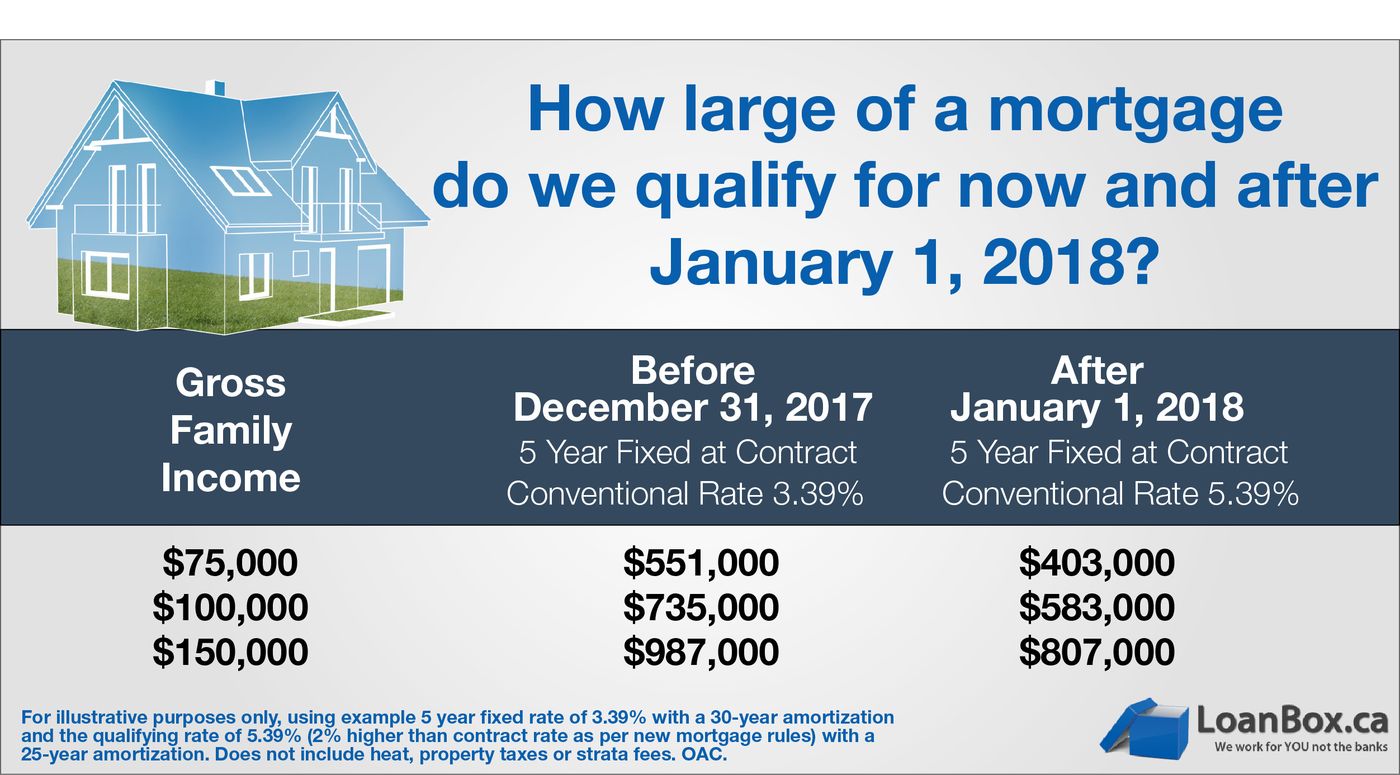
To illustrate, consider a borrower with a $90,000 gross annual salary and no other debt. If the qualifying rate is 6.39 percent, the maximum allowable mortgage payment is calculated based on the 39 percent GDS limit. This payment, combined with estimates for property tax and heating, determines the maximum mortgage principal the borrower can afford. The stress test effectively reduces the amount a borrower can qualify for compared to using the actual contract rate. This reduction can be significant, often meaning buyers must look at less expensive homes or save a larger down payment.
Who Must Take the Stress Test
The mortgage stress test applies to most borrowers seeking a mortgage from a federally regulated financial institution. This category includes all major banks such as RBC, TD, Scotiabank, BMO, CIBC, and National Bank, as well as most trust companies. The test applies to both insured mortgages, where the down payment is less than 20 percent, and uninsured or conventional mortgages, where the down payment is 20 percent or more. It is a mandatory step in the mortgage application process at these lenders.
The test is required in several specific scenarios beyond a standard new home purchase. It applies when refinancing an existing mortgage, which involves increasing the mortgage balance or extending the amortization. It also applies when switching lenders for an insured mortgage. However, there are important exceptions. Borrowers renewing their mortgage with the same lender do not have to pass a new stress test. Furthermore, as of September 2024, a new rule states that homeowners with an uninsured mortgage who switch to a new lender without increasing the loan amount or amortization, known as a straight switch, are also exempt from a new stress test.
- New home purchase mortgages at federally regulated lenders.
- Refinancing applications that increase the loan amount or term.
- Switching lenders for an insured mortgage.
- Switching lenders for an uninsured mortgage if the loan amount or amortization changes.
It is crucial to understand that the stress test is a federal banking regulation, not a universal Canadian law. Provincially regulated lenders, such as most credit unions, are not legally required to apply the federal stress test. In practice, many apply similar internal standards, but they may offer more flexibility. Private mortgage lenders are also not bound by the stress test, though they typically charge much higher interest rates, sometimes exceeding 10 percent. These alternative lenders can be an option for borrowers who fail the stress test at a bank.
History and Evolution of the Rules
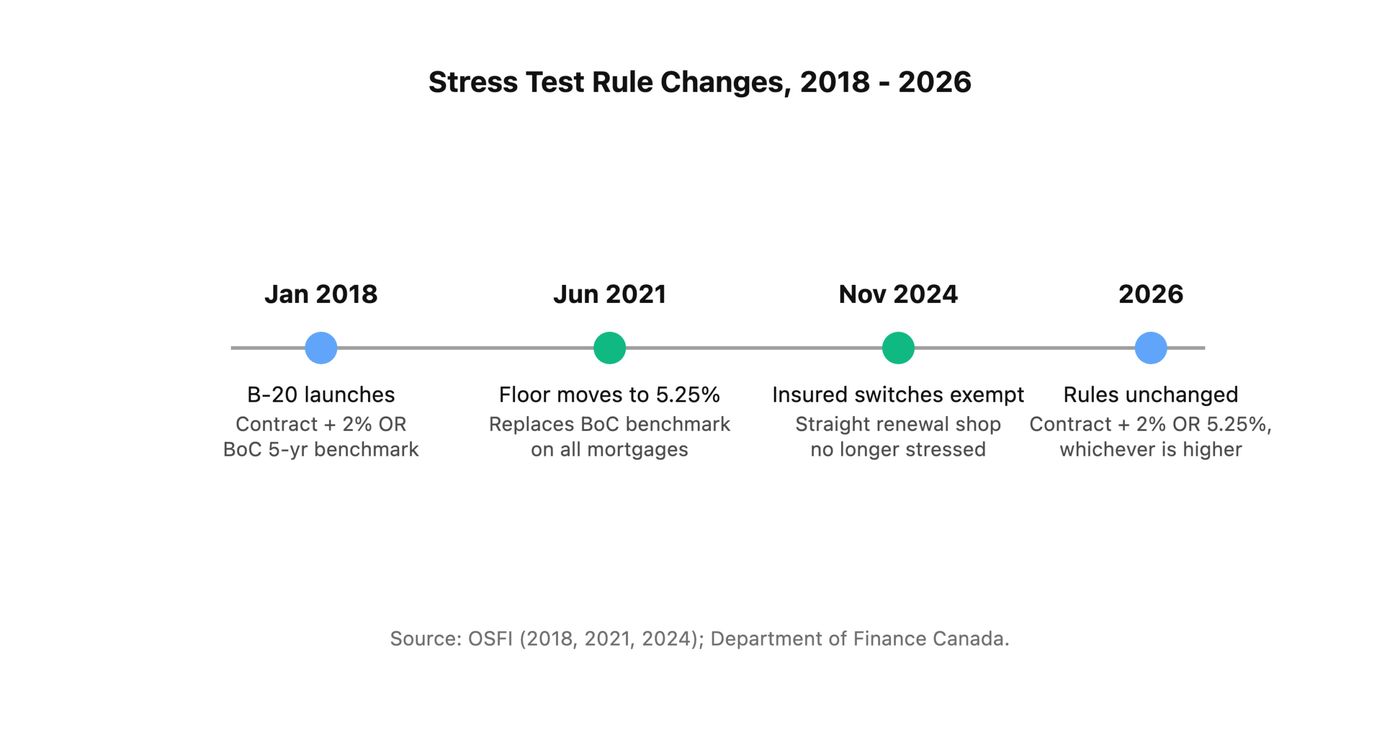
The mortgage stress test was formally introduced in January 2018 by OSFI under Guideline B-20 for uninsured mortgages. At the same time, the federal government extended an equivalent test to insured mortgages. The initial rule required borrowers to qualify at the greater of the Bank of Canada's five-year benchmark rate or their contract rate plus two percentage points. This was a significant change from prior practices, where borrowers only had to prove they could afford payments at their actual contract rate.
In June 2021, the rules were updated, establishing a new, fixed minimum qualifying rate. The stress test rate became the higher of the borrower's contract rate plus two percent or a set floor of 5.25 percent. This floor rate replaced the previous benchmark rate system. The 5.25 percent floor has remained in place through 2026. OSFI reviews the minimum qualifying rate, including both the floor and the two percent buffer, at least annually. The regulator bases its decisions on data from financial institutions, housing market vulnerability indicators, and consultations with the Department of Finance Canada and the Bank of Canada.
| Year | Key Change |
|---|---|
| 2018 | Stress test introduced for insured and uninsured mortgages. |
| June 2021 | Floor rate set at 5.25%, replacing the benchmark rate. |
| September 2024 | Exemption introduced for straight switches of uninsured mortgages. |
| December 2024 | Mortgage default insurance ineligibility for properties $1.5M+. |
Other related policy changes have occurred alongside the stress test. In December 2024, the Canada Mortgage and Housing Corporation updated its policy so that properties costing $1.5 million or more are no longer eligible for mortgage default insurance. Furthermore, CMHC does not accept down payments funded through additional debt, such as personal loans. These evolving rules reflect ongoing efforts to manage risk in the Canadian housing market and financial system.
Impact on Borrowers and the Housing Market
The primary impact of the stress test on individual borrowers is a reduction in their maximum qualifying mortgage amount. Because lenders assess affordability at a higher interest rate, the same income supports a smaller loan. This can be particularly challenging for first-time homebuyers in expensive markets, as it limits their purchasing power. This often means buyers must adjust their expectations, save for a larger down payment, or consider less expensive properties.
On a broader scale, the stress test is intended to cool housing demand and slow the rise of home prices by limiting the amount of debt buyers can take on. By ensuring borrowers can withstand rate increases, it also aims to protect them from default if their financial situation worsens or interest rates rise. The test addresses one of the biggest risks for financial institutions: real estate secured lending risk. Widespread mortgage defaults could negatively impact Canada's financial system, so the stress test acts as a preventive measure.
Critics of the policy argue that it disproportionately affects first-time homebuyers, potentially locking them out of homeownership. They also note that it can push some borrowers toward unregulated private lenders, who charge significantly higher interest rates. Proponents counter that the test promotes long-term financial stability for both borrowers and the economy. The test has undeniably become a permanent and influential feature of the Canadian mortgage landscape, shaping borrowing capacity and market dynamics.
Key Rules and Qualification Criteria
Several specific rules and criteria govern the application of the mortgage stress test. The central rule is the qualifying rate formula: borrowers must qualify at the higher of their mortgage contract rate plus two percentage points or the OSFI floor rate, which is 5.25 percent as of 2026. This rate is used to calculate the borrower's debt service ratios. The standard Gross Debt Service ratio must not exceed 39 percent, and the Total Debt Service ratio must not exceed 44 percent, though lenders may adjust these based on creditworthiness.
For mortgages that require default insurance, which is mandatory for down payments below 20 percent, the same stress test applies. The insurers, CMHC, Sagen, and Canada Guaranty, have slightly different qualification policies, but all require the stress test. As noted, properties with a purchase price of $1.5 million or more are not eligible for this insurance as of December 2024. For conventional, uninsured mortgages, the stress test is applied under OSFI's Guideline B-20, which sets expectations for federally regulated lenders.
- Qualifying Rate: Higher of contract rate + 2% or 5.25%.
- GDS Limit: Typically 39% of gross income.
- TDS Limit: Typically 44% of gross income.
- Applies to: New purchases, refinances, and certain lender switches.
- Exemptions: Renewals with same lender, straight switches of uninsured mortgages.
- Insured Mortgage Limit: Purchase price below $1.5 million.
It is important for borrowers to know that their mortgage affordability depends on three key factors: their gross household income, their total monthly debt obligations, and the stress-tested qualifying rate. Lenders will collect documentation on all these elements during the application process. Borrowers should prepare by understanding these ratios and calculating their own position before applying. This preparation can help avoid surprises and improve the chances of a successful mortgage application.
Frequently asked questions
What is the current mortgage stress test rate in Canada for 2026?
The current stress test qualifying rate is determined by a specific formula. It is the higher of your actual mortgage contract rate plus two percentage points, or a fixed floor rate of 5.25 percent. As of 2026, with typical contract rates above 4 percent, the contract rate plus 2 percent is usually the higher figure. For example, if your offered rate is 4.39 percent, your qualifying rate for the stress test would be 6.39 percent. The 5.25 percent floor was set in June 2021 and has not changed since.
Who has to pass the mortgage stress test?
Most borrowers seeking a mortgage from a federally regulated lender must pass the stress test. This includes customers of all major banks and most trust companies. The test applies to both new home purchases and refinancing applications where the loan amount increases. It applies to insured mortgages with less than 20 percent down payment and uninsured conventional mortgages. The main exceptions are borrowers renewing their mortgage with the same lender and, as of September 2024, homeowners with uninsured mortgages making a straight switch to a new lender without changing the loan amount or amortization.
How does the stress test reduce the mortgage amount I can get?
The stress test reduces your qualifying mortgage amount by using a higher interest rate to calculate your debt service ratios. Lenders determine how much you can borrow based on your income and the maximum allowed Gross Debt Service and Total Debt Service ratios. By calculating your hypothetical mortgage payment at the higher qualifying rate instead of your actual rate, the payment amount increases. This larger payment consumes more of your allowable debt service ratio, leaving less room for the principal loan amount. Consequently, the maximum mortgage you are approved for is lower than it would be if calculated at your actual contract rate.
Do I have to pass the stress test when I renew my mortgage?
No, you do not have to pass a new stress test when renewing your mortgage with your existing lender. The stress test rules apply only to new mortgage loan agreements. A renewal with the same lender, under the same terms, is not considered a new agreement. However, if you refinance your mortgage by increasing the loan amount or extending the amortization, you will need to pass the stress test again. Similarly, if you switch your mortgage to a different lender, you will generally need to pass a new stress test, unless you have an uninsured mortgage and are making a straight switch as defined by the 2024 exemption.
What happens if I fail the mortgage stress test?
Failing the mortgage stress test means you are ineligible for a mortgage from any federally regulated lender in Canada, including all the major banks. If you fail, you may need to explore alternative lending options. Provincially regulated lenders, such as some credit unions, are not legally required to apply the federal stress test, though they often have their own standards. Private mortgage lenders also do not apply the stress test, but they typically charge much higher interest rates, sometimes exceeding 10 percent, and may have more flexible credit requirements. Failing the test usually indicates that, according to the regulator's standards, your budget may not withstand a significant increase in interest rates.
What are the GDS and TDS ratios for the stress test?
The Gross Debt Service ratio and Total Debt Service ratio are key metrics used in the stress test calculation. The GDS ratio measures your housing costs, including the mortgage payment at the stress-tested rate, property tax, heating, and half of condo fees, as a percentage of your gross annual income. The maximum is typically 39 percent. The TDS ratio measures all your monthly debt obligations, including the stress-tested housing costs plus other debts like car loans and credit card payments, against your gross income. The maximum TDS is typically 44 percent. Lenders use these ratios with the higher qualifying rate to determine your maximum affordable mortgage payment and loan amount.
Sources and further reading
- Mortgage Stress-Test Calculator | 2026 Updates wowa.ca
- What is the Canadian mortgage stress test? | Posts scotiabank.com
- New Mortgage Qualification Rules (Stress Test) td.com
- Mortgage Stress Test Canada 2026, How It Works lendsimpl.ca
- Minimum qualifying rate for uninsured mortgages osfi-bsif.gc.ca
This article explains how things work and is not financial, tax or legal advice. Rules, limits and rates change, so check the current figures with the Canada Revenue Agency, your province or your financial institution before you act.