The break-even point is the level of sales at which total revenue equals total costs, resulting in neither profit nor loss. It is a fundamental concept in cost accounting and financial analysis used to determine the minimum output required for a business to become viable. For Canadian entrepreneurs, managers, and policymakers, understanding and calculating the break-even point is crucial for setting sales targets, planning for profitability, and assessing the financial health of enterprises across sectors. The concept also applies to broader economic indicators, such as employment growth needed to stabilize the unemployment rate.
Definition and Core Concept
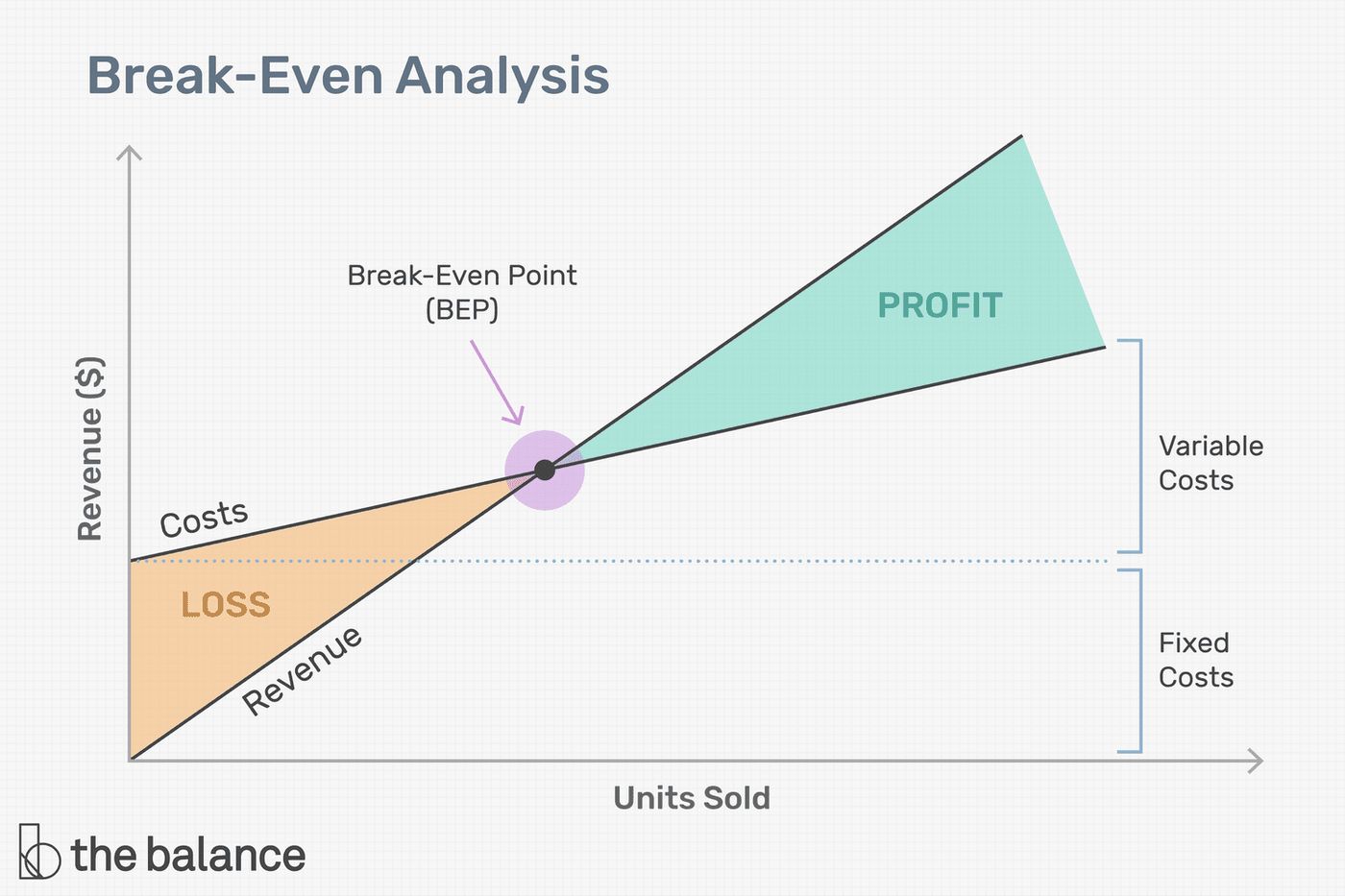
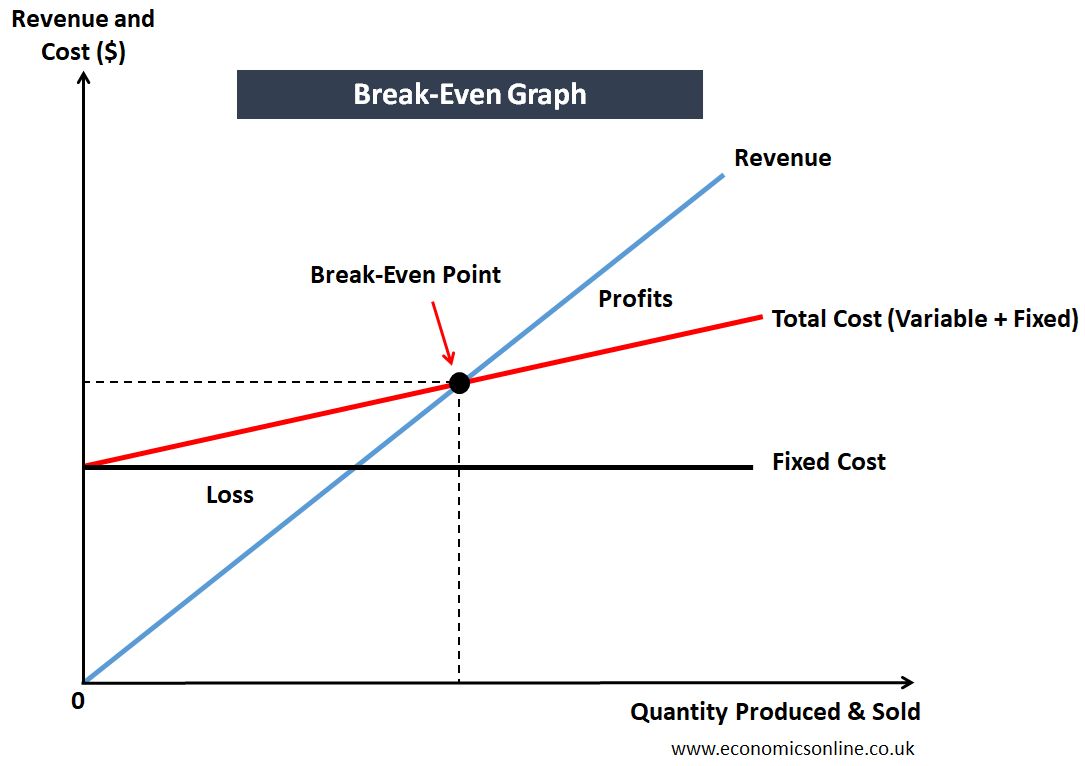
The break-even point represents the sales amount required to cover all of a company's costs, with total profit at this point being zero. In practical terms, it is the threshold a business must cross to stop operating at a loss and begin generating an operational profit. The analysis is built on separating costs into two categories: fixed costs, which do not change with the level of output, and variable costs, which do. The fundamental calculation determines how many units must be sold, or how much revenue must be generated, to cover the sum of these costs. This concept is not limited to for-profit businesses but is also a critical tool for non-profits and government corporations assessing financial sustainability. The break-even point provides a clear goal for sales and production teams and is a foundational element in business plans presented to potential investors or lenders. In economics, breaking even has a broader definition where opportunity costs are covered and capital receives the risk-adjusted, expected return, even if there is no net accounting loss or gain.
Calculation Methods and Formulas
Calculating the break-even point can be done in terms of units sold or total revenue. The basic formula for determining the break-even point in units requires knowing the total fixed costs, the unit sale price, and the unit variable cost. The calculation is Total Fixed Costs divided by the unit contribution margin, which is the sale price minus the variable cost per unit. The break-even point would then be approximately 3,846 units. To find the break-even point in revenue dollars, you divide the total fixed costs by the contribution margin ratio, which is the unit contribution margin divided by the unit sale price. Using the same example, the contribution margin ratio is 65 percent, leading to a break-even revenue of about $38,461. These formulas assume a linear relationship in the cost-volume-profit analysis model, where marginal costs and marginal revenues are constant. The quantity (P, V) is called the Unit Contribution Margin and represents the portion of each sale that contributes to covering fixed costs. For service businesses, the calculation is identical, though volume may be measured in billable hours instead of physical units, as in a consulting firm.
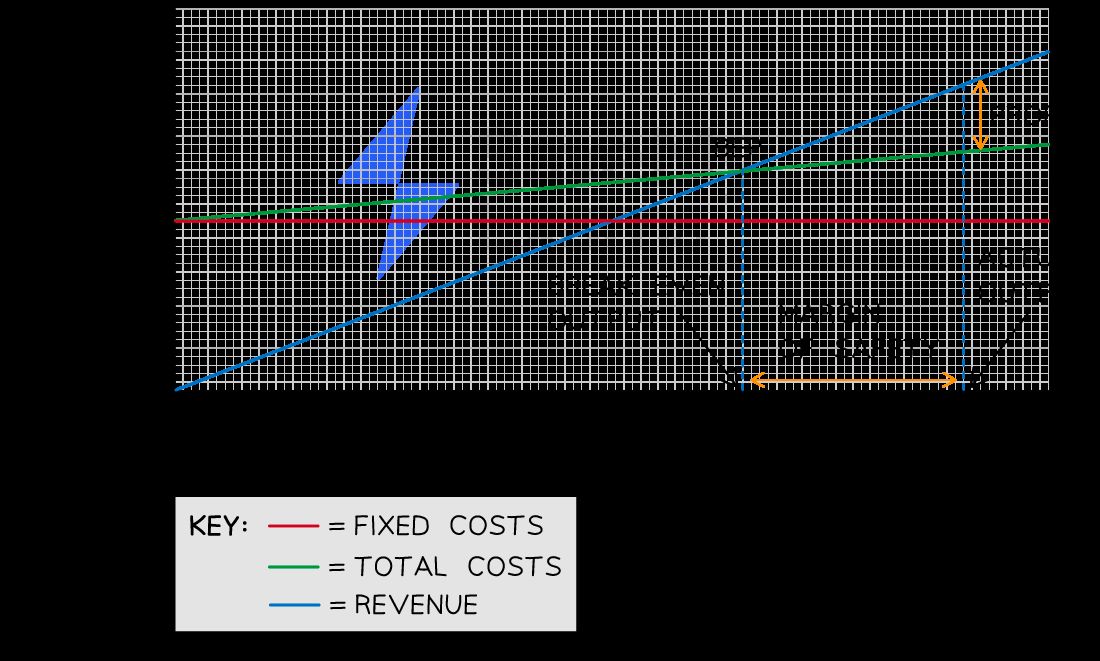
A related and important metric is the margin of safety, which measures how much actual or projected sales exceed the break-even point. The margin of safety can be calculated as the difference between current output and breakeven output, or as a percentage: (current output, breakeven output) / current output × 100. This figure represents the strength of the business and indicates how much sales can fall before losses begin. In break-even analysis, adjusting the selling price changes the required volume. This demonstrates the direct relationship between pricing strategy and the financial threshold for profitability.
Purpose and Applications in Business
The primary purpose of break-even analysis is to determine the minimum output a business must achieve to avoid losses and to understand the relationships between sales, costs, and profits. It serves as a rough indicator of the earnings impact of marketing activities and helps set clear financial targets. Managers use it to analyze how changes in price, costs, or sales volume affect profitability. For instance, a business can model how a price increase might lower the number of units needed to break even. The analysis is also crucial for new ventures seeking investment, as it demonstrates to potential backers the sales volume required for viability. In Canada, business advisors emphasize that the break-even point should be viewed as a range rather than a single number due to fluctuations in costs and revenue. Entrepreneurs are advised to perform sensitivity analyses to understand the impact of variables like a 10 percent drop in sales or a 5 percent increase in material costs. This helps in developing strategies to manage risk and adjust operations proactively. The break-even point is a special case of Target Income Sales where the target income is zero, making it a foundational step in more complex financial planning.
Common strategies to lower the break-even point include reducing fixed costs through negotiations on rent or better management of overhead, lowering variable costs by finding suppliers with better prices or improving production efficiency, increasing the unit selling price if market conditions allow, and improving the sales mix to favour products with higher contribution margins. These actions reduce the sales volume or revenue required to cover costs, making it easier for a business to become profitable. A break-even analysis can also provide data useful to a marketing department by establishing financial goals that marketers can work towards. Furthermore, it can help businesses identify areas to restructure or cut costs for optimum results, potentially making the operation more effective and achieving higher returns. For example, a table-selling business needing to sell 200 tables annually to break even would, if selling fewer, need to consider such strategies to become viable.
Break-Even Analysis in the Canadian Context
The break-even concept is frequently applied across the Canadian economy, from small businesses to major national industries. For small businesses, it is a vital tool for survival, with organizations like the Business Development Bank of Canada providing guidance on its calculation. In the restaurant sector, a 2025 report from Restaurants Canada found that half of all Canadian restaurants were operating at a loss or just breaking even, citing high costs for food, labour, and insurance, along with pandemic-related debt. Specific examples illustrate the pressure: a restaurant owner noted pre-pandemic avocado costs of $42 per case rising to $92, forcing difficult price decisions for menu items like avocado toast, and margins shrinking from 8-9 percent to 1-2 percent. In the energy sector, the break-even price for crude oil is a critical benchmark. In 2025, the price of Western Canadian Select crude fell below US$10 per barrel to as low as $7.36, which was under the break-even point for nearly all Canadian producers, creating a severe crisis for the industry and leading to an estimated $3.5 billion in capital expenditure cuts. For Crown corporations, achieving break-even is a public policy goal. Canada Post, which lost over $1 billion in 2025, submitted a restructuring plan with the aim of breaking even by 2030 through measures like increasing community mailbox use, adjusting delivery standards, and closing some post offices, following a federal loan of $1 billion earlier that year and ongoing labour negotiations with the Canadian Union Of Postal Workers. These examples show how the break-even point serves as a key indicator of financial pressure and sustainability in diverse Canadian contexts.
Breakeven Employment and Macroeconomic Policy
Beyond business accounting, the break-even concept is used in macroeconomics to analyze labour market conditions. Breakeven employment growth is the pace of job creation needed to prevent the unemployment rate from rising, given population and labour force changes. This rate has shifted dramatically in Canada due to changes in population growth. In 2023 and 2024, with high population growth, the breakeven rate was about 60,000 jobs per month needed to keep unemployment stable, even though actual job growth of 45,000 and 32,000 per month respectively represented a strong historical pace. By 2025, reduced temporary resident arrivals lowered the breakeven rate to 25,000 jobs per month. Projections for 2026 indicate the breakeven rate could become slightly negative, at approximately -10,000 jobs per month on average, meaning modest job losses could coincide with a stable or declining unemployment rate. This recalibration is crucial for policymakers and analysts interpreting labour data, as strong aggregate job growth numbers may not reflect improving conditions for individual workers if they do not outpace population growth. The aging Canadian population also influences this dynamic, as a shrinking labour force relative to consumer demand could lead to future labour shortages. An aging population has already lowered the Canadian labour force participation rate by more than 4 percentage points since 2008, and reducing immigration accelerates this aging, potentially making current restrictive immigration policies difficult to sustain in the long term.
Limitations and Critical Considerations
While break-even analysis is a valuable tool, it has several important limitations that users must acknowledge. It is fundamentally a supply-side analysis that focuses on costs and does not predict what sales are likely to be at various price points. The model assumes fixed costs remain constant, which may only be true in the short run before expansion increases overhead. It also assumes average variable costs are constant per unit and that the quantity of goods produced equals the quantity sold, ignoring inventory changes. For companies with multiple products, the analysis assumes a constant sales mix, which is often unrealistic. In practice, Canadian business advisors stress that the calculated break-even point is a moving target. Fluctuations in indirect costs or gross margin percentages mean the actual point can shift, necessitating regular review and the use of scenario ranges. A sensitivity analysis is recommended to understand how changes in key variables affect profitability, allowing businesses to prepare contingency plans rather than relying on a single, static number. The break-even analysis is one of the simplest yet least-used analytical tools, and its static assumptions can be a pitfall if not complemented with dynamic forecasting and market demand analysis.
Historical Development and Economic Theory
The break-even analysis was developed by economists Karl Bücher and Johann Friedrich Schär. It became a standard tool in managerial accounting and financial planning during the 20th century. The concept fits within the broader framework of cost-volume-profit analysis, which examines how changes in costs and volume affect a company's operating profit. In economic theory, breaking even means more than just a zero accounting profit. It implies that all opportunity costs have been covered and capital has received its risk-adjusted, expected return. The break-even point is a special case of target income sales where the target income is set to zero. Academic and professional literature on the subject expanded its applications, leading to its widespread use in capital budgeting and investment project appraisal. Its simplicity makes it one of the most commonly used analytical tools, though it is also noted as being underutilized by some managers who may overlook its dynamic insights into business operations. The graphical representation of break-even analysis involves plotting total cost and total revenue curves, with their intersections indicating break-even points at different price levels, providing a visual tool for understanding the relationships between these variables.
Sector-Specific Break-Even Challenges in Canada
Different Canadian industries face unique challenges in reaching and maintaining their break-even points, often influenced by global markets, domestic policy, and local economic conditions. The oil and gas sector provides a stark example of volatility, where the break-even price is a matter of corporate survival. The 2025 price collapse was driven by a combination of plummeting demand due to global events and a price war among major producers, pushing prices below the operational break-even for nearly all Canadian companies. This led to immediate actions like Syncrude and Suncor delaying maintenance to keep production flowing, and companies like Kelt Exploration and Whitecap Resources slashing capital expenditures by 36 percent and 44 percent respectively. The restaurant industry faces a more chronic struggle, where fixed costs like rent and insurance combine with soaring variable costs for ingredients. A Vancouver restaurateur reported margins shrinking from 8-9 percent pre-pandemic to 1-2 percent, a situation common across the country where passing cost increases to customers is difficult. For national infrastructure like Canada Post, the break-even goal is tied to public service mandates and political decisions, such as the federal government's allowance to end door-to-door delivery. Each sector demonstrates that the break-even point is not just an internal metric but is deeply interconnected with external economic forces and policy environments.
The following table summarizes key break-even related figures and events in recent Canadian contexts. Canada Post, a Crown corporation, lost over one billion dollars in a recent year and its CEO stated a goal to break even by 2030 through a restructuring plan. In Canada's labour market, the breakeven employment growth rate is projected to be slightly negative, averaging about -10,000 jobs per month in 2026. For the Canadian oil industry, the market price for crude oil fell below the break-even point for nearly all producers in a recent period, with Western Canadian Select dropping as low as US$7.36 per barrel. Many Canadian restaurants were reported to be operating at or near their break-even point due to high operational costs and pandemic-related debt.
| Sector/Entity | Key Break-Even Figure or Event | Year/Period |
|---|---|---|
| Canadian Restaurants | 50% operating at loss or break-even | 2025 Report |
| Western Canadian Select Crude | Price fell below break-even at $7.36/barrel | 2025 |
| Canada Post | Target to break even | By 2030 |
| Canada Post Annual Loss | Over $1 billion | 2025 |
| Breakeven Employment Growth | Approx. 60,000 jobs/month needed | 2023 to 2024 |
| Projected Breakeven Employment | Approx. -10,000 jobs/month | 2026 |
| Oil Sector Capex Cuts | Estimated $3.5 billion | 2025 (following price crash) |
Frequently asked questions
What is a simple definition of the break-even point?
The break-even point is the level of sales where total revenue exactly equals total costs. At this point, a business is not making a profit but is also not incurring a loss. It is the minimum sales target required to cover all fixed and variable expenses. Once sales exceed this point, the business begins to generate an operational profit.
How do you calculate the break-even point for a small business in Canada?
The break-even point is calculated by determining the sales amount required to cover total costs. In unit terms, it is found by dividing total fixed costs by the unit contribution margin, which is the selling price per unit minus the variable cost per unit. In revenue terms, it is calculated by dividing total fixed costs by the contribution margin ratio. This analysis is a fundamental financial tool used by entrepreneurs and managers to identify required sales outputs. For a service business, the formula is the same, though volume may be measured in hours instead of units. The resulting figure establishes a clear sales target and threshold for operational profit.
What is breakeven employment growth in Canada?
Breakeven employment growth is the number of jobs that must be created to prevent the unemployment rate from rising, accounting for population and labour force changes. In Canada, this rate is dynamic and has shifted significantly. Recent analysis indicates the breakeven employment growth rate is on track to be slightly negative, averaging about negative 10,000 jobs per month in 2026. This change is attributed to slowing population growth. Understanding this rate helps economists assess the health of the labour market and whether job creation is sufficient to absorb new entrants.
Why is the break-even point important for Canadian restaurants?
The break-even point is critically important for Canadian restaurants as many operate near this threshold. A recent report found that half of all restaurants were either operating at a loss or just breaking even. This financial pressure stems from high fixed and variable costs, including food, labour, and rent. Calculating the break-even point allows restaurant owners to understand the minimum revenue needed to cover all costs without profit or loss. This analysis helps in setting menu prices, controlling costs, and establishing clear sales targets to strive for profitability in a challenging economic environment.
What was the break-even price for Canadian oil producers in 2025?
In 2025, the break-even price for most Canadian oil producers was above the prevailing market price. Specifically, Canadian crude oil prices dropped as low as $7.36 per barrel, while the benchmark West Texas Intermediate was at $21.48. Both these prices were below the break-even point required to cover the costs of acquisition and production for nearly all Canadian producers. The break-even price is the price at which revenue equals total costs, resulting in no net loss or gain. When market prices fall below this point, companies face operational losses, which can lead to reduced capital expenditure and industry consolidation.
What is Canada Post's break-even goal?
Canada Post has a stated goal to break even by the year 2030. The Crown corporation faced significant financial challenges, losing over a billion dollars in a recent year. The break-even point is defined as when total costs equal total revenue, resulting in neither profit nor loss. To achieve this goal, Canada Post is implementing a restructuring plan designed to reduce costs and increase efficiency. This plan includes measures such as adjusting delivery services and optimizing its network. The aim is to reach financial sustainability without requiring additional government support.
Sources and further reading
- Break-even (economics) (Wikipedia) en.wikipedia.org
- What is the break-even point? bdc.ca
- Canada Post expects to 'break even by 2030,' says CEO globalnews.ca
- Canada's shifting labour market: Recalibrating 'breakeven ... rbc.com
- Oil plummets below break-even point for most Canadian ... financialpost.com
- 50% of Canadian restaurants just breaking even vancouver.citynews.ca
This article explains how things work and is not financial, tax or legal advice. Rules, limits and rates change, so check the current figures with the Canada Revenue Agency, your province or your financial institution before you act.