The Bank of Nova Scotia, operating as Scotiabank, is a Canadian multinational financial services company and one of the country's Big Five banks. Founded in Halifax in 1832, it is now headquartered in Toronto and ranks as the third-largest Canadian bank by assets. Scotiabank serves over 25 million customers globally through its extensive network in Canada and significant international operations, particularly in the Americas. Its comprehensive offerings include personal and commercial banking, wealth management, and investment services, making it a central institution in the Canadian financial landscape.
What is Scotiabank?
Scotiabank is the trade name for The Bank of Nova Scotia, a publicly traded multinational financial services corporation. It is one of Canada's Big Five banks, a group of the largest and most dominant financial institutions in the country. As of 2023, Scotiabank held the 88th position on the Forbes Global 2000 list. The bank operates through four primary business lines: Canadian Banking, International Banking, Global Wealth & Insurance, and Global Banking and Markets. Its services encompass a full range of retail and commercial banking products, including chequing and savings accounts, credit cards, mortgages, loans, and investment services. With assets of approximately $1.5 trillion as of early 2026, Scotiabank is a major player in North American finance and a significant global entity, particularly known for its strong presence in Latin America and the Caribbean.
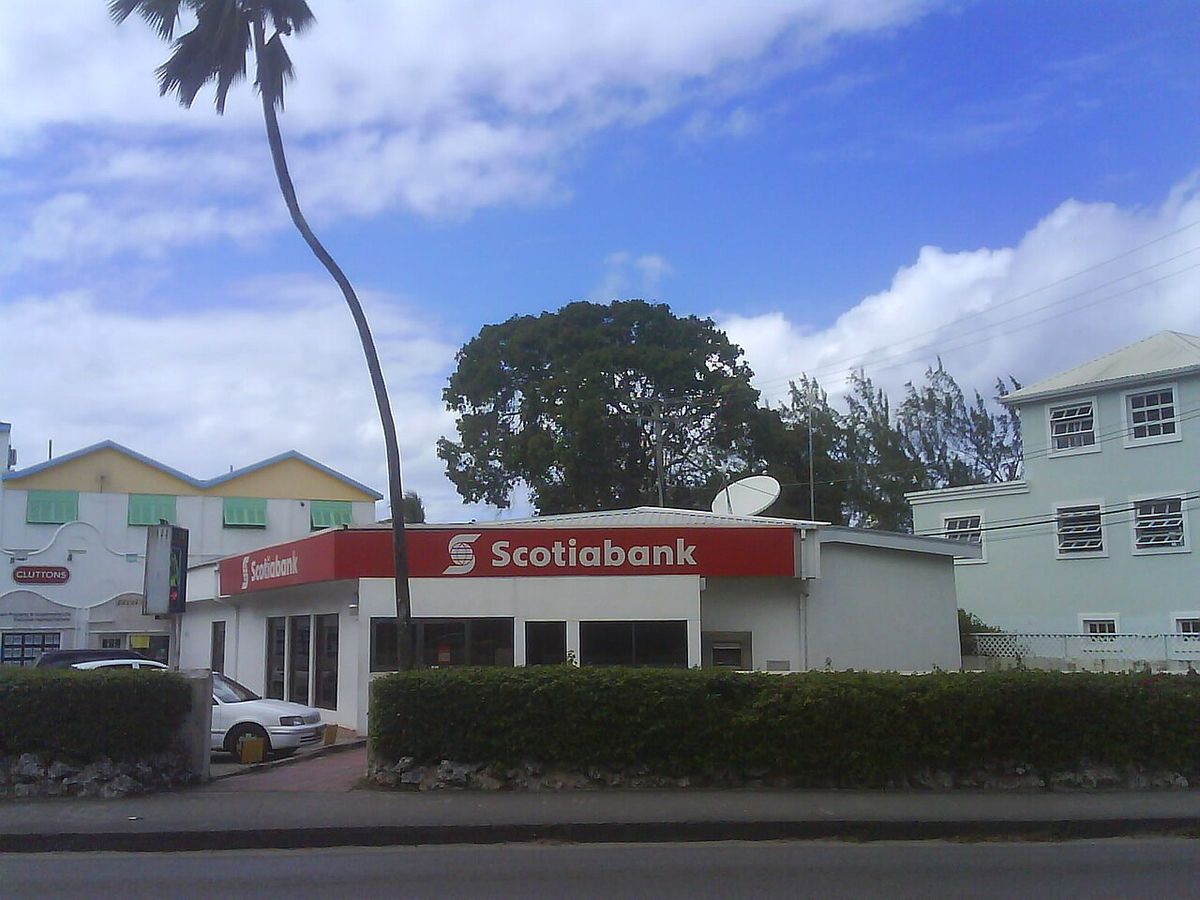
History and Expansion
Scotiabank was founded on March 30, 1832, in Halifax, Nova Scotia, then a British colony, by the Legislative Assembly of Nova Scotia. Its first president was William Lawson. The bank was established to facilitate trans-Atlantic trade and provide more accessible banking services. Its initial expansion was confined to the Maritimes, with its first branch opening in Windsor, Nova Scotia. A significant milestone came in 1889 when Scotiabank opened a branch in Kingston, Jamaica, marking the first time a Canadian bank established operations outside the United States or the United Kingdom. The bank moved its headquarters from Halifax to Toronto, Ontario, in 1900, a shift that coincided with a period of aggressive growth. Throughout the 20th century, Scotiabank expanded both domestically and internationally through acquisitions and branch openings.
The Bank of Nova Scotia, founded in 1832, began expanding through branch openings in the Maritimes and later into the American Midwest. In 1883, it acquired the Union Bank of Prince Edward Island. Major domestic acquisitions included the Bank of New Brunswick in 1913, the Metropolitan Bank in 1914, and the Bank of Ottawa in 1919. Internationally, the bank opened its first branch outside the US or UK in Jamaica in 1889 and expanded into Cuba, Puerto Rico, and the Dominican Republic in the early 20th century. Later key acquisitions include the purchase of ING Direct Bank of Canada in 2012, a majority stake in BBVA Chile in 2018, and a stake in KeyCorp in 2024.
- 1913: Merged with the Bank of New Brunswick.
- 1914: Acquired the Toronto-based Metropolitan Bank, becoming Canada's fourth-largest financial institution.
- 1919: Amalgamated with the Bank of Ottawa.
- 1954: Created a mortgage department following the National Housing Act.
- 1988: Acquired the McLeod Young Weir brokerage firm.
- 1994: Acquired Montreal Trustco Inc.
- 1997: Acquired National Trust Company for Can$1.25 billion.
- 2012: Acquired ING Direct Bank of Canada, later rebranded as Tangerine.
- 2018: Acquired Montreal investment firm Jarislowsky Fraser and a majority stake in BBVA Chile.
- 2024: Announced a partnership to create Cedar Leaf Capital, the first Indigenous-owned investment dealer in Canada.
- 2024: Announced the purchase of a 14.9% stake in U.S. regional bank KeyCorp for approximately $2.8 billion.
The bank adopted Scotiabank as its worldwide brand name in 1975. Its international focus earned it the moniker "Canada's most international bank," with major operations built across Latin America and the Caribbean. In recent years, leadership changes have included the retirement of CEO Brian J. Porter in January 2023, succeeded by Scott Thompson. The bank has also been a member of the London Bullion Market Association and was a participant in the London gold fixing through its ScotiaMocatta division until 2019.
How Scotiabank Works in Canada
Scotiabank's Canadian Banking division provides financial advice and products to personal and business customers across the country. It operates branches in every Canadian province and territory except Nunavut. The bank offers a comprehensive suite of services including everyday banking accounts, savings products, credit cards, mortgages, personal loans, and investment vehicles like Registered Retirement Savings Plans (RRSPs) and Tax-Free Savings Accounts (TFSAs). A key feature for Canadian customers is the Scotia Total Equity Plan (STEP) mortgage, which allows homeowners to access the equity in their property. Scotiabank also operates Tangerine Bank, a direct banking subsidiary that offers an alternative, self-directed banking experience with no physical branches. The bank actively markets bundled packages, such as the Ultimate and Preferred packages, which combine accounts and credit cards, often with cash bonus incentives for customers.
Scotiabank supports specific Canadian customer segments through targeted programs. The StartRight Program is designed for newcomers to Canada, helping them establish banking, credit, and investment services. The bank also engages in community initiatives, such as the 2024 creation of Cedar Leaf Capital, a partnership with Indigenous development corporations aimed at increasing Indigenous access to investment and infrastructure development. For everyday banking, customers can manage their finances through online banking platforms, mobile apps, and a network of automated banking machines. Scotiabank's credit cards are integrated with the Scene+ loyalty program, allowing customers to earn points on purchases. The bank's institution number for all Canadian transactions is 002.

Business Segments and Global Operations
Scotiabank organizes its worldwide operations into four distinct business segments. Canadian Banking, as described, focuses on the domestic market. International Banking provides retail and commercial banking products in select regions outside Canada, primarily in the Americas, including Mexico, Peru, Chile, Colombia, the Caribbean, and Central America. This segment is a major driver of the bank's "most international" identity. Global Wealth & Insurance (GWI) combines the bank's wealth management and insurance operations across Canada and internationally, including full-service brokerage, private banking, and mutual funds. Global Banking and Markets is the bank's wholesale banking and capital markets arm, offering corporate, government, and institutional clients a range of services including investment banking, sales and trading, and transaction banking.
Scotiabank's international footprint has been built through decades of expansion and acquisition. Historically significant operations included a network of branches in Cuba until their nationalization in 1960. More recent strategic moves include increasing its stake in Mexico's Grupo Financiero Inverlat, acquiring a majority stake in Colombia's Colpatria in 2011, and purchasing Citigroup's retail and commercial banking operations in Panama and Costa Rica in 2015. In 2025, the bank announced an agreement to merge its operations in Colombia, Panama, and Costa Rica with Davivienda, in which Scotiabank would take a 20% stake. The bank is also a member of the London Bullion Market Association and was historically a participant in the London gold fixing through its precious metals division, ScotiaMocatta, until 2019. The bank's global strategy involves adapting its presence to market conditions and regulatory requirements.
Key Financial Figures and Market Position
As one of Canada's largest financial institutions, Scotiabank's financial scale is substantial. Its total assets were approximately $1.5 trillion as of January 31, 2026. The bank serves over 25 million customers globally and employs around 88,000 people. In fiscal 2025, the bank reported net income of C$7.8 billion. Scotiabank trades on the Toronto Stock Exchange and the New York Stock Exchange under the symbol BNS. Among Canadian banks, it consistently ranks third by assets, behind the Royal Bank of Canada and Toronto-Dominion Bank. The following table outlines selected financial and operational metrics.
| Metric | Figure | Period/Date |
|---|---|---|
| Total Assets | ~$1.5 trillion | January 31, 2026 |
| Global Customers | Over 25 million | 2023 |
| Employees | ~88,000 | 2026 |
| Net Income | C$7.8 billion | Fiscal 2025 |
| Forbes Global 2000 Rank | 88 | 2023 |
The bank's performance is influenced by its diversified operations across Canada and international markets. Its Global Banking and Markets segment provides services to corporate and institutional clients worldwide, while its wealth management arm offers investment products to retail clients. Scotiabank's continued investment in technology and digital platforms supports its customer service and operational efficiency across all segments. The bank's position as a Big Five institution ensures it plays a fundamental role in the Canadian economy and financial system.

Controversies and Risks
Throughout its long history, Scotiabank has faced several controversies and legal challenges that highlight operational and ethical risks. One ongoing concern involves its investment funds. A Scotiabank mutual fund managed by its Dynamic Funds division was, until May 2024, a major investor in two controversial Israeli companies: Mizrahi Tefahot Bank, which is blacklisted by the United Nations Human Rights Council for investments in illegal settlements, and arms manufacturer Elbit Systems. In May 2024, the fund disclosed it had halved its stake in Elbit to 2.5%, valued at about US$237.6 million. Critics argue these investments conflict with the bank's own environmental, social, and governance (ESG) rules and represent a speculative concentration in small-cap, high-risk companies.
The bank has also been involved in significant legal settlements within Canada. In 2014, Scotiabank settled a class-action lawsuit covering 16,000 employees across Canada who claimed unpaid overtime worked between 2000 and 2013. The settlement provided 1.5 times their standard wage for overtime hours, with the bank also paying $10.45 million in legal fees. Another notable case involved trader David Berry, who was fired in 2005 amid allegations of securities violations. All charges against him were dismissed in 2013, and he subsequently filed a $100 million wrongful dismissal lawsuit, which was settled for an undisclosed amount in 2015. Documents suggested the allegations may have been pretextual, related to his high compensation.
Internationally, Scotiabank has encountered problems. In 2001, a murder investigation of a branch manager in Mexico City uncovered a US$14 million fraud involving the illegal transfer of client funds. While one former manager was convicted, 16 other employees were terminated but not prosecuted. In 2019, authorities in Costa Rica raided Scotiabank offices as part of a money laundering investigation linked to a former Peruvian president. Furthermore, the bank incurred costs of nearly $100 million to implement the Foreign Account Tax Compliance Act (FATCA) reporting system, which requires Canadian banks to report account information of U.S. persons to the Internal Revenue Service. These incidents illustrate the complex regulatory and reputational risks inherent in operating a global banking network.
Recent Developments and Future Outlook
Scotiabank continues to evolve its strategy and operations in response to market conditions and opportunities. A significant recent development is its increased focus on strategic partnerships and portfolio optimization. The 2024 announcement of a partnership to create Cedar Leaf Capital, the first Indigenous-owned investment dealer in Canada, reflects a commitment to inclusive finance. The same year, the bank announced a major investment in the United States with the purchase of a 14.9% stake in KeyCorp, a deal valued at approximately $2.8 billion and expected to close in early 2025. This move signals a deeper interest in the U.S. regional banking market and potential future commercial collaborations.
In Latin America, Scotiabank is restructuring its presence. In January 2025, the bank announced an agreement to merge its operations in Colombia, Panama, and Costa Rica with Davivienda, a Colombian banking group. Under the proposed deal, Scotiabank would sell its remaining stake in Scotiabank Colpatria and receive a 20% ownership stake in Davivienda. This transaction, subject to regulatory approvals throughout 2025, represents a shift from direct ownership to a strategic partnership model in those markets. Internally, the bank has seen leadership changes in its Global Banking and Markets division, with Jake Lawrence departing in 2024 after 22 years and responsibilities being reassigned. The bank also appointed Alton McDowell, formerly of JPMorgan Chase, as its Global Head of Corporate Banking in June 2025. As it addresses technological change, competitive pressures, and economic uncertainty, Scotiabank's future will depend on its ability to balance its domestic strength with its international ambitions while managing associated risks.
Frequently asked questions
Has Scotiabank been involved in any major lawsuits?
Yes, Scotiabank has been involved in several major lawsuits. In 2014, it settled a class-action lawsuit for unpaid overtime, covering 16,000 Canadian employees who worked between 2000 and 2013. The bank also settled a wrongful dismissal lawsuit with former trader David Berry in 2015, after he was fired in 2005 and all securities charges against him were later dismissed. These cases involved significant legal fees and settlement costs for the bank.
What is Scotiabank's institution number in Canada?
Scotiabank's institution number in Canada is 002. This is a key identifier for the bank within the Canadian banking system. The bank also uses the SWIFT code NOSCCATT for international transactions. As a major financial institution, Scotiabank trades on the Toronto and New York stock exchanges under the symbol BNS. Its operations are extensive, with over 25 million customers globally and approximately 88,000 employees.
When was Scotiabank founded and where is its headquarters?
Scotiabank was founded in Halifax, Nova Scotia, in 1832, being incorporated by the Legislative Assembly of Nova Scotia on March 30 of that year. The bank relocated its headquarters to Toronto, Ontario, in 1900, where it remains headquartered today. Initially focused on facilitating trans-Atlantic trade, its early expansion was within the Maritimes before moving westward. This historical move to Toronto was part of a broader pattern of growth and consolidation for the bank.
Is Scotiabank one of Canada's Big Five banks?
Yes, Scotiabank is one of Canada's Big Five banks. It holds the position of the third-largest Canadian bank by both assets and deposits. The bank's global scale is significant, with assets of approximately $1.5 trillion as of January 31, 2026. It serves over 25 million customers worldwide across its personal, commercial, wealth management, and investment banking divisions, solidifying its status as a major player in the Canadian and international financial landscape.
What is Tangerine Bank's relationship to Scotiabank?
Tangerine Bank is owned by Scotiabank. Scotiabank acquired ING Direct Bank of Canada from ING Groep N.V. in 2012 for Can$3.13 billion. The acquisition was completed on November 15, 2012, and the entity was later renamed Tangerine in April 2014. Within Scotiabank's business structure, Tangerine provides an alternative self-directed banking method as part of the Canadian Banking division. This acquisition expanded Scotiabank's reach in the Canadian retail banking market.
Where does Scotiabank operate outside of Canada?
Scotiabank operates extensively outside of Canada, with a primary focus on Latin America and the Caribbean, a strategy that has led it to bill itself as Canada's most international bank. Its international footprint also includes operations in parts of Asia, Europe, and the United States. Specific historical and current operations include branches in Jamaica, Mexico, Colombia, Chile, Costa Rica, Panama, and Thailand. Its Global Banking and Markets division serves corporate and institutional clients worldwide.
Sources and further reading
- Bank of Nova Scotia (Wikipedia) en.wikipedia.org
- Personal Banking | Scotiabank Canada scotiabank.com
- The Bank of Nova Scotia (BNS.TO) ca.finance.yahoo.com
- Bank of Nova Scotia (Scotiabank) | Business and ... ebsco.com
This article explains how things work and is not financial, tax or legal advice. Rules, limits and rates change, so check the current figures with the Canada Revenue Agency, your province or your financial institution before you act.