The lifetime TFSA contribution limit is the maximum total amount a Canadian can deposit into their Tax-Free Savings Account since 2009. For an individual who was at least 18 years old and a resident of Canada in 2009 and has never contributed, the lifetime limit is $109,000 as of 2026. This limit is the sum of all annual contribution room accumulated each year you were eligible. Understanding your personal lifetime limit is crucial to maximize tax-free growth and avoid costly over-contribution penalties.
How the TFSA Lifetime Contribution Limit Works
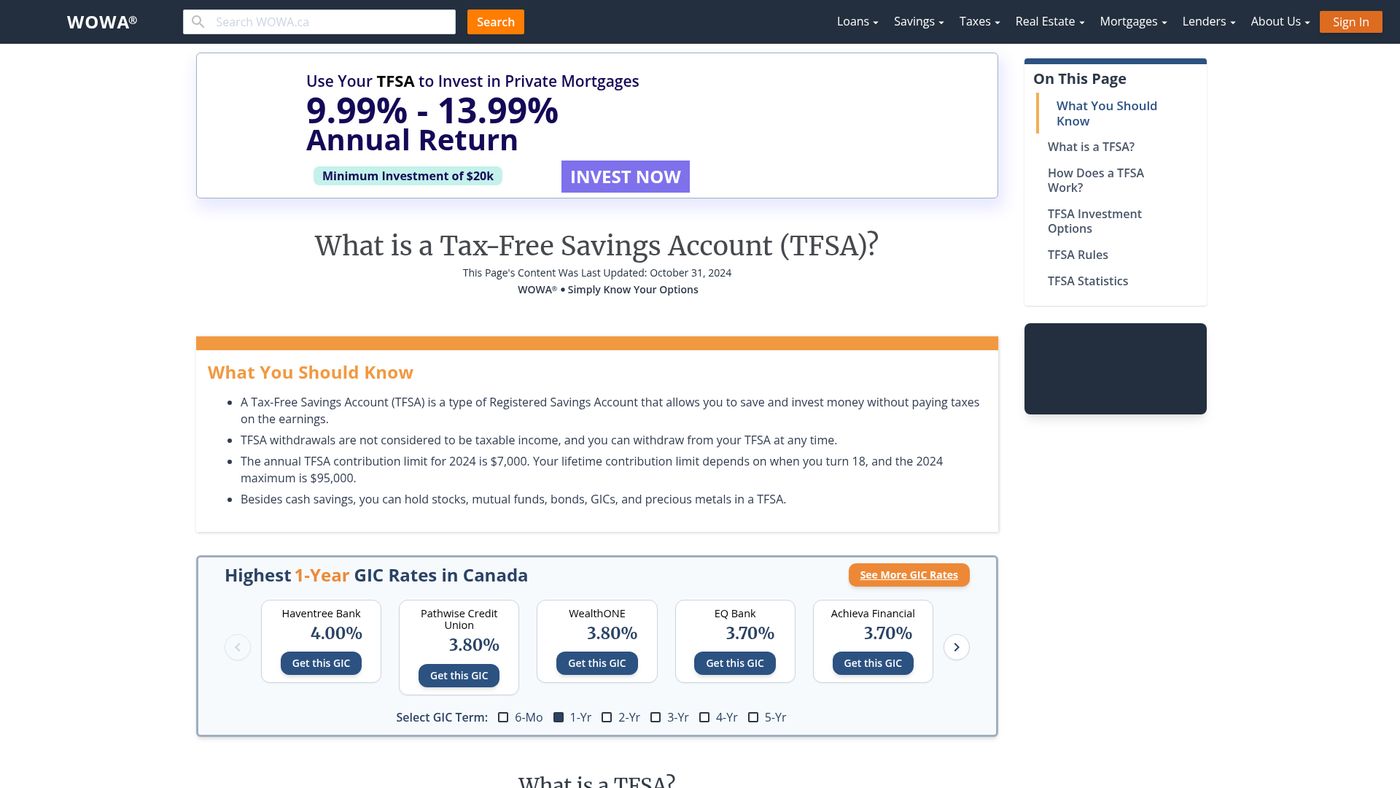
The TFSA lifetime contribution limit is not a single fixed number for everyone but a personal cumulative total. It represents the sum of every year's annual TFSA dollar limit for which you have been eligible since you turned 18. The program began in 2009, so the maximum possible lifetime limit for someone who has been eligible since then is $109,000 in 2026. Your limit accumulates each year you are at least 18 years old and a resident of Canada, even if you do not open an account or file a tax return. The annual limit is set by the federal government and is indexed to inflation, rounded to the nearest $500. It is crucial to understand that this lifetime limit is for contributions only. Investment income earned within the account does not count against it and grows tax-free.
Your personal contribution room is calculated by the Canada Revenue Agency (CRA) and consists of three components. The first is the current year's annual dollar limit, which is $7,000 for 2026. The second is any unused contribution room carried forward from all previous years you were eligible. The third is the total amount of any TFSA withdrawals you made in the previous calendar year, as those amounts are added back to your room on January 1. It is your responsibility to know your own limit, and the CRA provides tools like My Account and the Tax Information Phone Service (TIPS) to help you track it.
The CRA determines your available TFSA contribution room based on information provided annually by TFSA issuers like banks and investment firms. This information includes your contributions and withdrawals. Because these reports are submitted annually, there is a lag, and your current-year transactions may not be reflected in the CRA's official number until after February of the following year. This lag is why personal record-keeping is strongly recommended to avoid over-contribution based on outdated information.
Annual Contribution Limits and Cumulative History
The annual TFSA contribution limit has changed over the years since its introduction. It started at $5,000 for 2009 and remained at that level for several years before increasing with inflation. The limit for 2024 is $7,000, and this amount has been confirmed for both 2025 and 2026. The following table shows the complete annual and cumulative limits for an individual eligible since 2009.
| Year | Annual Limit | Cumulative Limit |
|---|---|---|
| 2009 | $5,000 | $5,000 |
| 2024 | $7,000 | $95,000 |
| 2025 | $7,000 | $102,000 |
| 2026 | $7,000 | $109,000 |
If you became eligible after 2009, your lifetime limit starts the year you turn 18. The cumulative limit grows each January 1 when the new year's contribution room is added to your total. This rollover of unused room continues indefinitely, providing significant flexibility for long-term savings planning. The annual limit is indexed to inflation and rounded to the nearest $500, which is why it does not change every year.
Eligibility, Provincial Rules, and Non-Resident Status
To accumulate TFSA contribution room, you must be a resident of Canada and at least 18 years old with a valid Social Insurance Number (SIN). Room accumulates each year these conditions are met, regardless of whether you open an account. There is an important provincial distinction regarding the age of majority. In provinces and territories where the legal age to enter a contract is 19, such as British Columbia, New Brunswick, Newfoundland and Labrador, Northwest Territories, Nova Scotia, Nunavut, and Yukon, you cannot open a TFSA at age 18. However, you still accumulate the contribution room for the year you turn 18, and it carries forward for you to use once you turn 19.
Non-residents of Canada with a valid SIN are eligible to open a TFSA, but they cannot contribute without facing penalties. If a non-resident makes a contribution, they are subject to a tax of 1% per month for every month the contribution remains in the account. Canadian residents who become non-residents stop accumulating new TFSA room for each year they are non-residents, but their existing contribution room remains available. It is critical to understand your residency status, as defined by the CRA, to correctly determine your eligibility and room. A non-resident can hold a TFSA and the investments within it continue to grow tax-free, but no new contributions can be made without penalty.
The CRA defines a TFSA holder as a person who is at least 18 years of age and who has entered into a TFSA arrangement with an issuer. The issuer is the organization, like a bank or trust company, that offers the TFSA product. At the time of opening your account, your TFSA issuer provides specific details about how your contributions can be invested and the types of returns you can expect. Working with an issuer is necessary to establish the account and ensure it is properly registered with the CRA.
Detailed Rules for Withdrawals and Re-contributions
Withdrawals from a TFSA are tax-free and can be made at any time for any purpose. The amount you withdraw is not lost from your contribution space forever. The full amount of any withdrawal made in a calendar year is added back to your contribution room at the beginning of the following calendar year. For example, a $3,000 withdrawal made in December 2026 will increase your contribution room on January 1, 2027, by $3,000. This rule provides great flexibility, allowing you to access funds and later replenish your savings. Withdrawals do not need to be reported as income and do not affect income-tested benefits like Old Age Security or the Canada Child Benefit.
A common mistake is attempting to re-contribute a withdrawal within the same calendar year without having sufficient contribution room left. If you have already maxed out your contribution room for the year, putting the withdrawn money back in before January 1 will result in an over-contribution. You must wait until the next calendar year for the withdrawal amount to be officially added to your room. Keeping personal records of all withdrawals and contributions is essential to avoid this error, as CRA data may lag. For instance, if you contributed $7,000 in 2026, your room is zero. A withdrawal later in 2026 does not create immediate new room for a re-contribution that same year.
The re-contribution rule also applies to multiple withdrawals. The total of all withdrawals made in a year is summed and added back as a single amount on January 1 of the next year. This sum is then available for you to contribute again, in addition to the new year's annual limit and any carried-forward room. This feature makes the TFSA uniquely flexible for savings goals that may require periodic access to funds, such as saving for a vehicle, home renovations, or an emergency fund.
Calculating and Tracking Your Contribution Room
The most reliable way to know your exact TFSA contribution room is to check with the Canada Revenue Agency. You can log into your CRA My Account online service, where you will find a section detailing your TFSA contribution room. Alternatively, you can call the CRA's Tax Information Phone Service (TIPS) at 1-800-267-6999. The CRA can also provide a TFSA Room Statement and a TFSA Transaction Summary upon request. It is important to note that the CRA's information may not reflect contributions or withdrawals from the current year until after February, as they rely on annual reports from financial institutions.
Given the potential lag in CRA data, maintaining your own records is a prudent practice. You should keep statements from all your TFSA providers and track every deposit and withdrawal. You can calculate your current year's room manually by adding your known unused room from previous years, adding the current year's annual limit, adding withdrawals from the previous year, and then subtracting all contributions made in the current year. This personal ledger will help you stay within your limits and provide documentation if there is a discrepancy with the CRA. You can have multiple TFSA accounts with different issuers, but your combined contributions to all of them cannot exceed your personal contribution room.
If you have not kept track, you must rely on the CRA's records. However, you should be aware that the CRA determines your available TFSA contribution room based on information provided annually by TFSA issuers. Discrepancies can occur, so it is in your best interest to ensure your records align with those of the CRA. If you discover an error, you should contact your TFSA issuer to have them correct their report to the CRA.
The Costly Consequences and Calculation of Over-Contribution
Over-contributing to your TFSA happens when the total amount you have deposited across all your TFSAs exceeds your available contribution room. The Canada Revenue Agency imposes a penalty tax of 1% per month on the highest excess amount in the account for each month the over-contribution remains. This penalty applies regardless of whether the over-contribution was accidental. The tax is calculated on the highest excess TFSA amount in the account for each month.
Several situations can lead to an over-contribution. One is simply losing track of deposits across multiple TFSA accounts. Another is misunderstanding the re-contribution rule and depositing a withdrawal in the same year. A third is incorrectly estimating your contribution room, especially if the CRA's records, which rely on annual reporting from financial institutions, have not yet been updated with your recent transactions. The onus is entirely on the individual to monitor their contributions and correct any excess promptly by withdrawing the extra funds. The penalty continues to apply every month until the excess amount is withdrawn. The formula for the penalty is 1% multiplied by the highest excess amount in the month, multiplied by the number of months the excess remains. If you partially withdraw the excess, the penalty in subsequent months is calculated on the new, lower excess amount.
Key Differences Between TFSA and RRSP
While both TFSAs and RRSPs are registered savings vehicles, their rules regarding contributions and taxation are fundamentally different. TFSA contributions are made with after-tax dollars. You do not get a tax deduction when you contribute. In contrast, RRSP contributions are tax-deductible, reducing your taxable income for the year. Withdrawals from a TFSA are completely tax-free, while RRSP withdrawals are treated as taxable income. TFSA contribution room is not dependent on earned income, whereas RRSP room is based on a percentage of your previous year's earned income.
Another major difference is the effect on government benefits. Money withdrawn from a TFSA is not considered income, so it does not affect your eligibility for income-tested federal benefits like Old Age Security, the Guaranteed Income Supplement, the Canada Child Benefit, or the GST/HST credit. RRSP withdrawals, however, are counted as income and could potentially reduce these benefits. Unlike an RRSP, there is no requirement to convert a TFSA into a retirement income vehicle at any age.
TFSA contribution room accumulates every year for anyone 18 and over, regardless of employment or income. RRSP room only grows with earned income. TFSA withdrawals are added back to your contribution room in the following year, allowing you to re-contribute. RRSP withdrawals are permanently removed from your retirement savings, except under specific programs like the Home Buyers' Plan. Both accounts can hold similar investments like cash, GICs, mutual funds, ETFs, and stocks, but their tax treatment and purpose are designed for different financial planning stages.
Common Uses and Advantages of a TFSA
A TFSA is a flexible account suitable for both short and long-term savings goals. Many people use a TFSA to set aside money for a down payment on a home, a new vehicle, a vacation, or an emergency fund. Because withdrawals are tax-free and do not affect government benefits, it is also an excellent tool for saving for retirement income supplementation. Unlike other registered accounts, there are no restrictions on how you use the money you withdraw. You are free to save for whatever you want.
All investment income earned within a TFSA, including interest, dividends, and capital gains, is tax-free for life. This tax-free growth applies while the money is in the account and when it is withdrawn. You never have to report TFSA earnings or withdrawals as income on your tax return. This makes the TFSA a powerful tool for investing, as compounded growth is not eroded by annual taxes. A TFSA can contain many types of eligible investments, including cash savings, mutual funds, securities listed on a designated stock exchange, guaranteed investment certificates (GICs), and bonds.
The TFSA also offers estate planning benefits. Upon death, the full value of a TFSA can be transferred to a surviving spouse or common-law partner's TFSA without affecting their contribution room and without immediate tax consequences. If transferred to another beneficiary, the funds are not taxable to the deceased, but the account's fair market value at the date of death may be considered income on the final return if there is a gain on certain properties. The flexibility, tax-free growth, and lack of impact on benefits make the TFSA a fundamental component of Canadian personal finance.
Frequently asked questions
What is the TFSA lifetime contribution limit for 2026?
For a Canadian resident who has been eligible since 2009 and has never contributed, the lifetime contribution limit as of 2026 is $109,000. This cumulative limit is the sum of all annual contribution room from 2009 through 2026. Your personal limit will be lower if you became eligible after 2009, such as the year you turned 18. It will also be lower if you have already made any contributions to a TFSA.
What happens if I over-contribute to my TFSA?
If you contribute more than your available TFSA contribution room, you must pay a penalty tax of 1% per month. This tax is calculated on the highest excess TFSA amount in your account for each month the over-contribution remains. You are responsible for withdrawing the excess funds to stop the penalty from accruing further. You must also file a TFSA return to report and pay this tax.
Can I re-contribute a TFSA withdrawal in the same year?
You can only re-contribute a withdrawal in the same calendar year if you have unused contribution room remaining for that year. If you have already used all your contribution room, re-contributing the withdrawn amount will result in an over-contribution. To avoid penalties, you can wait until January 1 of the following year when the withdrawal amount is added back to your contribution room. For example, if you withdraw money in 2024, that amount is only added back to your contribution room at the beginning of 2025. Over contributions are subject to a tax penalty of 1 percent per month on the excess amount.
How do I find out my TFSA contribution room?
You can find your official TFSA contribution room by logging into the CRA My Account online service. You can also call the Tax Information Phone Service (TIPS) at 1-800-267-6999. The CRA updates this information annually based on reports from financial institutions, so it may not reflect transactions from the current year until after the end of February. It is also recommended that you keep your own transaction records to ensure they align with the CRA's information. Your contribution room consists of the current year's limit, any unused room from previous years, and the value of withdrawals from the previous year.
Do I lose TFSA contribution room if I don't use it?
No, you do not lose unused TFSA contribution room. Any unused room from a given year is carried forward indefinitely into future years. This room accumulates each year you are eligible, which means you are 18 or older and a resident of Canada, even if you do not open an account or file a tax return. Your total contribution room consists of the current year's limit plus all accumulated unused room from previous years. For instance, if you were eligible starting in 2009 and never contributed, your lifetime limit would be $109,000.
Can I contribute to my spouse's TFSA?
You cannot contribute directly to your spouse's or common law partner's TFSA account. However, you can give them money, which they can then contribute to their own TFSA using their own available contribution room. Any investment income earned on those funds within their TFSA belongs to them and grows tax free. This is different from a spousal RRSP, where you can contribute directly. The income attribution rules do not apply to funds gifted for a TFSA contribution.
Sources and further reading
- 2026 Maximum TFSA Contribution Limits & Withdrawal Rules td.com
- What you should know about contributing to your TFSA in ... scotiabank.com
- TFSA Calculator, RBC Royal Bank rbcroyalbank.com
- What is the TFSA limit for 2025? (+ TFSA lifetime limits) fbc.ca
- How to determine your TFSA contribution limit northernbirchcu.com
This article explains how things work and is not financial, tax or legal advice. Rules, limits and rates change, so check the current figures with the Canada Revenue Agency, your province or your financial institution before you act.