Your RRSP contribution limit is the maximum amount you can contribute to a Registered Retirement Savings Plan in a year without tax penalties. This limit is calculated as 18% of your earned income from the previous year, up to an annual maximum dollar amount set by the federal government. Unused contribution room from past years carries forward, increasing your available limit. Understanding your personal RRSP contribution limit is crucial for effective retirement planning and avoiding costly over-contribution penalties.
How Your RRSP Contribution Limit Is Calculated
Your annual RRSP contribution limit is determined by a formula set by the Canada Revenue Agency. The primary calculation is 18% of your earned income from the previous tax year. Earned income generally includes employment income, business income, rental income, and certain other sources, but excludes investment income. This percentage is applied to your income to generate a preliminary limit. However, this amount is capped by a federally mandated annual maximum dollar amount, which is indexed to inflation. For the 2026 tax year, this maximum limit is $33,810. Your final contribution limit for the current year is the lower of these two figures: either 18% of your previous year's income or the annual dollar maximum. This calculation forms the base for your new contribution room each year.
In addition to the new room generated each year, any unused contribution room from previous years is added to your current limit. This carry-forward provision means you do not lose contribution room if you cannot maximize your RRSP contributions in a given year. The cumulative total of your new room plus all carried-forward unused room represents your total available contribution room. This total is the absolute maximum you can contribute across all your RRSP accounts without facing penalties. It is important to note that contributions to a spousal RRSP count against your own personal contribution limit, not your spouse's limit. The system is designed to provide flexibility, allowing Canadians to save more in higher-income years to offset years when saving was less feasible.

Annual RRSP Contribution Limits by Year
The federal government sets the annual RRSP dollar limit, which is the maximum contribution room that can be generated from earned income in a given year. This limit is adjusted periodically, often annually, based on changes in average wages. Knowing the limits for recent and upcoming years helps with long-term financial planning. The limit for the 2024 tax year is $31,560. For the 2025 tax year, the limit increases to $32,490. Looking ahead to 2026, the annual limit is set at $33,810. These figures represent the ceiling for the 18% of earned income calculation. If 18% of your previous year's income exceeds these amounts, your new room is capped at the dollar limit.
The federal government sets an annual maximum dollar limit for RRSP contributions. For the 2025 tax year, the annual RRSP contribution limit is $32,490. For the 2026 tax year, the annual limit is set at $33,810. These limits represent the maximum amount of new contribution room that can be generated from your previous year's earned income. Your personal limit is calculated as 18% of your previous year's earned income or this annual maximum, whichever is lower.
| Tax Year | Annual Dollar Limit |
|---|---|
| 2024 | $31,560 |
| 2025 | $32,490 |
| 2026 | $33,810 |
It is essential to remember that these figures are for the new contribution room generated in that tax year. Your personal limit will be this amount or 18% of your previous year's income, whichever is lower, plus any carried-forward room from all prior years. The limits are announced well in advance, allowing taxpayers to plan their contributions accordingly. These increases reflect the government's indexing of the plan to keep pace with wage growth and maintain the value of the retirement savings incentive.
Finding Your Personal RRSP Deduction Limit
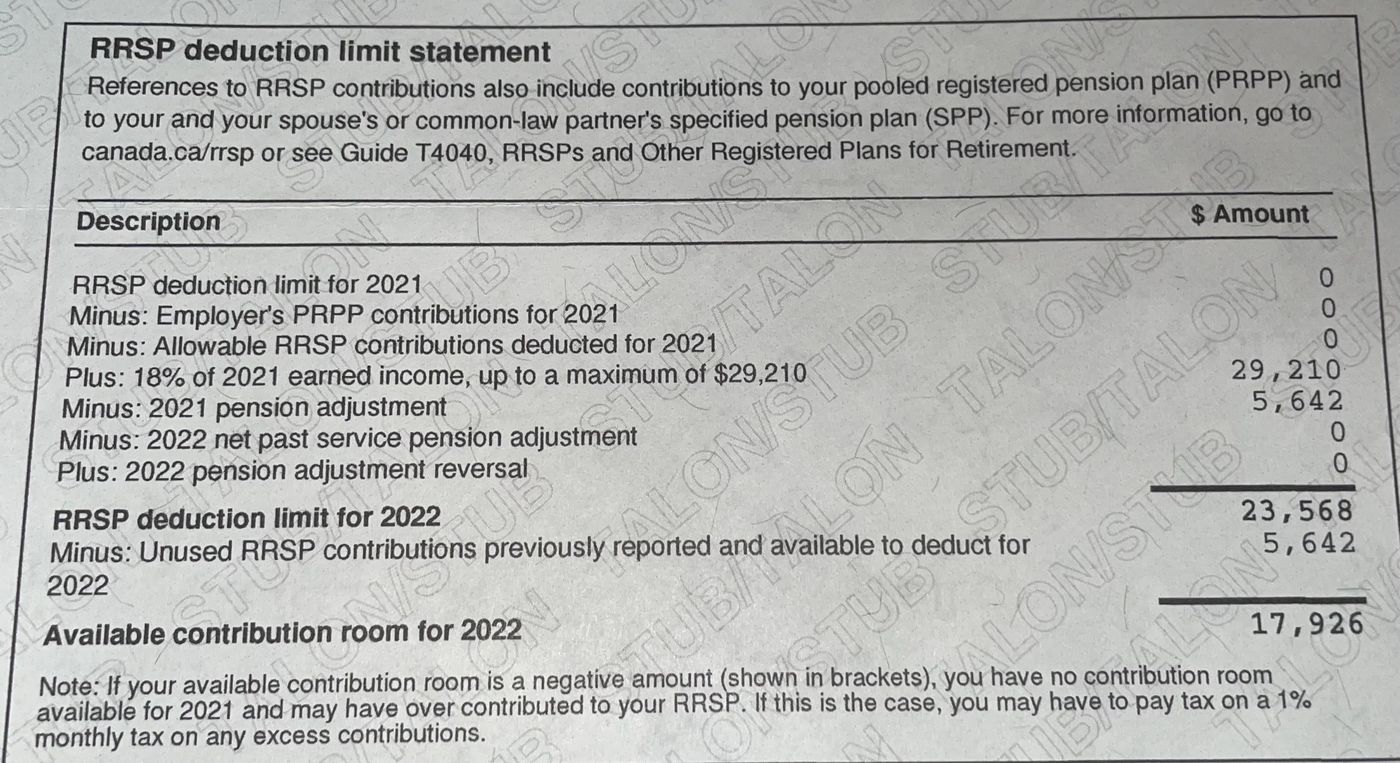
The most reliable way to know your exact RRSP deduction limit and available contribution room is to check the official documents provided by the Canada Revenue Agency. After you file your annual tax return, the CRA sends you a Notice of Assessment. This document contains a section specifically for RRSP information, titled the RRSP Deduction Limit Statement. It clearly states your deduction limit for the current year, which is the maximum amount you can claim as a tax deduction for RRSP contributions. It also shows your total available contribution room, which includes carried-forward amounts. You should always refer to your most recent Notice of Assessment for the authoritative figures.
If you need to check your limit outside of the paper notice, you have two main options. You can log into the CRA My Account portal online, where your RRSP deduction limit is displayed on the main dashboard under the Savings and Pension Plans section. Alternatively, you can call the CRA Tax Information Phone Service at 1-800-267-6999. When calling, you must have your social insurance number and other tax information ready for identity verification. Manually calculating your limit is complex because it requires knowing your exact earned income, pension adjustments, and past contribution history, which is why relying on the CRA's calculated figure is the standard practice for most Canadians.

Factors That Reduce Your RRSP Contribution Room
Several factors can reduce the amount of new RRSP contribution room you generate each year. The most significant reduction for many employed Canadians comes from participating in a workplace pension plan. If you are a member of a Registered Pension Plan or a Deferred Profit Sharing Plan, your employer reports a Pension Adjustment on your T4 slip. This PA amount represents the value of the pension benefits you accrued during the year and directly reduces your RRSP contribution room for the following year. This system prevents double-dipping on tax-assisted retirement savings.
Contributions you make to a group RRSP through your employer also count against your personal contribution limit. Furthermore, if you contribute to a Pooled Registered Pension Plan or a Specified Pension Plan, those contributions will reduce your available RRSP room. It is crucial to account for these reductions when planning your contributions, as over-contribution can occur if you only consider the 18% calculation and ignore the pension adjustment. The CRA automatically factors in these adjustments when calculating the deduction limit reported on your Notice of Assessment, which is why that document is the definitive source for your personal limit.
Rules for RRSP Over-Contributions and Penalties
The Canada Revenue Agency imposes strict rules and penalties for contributions that exceed your available RRSP contribution room. There is a small buffer allowed. If your excess contribution is $2,000 or less, you will not face a monetary penalty. However, you cannot claim a tax deduction for these excess contributions. This $2,000 buffer is intended to accommodate minor calculation errors or timing differences without punishing savers. If your total contributions exceed your limit by more than $2,000 at any point, you become subject to a penalty tax of 1% per month on the excess amount over $2,000. This penalty applies for each month the excess remains in the plan.
To stop penalties from accruing, you must withdraw the excess contributions from your RRSP. You can request permission from the CRA to withdraw the excess without having withholding tax applied by submitting Form T3012A, Tax Deduction Waiver on the Refund of your Undeducted RRSP Contribution. Without this form, a standard withdrawal will be made, and withholding tax will be deducted at source. If you owe the 1% penalty tax, you must file a special tax return, the T1-OVP Individual Tax Return for RRSP, PRPP and SPP Excess Contributions, and pay the tax owed no later than 90 days after the end of the year in which the over-contribution existed. Late filing of the T1-OVP can result in additional penalties of 5% of the balance owing, plus 1% per month for up to 12 months.
Key Dates and Deadlines for RRSP Contributions
Understanding the annual timeline for RRSP contributions is essential for tax planning. The contribution period for a specific tax year runs from January 1 of that year until 60 days after the end of the calendar year. For example, contributions made between January 1, 2025, and March 2, 2026, can be claimed on your 2025 tax return. The deadline for the 2025 tax year is March 2, 2026, as March 1 falls on a weekend. It is important to confirm the exact date each year on the CRA website, as it can shift slightly based on weekends. Contributions must be deposited and processed by your financial institution by this deadline to be eligible for the tax deduction for that year.
There is also a final age-based deadline for contributing to your own RRSP. You can contribute until December 31 of the year you turn 71 years of age. At the end of that year, you must convert your RRSP into a Registered Retirement Income Fund, use the funds to purchase an annuity, or cash out the plan. Any unused contribution room you have accumulated up to that point expires and can no longer be used after this date. This makes age 71 a critical planning milestone for retirement savings. Contributions to a spousal RRSP can continue until December 31 of the year your spouse turns 71, provided you are under 71 yourself and have contribution room.
Common Mistakes and Misconceptions About RRSP Limits
One common mistake is confusing the RRSP deduction limit with the contribution room. The deduction limit is the maximum you can deduct on your tax return for a given year. Your contribution room is the total amount you can actually contribute, which includes deductions you may choose to carry forward. If you contribute but do not claim the deduction immediately, your contribution room decreases, but your deduction limit for future years increases. Another error is forgetting to account for pension adjustments from workplace plans, which can lead to unintentional over-contribution. Many people also mistakenly believe that contributions to a spousal RRSP create separate, additional room, when in fact they draw from the contributor's own limit.
Failing to track contributions across multiple RRSP accounts is another pitfall. Your contribution limit is a single, aggregate limit that applies to the sum of all contributions across all your individual and spousal RRSP accounts. Some investors also misunderstand the carry-forward rules, thinking unused room expires after a few years, when in fact it carries forward indefinitely until you turn 71. Lastly, a major misconception is assuming the annual dollar limit is a universal contribution amount for everyone, rather than a maximum cap.
Frequently asked questions
What happens if I over-contribute to my RRSP?
If you over-contribute by more than $2,000, you must pay a penalty tax of 1% per month on the excess amount over $2,000. You must withdraw the excess to stop further penalties and may need to file a special T1-OVP tax return. Over-contributions of $2,000 or less are not penalized, but you cannot deduct them from your income. You can request a tax waiver from the CRA to withdraw excess funds without withholding tax.
How does a workplace pension affect my RRSP limit?
Participation in a workplace Registered Pension Plan or Deferred Profit Sharing Plan reduces your RRSP contribution room. Your employer reports a Pension Adjustment on your T4 slip, which represents the value of pension benefits earned. This PA amount is subtracted from the new RRSP room you would otherwise generate. The CRA automatically includes this reduction in the deduction limit shown on your Notice of Assessment.
What is the RRSP contribution limit for 2025?
The RRSP contribution limit for the 2025 tax year is $32,490. This figure represents the maximum annual limit set by the federal government for new contribution room generated from your previous year's income. Your personal limit is calculated as 18 percent of your earned income from 2024, up to this $32,490 maximum. To determine your total available contribution room for 2025, you add any unused RRSP contribution room carried forward from prior years to this calculated amount. The official limit for the subsequent year, 2026, is set at $33,810.
Where can I find my RRSP contribution limit?
You can find your official RRSP deduction limit on the Notice of Assessment sent by the Canada Revenue Agency after you file your tax return. This document contains a statement of your RRSP deduction limit and available contribution room. Alternatively, you can log into your CRA My Account online to view this information on the main page under the Savings and pension plans section. You may also call the CRA Tax Information Phone Service at 1 800 267 6999 to confirm your limit.
Can I carry forward unused RRSP contribution room?
Yes, you can carry forward unused RRSP contribution room indefinitely. Any contribution room you do not use in a tax year is added to your available room for all future years. This cumulative carry forward amount is shown on your Notice of Assessment from the CRA. You can use this accumulated room at any time until December 31 of the year you turn 71, which is the final date you can contribute to your own RRSP.
What is the deadline to contribute to an RRSP for the 2025 tax year?
The contribution deadline for the 2025 tax year is March 2, 2026. To be eligible for a tax deduction on your 2025 return, contributions must be made by this date. This deadline is typically 60 days after the end of the calendar year. You should always confirm the exact date each year on the Canada Revenue Agency website as it can vary slightly.
Sources and further reading
- Maximum RRSP contribution. nbc.ca
- RRSP Rules and Contribution Limits rbcroyalbank.com
- What you need to know about RRSP contributions for this ... scotiabank.com
- RRSP Deduction Limits in Canada: Rules and Calculation wealthsimple.com
- RRSP Contribution limit and Deduction Rules in 2026 td.com
This article explains how things work and is not financial, tax or legal advice. Rules, limits and rates change, so check the current figures with the Canada Revenue Agency, your province or your financial institution before you act.