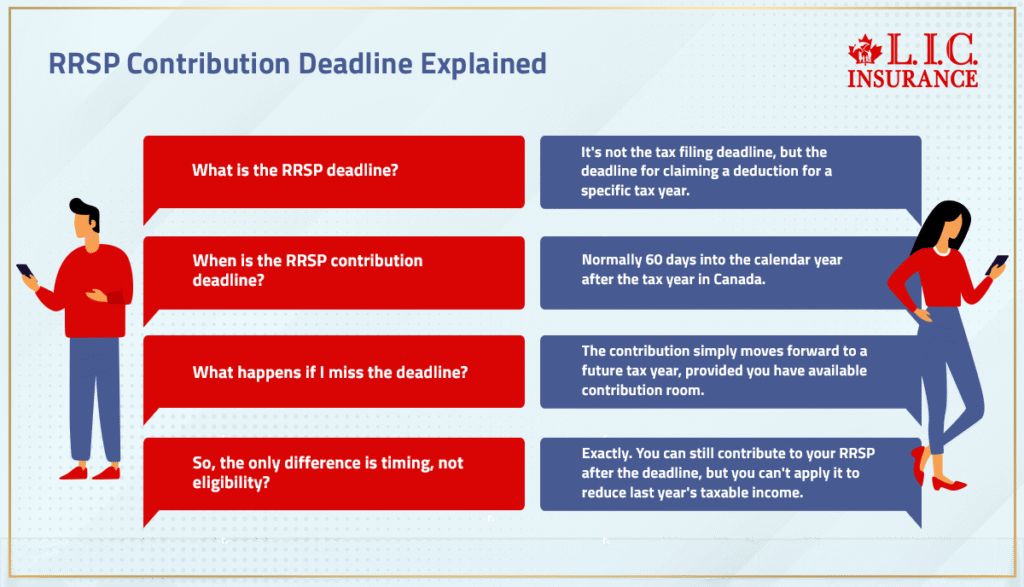
The RRSP contribution deadline is the last day you can contribute to your Registered Retirement Savings Plan and claim a deduction on your previous year's tax return. In Canada, this deadline falls 60 days after the end of the tax year, typically on March 1 or March 2. For the 2025 tax year, the deadline is March 2, 2026. Understanding this deadline and your contribution limits is crucial for maximizing tax savings and building your retirement fund.
Understanding the RRSP Contribution Deadline
The RRSP contribution deadline is a fixed annual date that allows Canadians to make contributions for the previous tax year. The rule is that you have the first 60 days of the new calendar year to make a contribution that can be deducted from your income for the tax year that just ended. For the 2025 tax year, which ended on December 31, 2025, the contribution deadline is March 2, 2026. This 60-day window provides a grace period for individuals to finalize their contributions, often using year-end bonuses or tax refund calculations to inform their decisions. Contributions made after this deadline, for example on March 3, 2026, will generally apply to the 2026 tax year instead, assuming you have available contribution room.
The deadline date shifts slightly each year based on the calendar. It is typically March 1, but moves to March 2 when March 1 is a Sunday, and was February 29 for the 2023 tax year due to the leap year. This consistent 60-day rule means you can always mark your calendar by counting forward from New Year's Day. The deadline applies to contributions made to your own RRSP or to a spousal RRSP. Making a contribution by this date is the administrative step that allows you to claim the corresponding tax deduction when you file your return, which can lower your taxable income and potentially generate a refund.
Annual Contribution Limits and How They Work
Your RRSP contribution limit is the maximum amount you can contribute to receive a tax deduction for a given year. For the 2025 tax year, the maximum dollar limit is set at $32,490. This limit is not a flat amount for everyone, it is calculated as 18 percent of your earned income from the previous year, up to that maximum. Earned income generally includes employment salary, commissions, and business income, but does not include investment income or pension payments. This calculation ensures that your contribution room grows in proportion to your working income.
Your personal limit is further adjusted by a pension adjustment if you participate in an employer-sponsored registered pension plan or deferred profit-sharing plan. The pension adjustment reduces your new RRSP contribution room for the year to account for the retirement benefits already accrued through your workplace. Any unused RRSP contribution room from previous years is carried forward indefinitely, allowing you to contribute more in future years if you were unable to maximize your contributions earlier. You can find your exact personal RRSP deduction limit for the current year on your most recent Notice of Assessment from the Canada Revenue Agency or by logging into your CRA My Account online.
Key RRSP Contribution Deadlines by Tax Year
The RRSP contribution deadline is set by law to be 60 days after the end of the tax year on December 31. This results in a predictable annual deadline. For example, the deadline for the 2025 tax year is March 2, 2026. The deadline for the 2026 tax year is March 1, 2027.
- For the 2022 tax year, the contribution deadline was March 1, 2023.
- For the 2023 tax year, the contribution deadline was February 29, 2024.
- For the 2024 tax year, the contribution deadline is March 3, 2025.
- For the 2025 tax year, the contribution deadline is March 2, 2026.
- For the 2026 tax year, the contribution deadline is March 1, 2027.
The deadline may shift slightly from the typical March 1 date due to weekends or leap years. For instance, the deadline for the 2024 tax year was February 29, 2024, due to the leap year. Your contribution must be processed by your financial institution by the end of the business day on the deadline date. This is the last day you can make an RRSP contribution to reduce your tax bill for the previous year.

Rules for Overcontributions and Penalties
The Canada Revenue Agency allows a lifetime overcontribution buffer of $2,000 without applying a penalty. This means you can contribute up to $2,000 more than your available deduction limit at any time without facing immediate financial consequences. This buffer is designed to accommodate minor calculation errors or timing differences. However, any overcontribution that exceeds this $2,000 buffer is subject to a penalty tax of one percent per month on the excess amount. This penalty applies for each month the excess remains in your RRSP.
If you discover you have overcontributed beyond the buffer, you should withdraw the excess funds from your RRSP. To avoid having the withdrawal counted as taxable income, you must complete and submit the required CRA form, T3012A, to request authorization for a tax-free withdrawal of the overcontribution. It is crucial not to guess your contribution limit. Relying on your official Notice of Assessment or CRA My Account is the best way to prevent costly overcontribution errors and the associated monthly penalties.
Contributing to a Spousal RRSP
A spousal RRSP is a plan where one spouse contributes to an RRSP that is owned by the other spouse. The contributor uses their own RRSP contribution room and claims the tax deduction for the amount contributed. The primary objective of this strategy is income splitting in retirement, as withdrawals are taxed in the hands of the lower-income spouse. The combined total of contributions to your own RRSP and a spousal RRSP must not exceed your personal RRSP deduction limit for the year.
There is an important attribution rule to be aware of with spousal RRSPs. If the spouse who owns the plan makes a withdrawal from the spousal RRSP within three years of a contribution being made by their partner, the withdrawal amount is taxed as income to the contributor, not the owner. This rule prevents the immediate shifting of income for tax purposes. After the three-year period, withdrawals are fully attributed to the spouse who owns the plan, making it an effective long-term strategy for couples with different income levels.
The Final Contribution Age and Mandatory Conversion
December 31 of the year you turn 71 years old is the absolute last day you can contribute to your own RRSP. This is a hard deadline set by the Canada Revenue Agency. By the end of that year, you must also convert your RRSP into a retirement income option. You cannot simply leave the funds in an RRSP past this age. The available options are to convert the RRSP into a Registered Retirement Income Fund, purchase an annuity, or take the entire value as a lump-sum cash withdrawal, which would be fully taxable.
If you convert your RRSP to a RRIF, you must begin taking minimum annual withdrawals starting the year after the RRIF is established. The minimum withdrawal percentage starts at 5.28 percent at age 71 and increases each year. There is no maximum amount you can withdraw from a RRIF, but any amount taken out is added to your taxable income for that year. The strategy of contributing during higher-earning years and withdrawing in lower-earning retirement years leverages the tax-deferred growth of the RRSP to potentially reduce your lifetime tax burden.
Receipts, Reporting, and Contribution Timing
When you contribute to an RRSP, your financial institution will provide you with official contribution receipts for tax purposes. These are typically issued in two parts. The first receipt covers contributions made from March 3 to December 31 of the previous year. The second receipt covers contributions made during the first 60 days of the current year, from January 1 to the deadline. You need the totals from both receipts to claim your full deduction on your tax return. You report your RRSP contributions on Schedule 7 of your income tax return, which is filed with your annual return.
It is important to note that you do not have to claim the deduction in the same year you make the contribution. You can choose to defer claiming the deduction to a future tax year if you expect to be in a higher tax bracket, which would make the deduction more valuable. This flexibility allows for strategic tax planning, but the contribution itself must still be made by the applicable deadline to be eligible for any deduction. Contributions made within the first 60 days can be applied to the previous year's income, giving you the option to claim them now or later.
Withdrawal Rules and Tax Implications
You can withdraw money from your RRSP at any time, but such withdrawals are added to your taxable income for the year. Your financial institution is required to withhold a portion of the withdrawal as a prepayment of the tax you will owe. Quebec residents are subject to different provincial withholding rates. This withheld amount is sent directly to the CRA and is credited against your final tax bill for the year.
Unlike a Tax-Free Savings Account, you do not regain RRSP contribution room when you make a standard withdrawal. The contribution room used for that money is permanently lost. There are two government programs that allow for tax-free withdrawals under specific conditions, the Home Buyers' Plan and the Lifelong Learning Plan, but these require the funds to be repaid to the RRSP over time. For all other withdrawals, the tax is due, and the room is gone, which is why RRSPs are generally considered long-term retirement savings vehicles.
Frequently asked questions
What is the RRSP contribution deadline for 2025?
The RRSP contribution deadline for the 2025 tax year is March 2, 2026. This is the last day you can contribute to your own or a spousal RRSP to claim a deduction on your 2025 income tax return. Contributions made within the first 60 days of the year, on or before this deadline, can be deducted from your 2025 taxable income. Any contributions made after March 2, 2026, will generally be applied to the 2026 tax year instead. You can also choose to postpone claiming the deduction for a contribution to a future tax year.
How is the RRSP contribution deadline determined?
The RRSP contribution deadline is set by law as 60 days after the end of the tax year, December 31. This rule means the deadline typically falls on March 1 each year. The date adjusts when March 1 is a Sunday, making the deadline March 2, as it is for the 2025 tax year. During a leap year, the deadline is February 29, as it was for the 2023 tax year. This 60 day grace period at the start of each calendar year is a consistent feature of the RRSP system.
What happens if I miss the RRSP contribution deadline?
If you contribute after the deadline, that contribution will generally apply to the current tax year, not the previous one. For example, a contribution made on March 3, 2026, would be for the 2026 tax year, and you could claim the deduction on your 2026 tax return filed in 2027. Your contribution room does not disappear. Unused room carries forward indefinitely. You can still use the contribution room in a future year, provided you have not exceeded your personal limit.
What is my RRSP contribution limit for 2025?
For the 2025 tax year, your maximum contribution limit is generally 18 percent of your earned income from 2024, up to a government set maximum of $32,490. Your personal limit may be reduced by a pension adjustment if you belong to a workplace pension plan. You should check your specific limit on your latest Notice of Assessment from the Canada Revenue Agency or via your CRA My Account online. Any unused contribution room from previous years is also carried forward and added to your current limit.
Can I contribute to an RRSP after age 71?
No, you cannot contribute to your own RRSP after December 31 of the year you turn 71. This is the final contribution deadline for your personal plan. However, you may still contribute to a spousal RRSP after you turn 71 if your spouse is 71 or younger and you have available contribution room. The age restriction is based on the age of the plan holder, or annuitant. At age 71, you must convert your RRSP into a retirement income option like a RRIF or an annuity.
What is the penalty for overcontributing to my RRSP?
The penalty for overcontributing applies if you exceed your lifetime limit by more than a $2,000 buffer. You are allowed this $2,000 overcontribution without penalty. Any excess amount beyond that $2,000 buffer is subject to a penalty of 1 percent per month. To stop the penalty, you must withdraw the excess funds from your RRSP. You may also need to submit the required forms to the Canada Revenue Agency to correct the overcontribution.
Sources and further reading
- RRSP Contribution Deadlines | TD Canada Trust td.com
- RRSP Contribution Deadline & Limits Guide rbcroyalbank.com
- RRSP deadline and limits cooperators.ca
- RRSP contribution deadline for 2026 wealthsimple.com
- RRSP contribution deadline nbc.ca
This article explains how things work and is not financial, tax or legal advice. Rules, limits and rates change, so check the current figures with the Canada Revenue Agency, your province or your financial institution before you act.