CIBC mortgage rates are the interest rates offered by the Canadian Imperial Bank of Commerce on its home loan products. These rates are available in both fixed and variable formats and are influenced by the bank's prime rate, which is currently 4.45% as of late 2025. Understanding CIBC's mortgage offerings, including posted versus special rates and the differences between open and closed terms, is important for Canadian homebuyers and homeowners looking to renew or refinance. The rates form a key part of the cost of homeownership and are directly affected by the Bank of Canada's monetary policy decisions.
Understanding CIBC's Prime Rate
The CIBC prime rate is the foundational interest rate the bank uses to price its variable-rate lending products, including mortgages, lines of credit, and credit cards. As of October 30, 2025, CIBC's prime rate is 4.45%, which is aligned with the prime rates posted by other major Canadian financial institutions. This rate typically changes only in response to adjustments made by the Bank of Canada to its target for the overnight rate. When the Bank of Canada raises or lowers this key policy rate, CIBC usually adjusts its prime rate by an identical amount, measured in basis points where one basis point equals 0.01%. There have been historical exceptions where CIBC and other major banks did not fully pass on a Bank of Canada rate cut, such as lowering their prime rate by only 15 basis points following a 25 basis point cut. For variable-rate mortgage products, the interest rate is expressed as the CIBC prime rate plus or minus a specified percentage, meaning the borrower's payment fluctuates directly with changes to the prime rate.

Types of CIBC Mortgage Products
CIBC offers a comprehensive suite of mortgage products to cater to different borrower needs and risk tolerances. The primary distinction is between fixed-rate and variable-rate mortgages. A fixed-rate mortgage guarantees that the interest rate and the regular payment amount will remain unchanged for the entire term of the mortgage, which provides payment stability regardless of market fluctuations. In contrast, a variable-rate mortgage has an interest rate that can rise or fall during the term based on changes to the CIBC prime rate. When the prime rate decreases, more of the borrower's payment is applied to the principal, and when it increases, more goes toward interest. CIBC also differentiates between open and closed mortgages. An open mortgage allows the borrower to increase payments or pay off the mortgage in full at any time without penalty, though it typically comes with a higher interest rate. A closed mortgage imposes annual limits on prepayments but offers a lower interest rate. Additionally, CIBC provides specialized products like a six-month closed convertible mortgage, which can be converted to a longer-term mortgage without penalty, and offers mortgages for second homes and investment properties.
CIBC offers a range of mortgage products including fixed rate closed, fixed rate open, convertible, and variable rate mortgages. A fixed rate mortgage provides security as the interest rate and monthly payments stay the same for the entire term. A high ratio mortgage is for a principal greater than 80 percent of the property value and requires mortgage default insurance. CIBC also offers variable rate mortgages where the interest rate can change based on the CIBC prime rate.
- Fixed-Rate Closed Mortgage: Offers a locked-in interest rate for the term with limits on annual prepayments.
- Fixed-Rate Open Mortgage: Provides a fixed interest rate with the flexibility to make unlimited prepayments without penalty.
- Convertible Mortgage: A short-term closed mortgage that can be converted to a long-term mortgage at any time without a prepayment charge, useful if interest rates fall.
- Variable Flex Mortgage: A variable-rate mortgage that allows annual prepayments of up to 20% of the original principal without a prepayment charge.
- Variable Rate Open Mortgage: Features a variable interest rate with the ability to pay off the mortgage in full at any time without penalty.
- High-Ratio Mortgage: A mortgage where the principal is greater than 80% of the property value, requiring mandatory mortgage default insurance.
Fixed rate mortgages offer the security of a predictable payment unaffected by market changes. Open mortgages provide flexibility to pay off the mortgage at any time without penalty but often have higher rates. A convertible mortgage is a short term option that can be converted to a long term mortgage without a prepayment charge. A high ratio mortgage is considered a higher risk loan and requires mandatory mortgage default insurance.
Posted Rates Versus Special Discounted Rates
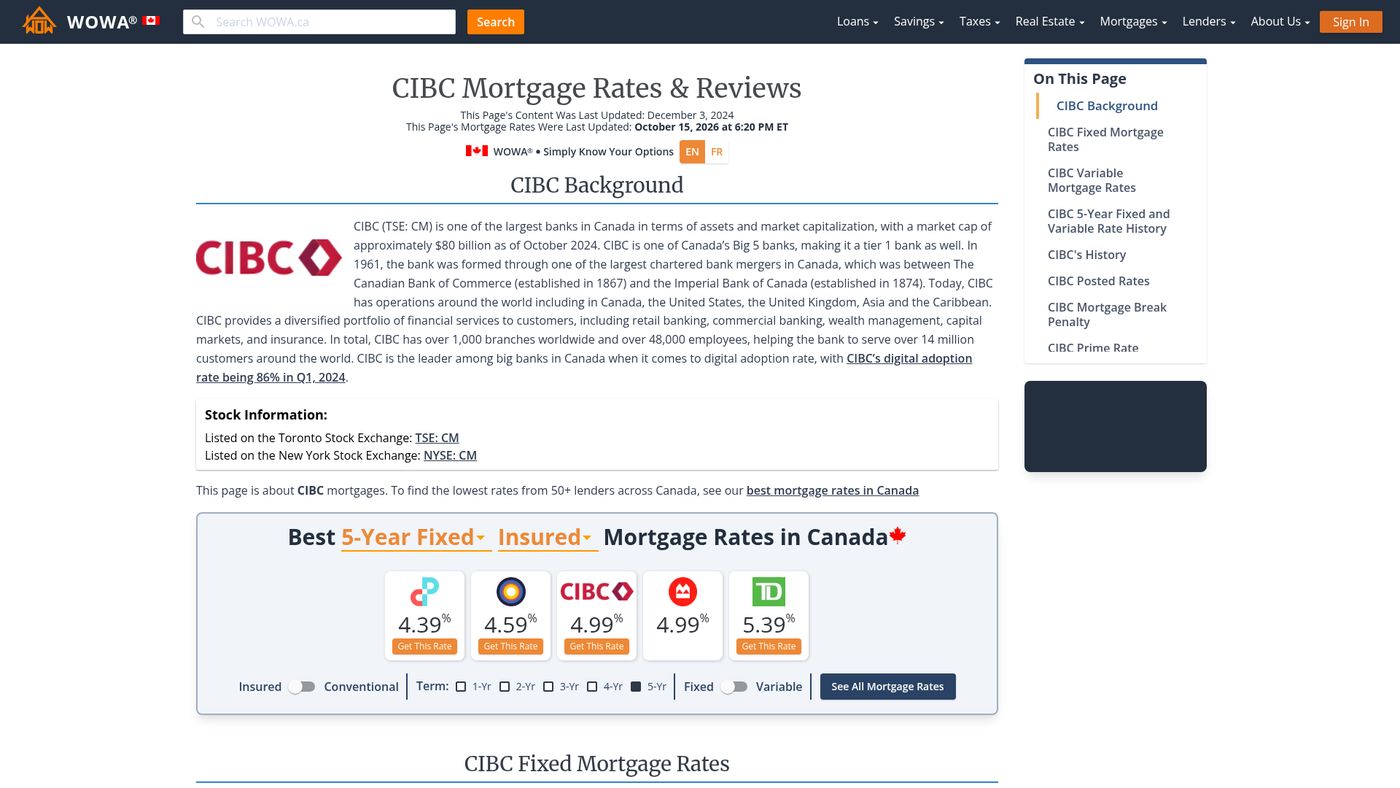
CIBC, like other major lenders, publishes two sets of mortgage rates: posted rates and special discounted rates. Posted rates are the publicly advertised, pre-discounted rates that are often significantly higher than the rates most borrowers actually pay. These rates are typically the starting point for negotiation when a customer walks into a branch. The practice of maintaining higher posted rates may relate to customer psychology or to the calculation of penalties for breaking a mortgage contract early. Special rates are CIBC's posted rates that have already been discounted, often as part of limited-time offers or promotions. These special rates are more reflective of the competitive rates available in the market and are closer to what a borrower might be offered after negotiation. It is standard practice for borrowers to compare these special rates across multiple lenders and to attempt to negotiate an even lower rate, regardless of whether they begin with a posted or special offer from CIBC. The existence of these two rate tiers underscores the importance of shopping around and not accepting the first offer presented.
Historical Context and Rate Trends
The trajectory of CIBC mortgage rates, particularly the popular five-year term, has followed broader economic cycles. During the peak of the COVID-19 pandemic, the Bank of Canada lowered interest rates to historically low levels to stimulate the economy, which led to very low mortgage rates. Following the economic reopening, a period of rapid inflation prompted the Bank of Canada to raise rates aggressively, causing a significant surge in both fixed and variable mortgage rates. From March 2022 to July 2023, variable-rate mortgage holders saw their rates increase by 475 basis points, illustrating the potential volatility. The CIBC prime rate itself has seen considerable historical movement, reaching a high of 7.20% in 2023 before declining to 4.45% by late 2025. This history underscores how CIBC's rates are not static and are deeply connected to central bank policy and macroeconomic conditions. Analyzing these trends can help borrowers understand the potential risks and rewards associated with different rate choices.
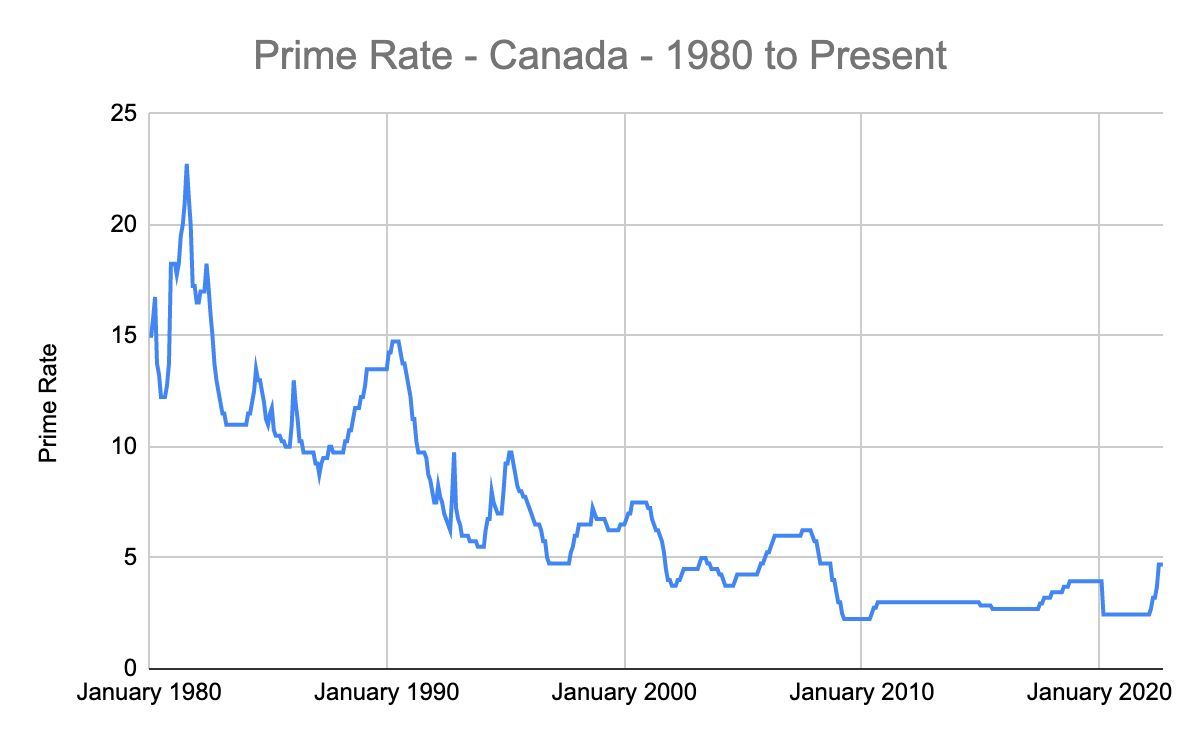
The CIBC prime rate has changed significantly over decades in response to economic conditions. Historical records show the prime rate was 13.25 percent in November 1980 and 3.75 percent in April 2004. The prime rate increased sharply from 2.70 percent in March 2022 to 6.70 percent in March 2023. These changes are primarily driven by adjustments to the Bank of Canada's overnight rate.
- In April 1974, the CIBC prime rate was 10.50%.
- By November 1980, it had risen to a peak of 13.25%.
- It decreased to 12.00% by May 1984 and further to 11.75% by September 1988.
- In April 2004, the prime rate was recorded at 3.75%.
- A notable period of increase began in March 2022 when the prime rate was 2.70%, rising to 6.70% by March 2023.
- The prime rate peaked at 7.20% in July 2023.
- A series of decreases followed, bringing the rate down to 4.45% by October 29, 2025.
Historical prime rate volatility shows long term cycles that impact mortgage costs. For example, the prime rate increased by 475 basis points from March 2022 to July 2023. This rapid increase was a response to inflationary pressures and Bank of Canada policy. Such volatility highlights the risk for borrowers with variable rate mortgages during economic uncertainty.
Key Considerations When Choosing a CIBC Mortgage
Selecting a mortgage from CIBC involves several important decisions beyond just the interest rate. Borrowers must choose between the security of a fixed rate and the potential savings of a variable rate, which carries the risk of payment increases if the prime rate rises. The choice between an open and closed mortgage hinges on the borrower's need for prepayment flexibility versus securing a lower rate. A convertible mortgage can be a strategic option for those anticipating a future drop in rates, as it allows locking in a longer term later without penalty. It is also crucial for borrowers to consider the annual percentage rate (APR), which includes additional fees, rather than just the interest rate when comparing offers. For those new to Canada, CIBC offers specific mortgage programs that may help qualify applicants without a Canadian credit history. Finally, given that CIBC's posted rates are often a starting point for negotiation, comparing rates from multiple lenders simultaneously is a critical step in the process to ensure you secure the most favourable terms available.
The Mortgage Application and Renewal Process at CIBC
CIBC provides several avenues for customers to begin the mortgage process, including online tools, phone support, and in-branch consultations. Prospective borrowers can get pre-qualified online to receive a personalized estimate of how much they can borrow based on factors like home price, down payment, interest rate, and amortization period. CIBC's Mortgage Contact Centre has specialists available to answer questions and guide customers through inquiries. When it comes time to renew an existing mortgage, CIBC examines the borrower's goals to help select a suitable option for the next term. The bank also facilitates switching a mortgage from another lender, offering expert advice and flexible payment options. Throughout these processes, borrowers are encouraged to use CIBC's mortgage payment calculator to estimate regular payments and understand the long-term financial commitment. This calculator is a key tool for planning and can illustrate how changes in the interest rate or amortization period affect the monthly payment amount.
How the Bank of Canada Influences CIBC Rates
CIBC's prime rate and, by extension, its variable mortgage rates are directly influenced by the monetary policy decisions of the Bank of Canada. The Bank of Canada sets a target for the overnight rate, which is the interest rate at which major financial institutions borrow and lend one-day funds among themselves. When the Bank of Canada adjusts this rate, it signals a change in its monetary policy stance aimed at controlling inflation. CIBC and other major banks typically respond by adjusting their prime lending rates by the same amount. This linkage means that Canadian homeowners with variable-rate mortgages from CIBC are directly exposed to the central bank's policy decisions. The historical record shows a clear correlation, with the bank prime rate moving in lockstep with the overnight target rate through numerous economic cycles. This relationship is fundamental to understanding why mortgage rates change over time.
CIBC's prime rate usually changes in direct response to Bank of Canada policy announcements. When the Bank of Canada raises or lowers its target for the overnight rate, CIBC typically adjusts its prime rate by the same amount. For example, a 25 basis point increase by the Bank of Canada usually results in a 25 basis point increase in CIBC's prime rate. There have been rare exceptions where CIBC did not fully pass on a Bank of Canada rate cut.
| Date of Rate Change | Key Overnight Target Rate (%) | Change (%) | Bank Prime Rate |
|---|---|---|---|
| March 3, 2022 | 0.50 | +0.25 | 2.70% |
| April 14, 2022 | 1.00 | +0.50 | 3.20% |
| July 14, 2022 | 2.50 | +1.00 | 4.70% |
| September 7, 2022 | 3.25 | +0.75 | 5.45% |
| October 26, 2022 | 3.75 | +0.50 | 5.95% |
| December 7, 2022 | 4.25 | +0.50 | 6.45% |
| October 29, 2025 | 2.25 | -0.25 | 4.45% |
The pass through mechanism means a change to the Bank of Canada overnight rate directly affects CIBC's prime rate. This was seen during the period from 2022 to 2023 when repeated increases led to a prime rate rising from 2.70 percent to 6.70 percent. In October 2025, CIBC's prime rate decreased by 0.25 percent following a Bank of Canada move. This prime rate is the basis for variable rate mortgages and other lending products.
Common Mistakes and Important Details
When considering a CIBC mortgage, borrowers should be aware of several common pitfalls and important contractual details. One key mistake is focusing solely on the advertised interest rate without considering the annual percentage rate (APR), which includes other fees and provides a more complete cost picture. Another is not understanding the implications of choosing a closed mortgage, which can carry significant prepayment penalties if the contract is broken early, penalties that may be calculated using the higher posted rate. Borrowers sometimes overlook the difference between posted and special rates, potentially accepting a higher initial offer without negotiation. It is also important to recognize that while CIBC's prime rate usually moves with the Bank of Canada, there have been instances where the bank did not fully pass on a rate cut, which can affect the savings expected on a variable-rate product. Finally, failing to use available tools like CIBC's mortgage payment calculator can lead to underestimating the long-term financial commitment associated with a home loan.
CIBC mortgage agreements contain specific rules regarding prepayment privileges and penalties. For example, a Variable Flex Mortgage may allow annual prepayments of up to 20 percent without a prepayment charge. Breaking a fixed rate mortgage contract before its term ends can trigger steep prepayment penalties. It is important for borrowers to understand these details before signing a mortgage agreement.
- For a high-ratio mortgage (loan-to-value greater than 80%), mandatory mortgage default insurance is required from a provider like CMHC.
- CIBC's Variable Flex Mortgage allows annual prepayments of up to 20% of the original principal amount without incurring a prepayment charge.
- The bank's six-month convertible mortgage can be converted to a longer-term mortgage at any time without paying a prepayment penalty.
- Fixed-rate mortgages are not immediately affected by changes in the CIBC prime rate. The rate is locked for the entire term.
- CIBC is the fifth largest of Canada's Big Six banks, with a Canadian residential mortgage portfolio valued at $263 billion as of the second quarter of 2023.
- The bank has introduced innovations in the past, including different payment frequencies for mortgages and automated telephone banking services.
Understanding mortgage details helps borrowers choose products that match their financial goals. Prepayment privileges allow borrowers to pay down their principal faster, saving on interest over the loan's lifetime. Choosing between open and closed mortgages involves weighing flexibility against cost, as open mortgages typically have higher rates. Being informed about these features can prevent unexpected costs and support better financial planning.
Frequently asked questions
What is CIBC's current prime rate?
As of October 30, 2025, CIBC's prime rate is 4.45%. This rate is the benchmark CIBC uses to set interest rates for its variable-rate lending products, including mortgages. It is typically adjusted in line with changes announced by the Bank of Canada to its target for the overnight rate. The prime rate is the same across most major Canadian financial institutions.
What is the difference between a fixed and variable mortgage rate from CIBC?
A fixed-rate mortgage from CIBC locks in your interest rate for the entire mortgage term, so your payment remains constant regardless of market changes. A variable-rate mortgage has an interest rate that fluctuates with CIBC's prime rate. If the prime rate rises, more of your payment goes to interest. If it falls, more goes to principal. Variable rates have generally been lower than fixed rates but carry the risk of increasing during the term.
What are CIBC's posted rates versus special rates?
CIBC's posted rates are the publicly advertised, pre-discounted rates that are often higher than what borrowers ultimately pay. Special rates are discounted versions of these posted rates, often offered as promotions. Borrowers are generally encouraged to negotiate from the posted rate or seek out the special rates for a better deal. The special rate is more in line with the competitive rate you are likely to be offered.
Does CIBC offer mortgages for newcomers to Canada?
Yes, CIBC offers mortgage programs designed for newcomers to Canada. These programs may help individuals qualify for a mortgage even if they do not have an established Canadian credit history. Specific offerings and eligibility criteria can be discussed with a CIBC mortgage specialist. This is part of the bank's suite of services for clients new to the country.
What happens to my CIBC variable mortgage rate if the prime rate changes?
Your CIBC variable mortgage rate will change by the same amount as any change to the CIBC prime rate. For example, if your rate is prime minus 0.50 percent and the prime rate increases by 0.25 percent, your mortgage rate will also increase by 0.25 percent. If the prime rate goes down, more of your payment goes to the principal. If the prime rate rises, more of your payment goes to interest.
Can I prepay my CIBC mortgage without penalty?
This depends on the type of mortgage you have. An open mortgage from CIBC allows you to increase payments or pay off the mortgage in full at any time without penalty. A closed mortgage has annual limits on how much you can prepay, and exceeding those limits may trigger a prepayment charge. The Variable Flex Mortgage, for instance, allows annual prepayments of up to 20% of the original principal.
Sources and further reading
- Mortgage rates across Canada 1 cibc.com
- CIBC Mortgage Rates, NerdWallet Canada nerdwallet.com
- CIBC Prime Rate ratehub.ca
- Compare CIBC Mortgage Rates in Canada nesto.ca
This article explains how things work and is not financial, tax or legal advice. Rules, limits and rates change, so check the current figures with the Canada Revenue Agency, your province or your financial institution before you act.