The best mortgage rates in Canada are the lowest interest rates available to qualified borrowers for financing a home purchase or renewal. These rates vary daily and are influenced by factors like your down payment, credit score, and the type of mortgage you choose. Understanding how rates are determined and where to find them is crucial for Canadian homebuyers and homeowners, as even a small difference in the rate can save thousands of dollars over the life of the loan. This guide explains the key factors that affect mortgage pricing and the steps to secure a competitive rate.
How Mortgage Rates Are Determined in Canada
Mortgage rates in Canada are not set by a single authority but are instead determined by a combination of market forces, lender risk assessment, and government policy. The rates you see advertised are for prime residential mortgages, which are loans for owner-occupied homes bought by borrowers with strong credit, generally a score around 700 or higher, and verified income. These loans are funded by banks, credit unions, or mortgage finance companies and carry the lowest rates in the market. The broader interest-rate environment is a primary driver, with fixed mortgage rates generally moving with government bond yields and variable rates tied to lenders' prime rates, which typically move in response to changes in the Bank of Canada's policy rate. In 2026, the Bank of Canada's policy rate sits at 2.25% and a typical lender's prime rate is 4.45%. The type of borrower and the specific characteristics of the mortgage application then layer on additional adjustments, creating a tiered system of pricing from the very best insured rates to higher non-prime offerings.
Your down payment is one of the most significant factors in determining your rate tier. The minimum down payment is 5% on the first $500,000 of a home's purchase price and 10% on the portion from $500,000 to $1.5 million. If you put down less than 20%, you are required by law to purchase mortgage default insurance from providers like CMHC. Counterintuitively, these default-insured mortgages often carry the lowest rates because the insurer covers the lender's risk of default. Mortgages with a 20% or higher down payment are considered conventional and do not require insurance. Among these, a subset known as insurable mortgages can still qualify for very competitive rates if they meet criteria like a 25-year or less amortization and are for an owner-occupied home purchased for under $1 million. Finally, uninsurable mortgages, which do not meet those criteria, typically have the highest rates as the lender assumes the full risk.

Key Factors That Affect Your Mortgage Rate
Several specific elements of your financial profile and the loan itself will directly influence the interest rate a lender offers you. Your credit score is paramount, with prime rates generally requiring a score around 700 or higher. Your debt service ratios are also critically examined through a mandatory stress test for federally regulated lenders. This test requires lenders to calculate your ability to pay using a qualifying rate that is the greater of 5.25% or 200 basis points above your actual contract rate. This hurdle can affect which terms and amounts you qualify for. The property type and its intended use matter, as rates for rental properties are typically higher than for owner-occupied primary residences. Furthermore, the location of the property can cause rate variation, as competition among lenders differs from province to province and even between cities.
Lenders apply specific premiums or surcharges to offset risks they perceive in an application. For example, a mortgage for a rental property typically carries a rate premium of 10 to 30 basis points compared to a primary residence. Similarly, a cash-back mortgage offer, where the lender provides an upfront sum, usually has a rate that is 10 to 50 basis points higher than a standard mortgage. Borrowers who are self-employed without traditional income verification, or those with a history of credit issues like a consumer proposal or bankruptcy, will face significantly higher non-prime rates. These non-prime mortgages can cost at least 100 to 200 basis points more than the best prime rates and often include lender or broker fees of one percent of the mortgage amount or more. Pre-approvals can also sometimes carry a slight premium because many do not close, leaving the lender with hedging costs and no revenue.
Comparing Fixed, Variable, and Short-Term Rates
Choosing between a fixed and variable rate mortgage is a fundamental decision that impacts both your payments and your rate. A fixed-rate mortgage locks in your interest rate for the entire term, which can range from six months to ten years, with the five-year fixed being the most popular option in Canada. The rate for a fixed mortgage is determined at the outset and does not change, providing payment certainty. In contrast, a variable-rate mortgage has an interest rate that fluctuates with the lender's prime rate. Your payments may stay the same, but the portion going toward interest changes. If rates rise, more of your payment covers interest, and if they fall, more goes toward principal. Historically, variable rates have saved borrowers money over the long run, but they come with the risk of payment increases if interest rates rise.
The length of the mortgage term also affects the rate you receive. Lenders price each term differently based on their expectations for future interest rates and their cost of funding. In the period from 2023 to 2025, shorter-term mortgages became more popular as borrowers anticipated lower rates in the future. As of 2026, shorter terms remain popular because they are often priced more competitively. For example, a three-year fixed rate may be offered at a different level than a five-year fixed rate. It is important to compare rates across all terms, including one-year, two-year, three-year, and five-year fixed rates, as well as three-year and five-year variable rates. Over the long run, historical data suggests that shorter terms and variable rates have saved borrowers more than longer-term fixed rates, particularly when the prime rate is above its long-term average and beginning to flatten out.

Current Mortgage Rate Landscape and Examples
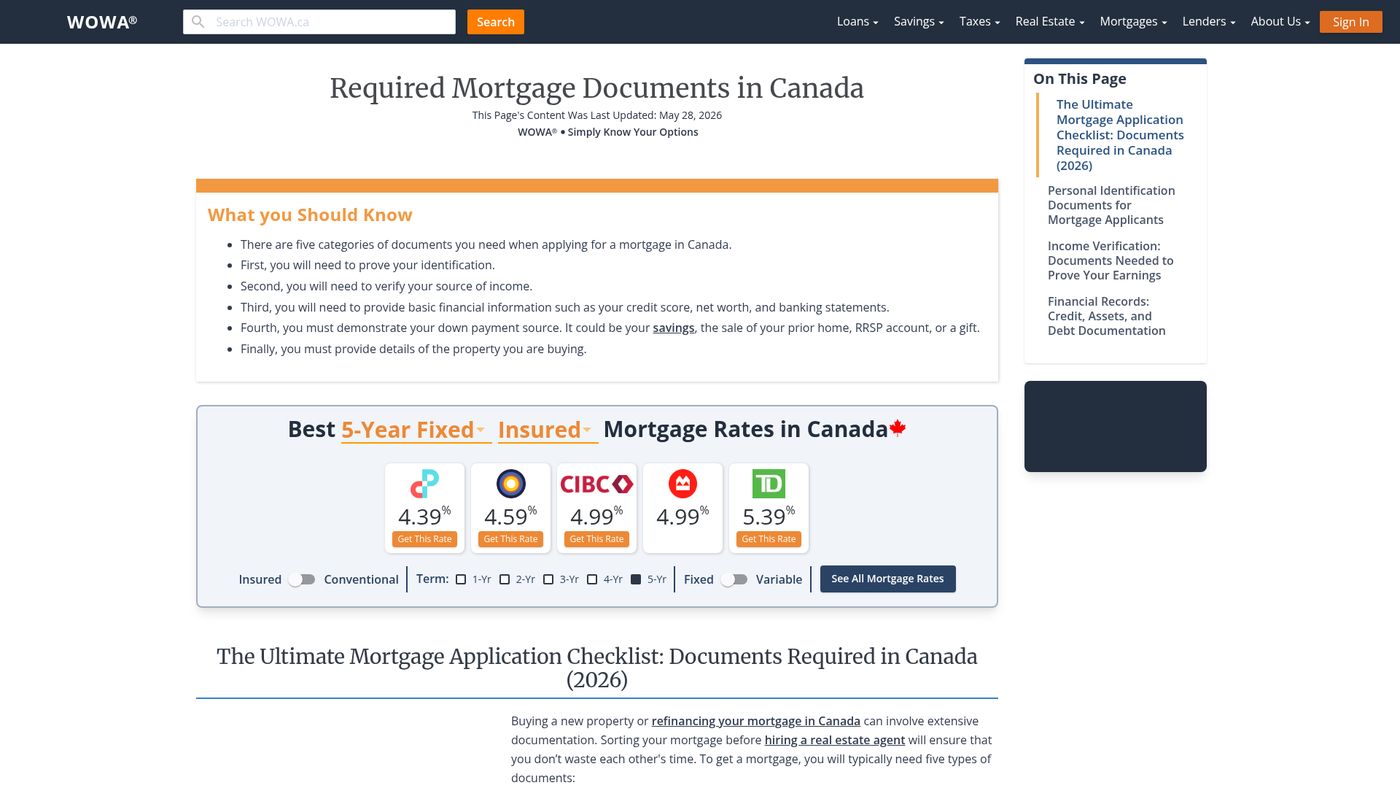
Mortgage rates in Canada are dynamic and change frequently, with some services updating their compiled rates multiple times per business day. The rates are sourced from over fifty federal and provincial lenders and major brokerages across the country. As of recent data, the average uninsured five-year fixed mortgage rate in Canada is approximately 5.39%, while the average three-year fixed rate is about 5.23%. Specific advertised offers from lenders can vary, with some promotional rates for insured five-year fixed mortgages starting as low as 4.34%. Variable rates are typically expressed as a discount to the lender's prime rate. It is essential to understand that the very best rates are usually reserved for insured mortgages, where the loan is protected by default insurance. Mortgage rates in Canada vary by type and lender. Rates for insured mortgages, which require a down payment of less than 20%, are typically lower than those for uninsured mortgages. These rates are sourced daily from banks and mortgage brokers and are subject to frequent change.
| Mortgage Type | Example Rate | Term |
|---|---|---|
| Insured 5-Year Fixed | From 4.34% | 5 years |
| 1-Year Fixed Closed | 5.69% | 1 year |
These examples highlight the pricing tiers, with insured mortgages at the low end. The rates for uninsured mortgages are higher, reflecting the additional risk to the lender. It is also worth noting that open mortgages, which allow for penalty-free repayment at any time, carry significantly higher rates, such as a one-year open mortgage with a posted rate of 9.95%. The rates you are offered will depend on your specific province, as lender competition and licensing can cause variations across the country. For instance, a lender may offer a slightly better rate in Ontario than in Saskatchewan due to different market conditions.
Provincial Variations and Where to Find Rates
Mortgage rates are not uniform across Canada. Because many lenders and brokers are licensed and compete on a province-by-province basis, the lowest available rate can vary depending on where you are buying a home. The same national lender may quote slightly different rates in different regional markets due to local competition and economic conditions. For this reason, many rate comparison services and brokerages allow you to filter rates by province or even by major city to get the most accurate picture for your location. Major urban centres like Toronto, Vancouver, Calgary, Montreal, and Ottawa often have highly competitive markets with a wide array of lenders, which can work to a borrower's advantage. Regional credit unions may also offer competitive products that are only available within specific provinces.
To find and compare current rates, Canadians use a variety of online resources. Major bank websites, such as those of RBC and TD Canada Trust, post their current posted and special offer rates. Independent rate comparison websites and mortgage broker portals aggregate rates from dozens of lenders, updating them frequently throughout the business day. These platforms often provide tools to personalize rates based on your down payment, purchase price, and province. It is important to use multiple sources, as no single site captures every available offer from all monoline lenders and brokerages. Furthermore, engaging with a mortgage broker can provide access to lender deals that are not widely advertised to the public, as brokers have relationships with multiple lending institutions and can often negotiate on your behalf.
Steps to Secure the Best Available Mortgage Rate
Securing a competitive mortgage rate requires preparation and a strategic approach. The process involves more than just accepting the first offer you receive. It requires understanding your position, shopping around, and being ready to negotiate. The first step is always to check and strengthen your credit profile well in advance of applying, ensuring your score is as high as possible and that your reported debts are managed. You should then get a clear understanding of your budget, including how much you can afford for a down payment and what your approximate purchase price range will be. Using online mortgage calculators can help you estimate payments and understand how different rates affect your monthly costs. With this information in hand, you are ready to start comparing offers from different sources.
There is a recognized process for effectively shopping for a mortgage rate. First, research and compare rates from banks, credit unions, and online mortgage brokers to establish a benchmark for the best available rate. Second, get a formal mortgage pre-approval from at least one lender to understand your borrowing power and lock in a rate guarantee, though be aware that pre-approval rates may not be the absolute lowest. Third, do not hesitate to negotiate with lenders or your broker. Use competing offers as leverage to ask for a better deal or for fees to be waived. Fourth, carefully review all the terms of the mortgage offer beyond the interest rate, including prepayment privileges, penalties for breaking the mortgage, and any associated fees. Finally, ensure all your financial documentation is organized and accurate to facilitate a smooth application process once you have chosen a lender.
Common Mistakes and Important Considerations
When searching for a mortgage, borrowers often focus solely on the advertised interest rate without considering the total cost of the loan. This can lead to overlooking significant fees, restrictive terms, or penalties that could outweigh the benefit of a slightly lower rate. For example, a mortgage with a very low rate but high penalties for breaking the contract early could be costly if your circumstances change. Another common mistake is not understanding the implications of the stress test. Even if you qualify for a mortgage at a low contract rate, the stress test at a higher qualifying rate may limit the amount you can borrow, affecting your home purchase budget. It is also a mistake to assume that your existing bank will offer you its best rate automatically. Customers often need to ask and negotiate to receive promotional pricing.
Several key regulatory and procedural details are important for Canadian borrowers to know. Effective November 21, 2024, the federal government's stress test no longer applies when borrowers switch lenders at maturity, provided the mortgage amount and amortization remain the same. This can make switching lenders for a better rate at renewal much easier. Since December 2024, thirty-year amortizations have been available on insured mortgages, but only for first-time homebuyers and buyers of newly built homes. For all other insured mortgages and for uninsured mortgages, the standard maximum amortization remains 25 years, though some non-prime lenders may offer longer terms. When comparing rates, always check whether the rate is for an insured, insurable, or uninsurable mortgage, as this classification has a major impact on the price. Finally, remember that the posted rates you see on bank websites are often higher than the actual negotiated or special offer rates you can obtain, so it pays to inquire directly.
Frequently asked questions
What is the lowest mortgage rate in Canada right now?
The lowest mortgage rates in Canada are typically for insured mortgages, where the borrower has a down payment of less than 20%. As of recent data, advertised rates for insured five-year fixed mortgages can start from around 4.34%. However, the best available rate for any individual depends on their credit score, debt ratios, property location, and the specific lender's offers, which change multiple times per day. The national average for an uninsured five-year fixed rate is approximately 5.39%.
How does a down payment affect my mortgage rate?
Your down payment significantly affects your mortgage rate by determining whether your loan requires default insurance. A down payment of less than 20% mandates insurance, which often results in a lower interest rate because the insurer assumes the lender's risk. This means a smaller down payment can paradoxically lead to a better rate than a 20% or higher down payment on an uninsured mortgage. Mortgages with 20% down or more are sorted into insurable and uninsurable categories, with insurable loans (meeting criteria like a 25-year amortization) getting better rates than uninsurable ones.
Should I choose a fixed or variable mortgage rate?
The choice between a fixed and variable rate depends on your risk tolerance and view on future interest rates. A fixed rate provides payment certainty for the entire term, which is often five years. A variable rate fluctuates with the lender's prime rate, which can lead to lower costs if rates fall but higher costs if they rise. Historically, variable rates have saved borrowers money over the long term. Your decision should factor in the current economic environment, your budget flexibility, and how long you plan to hold the mortgage.
How often do mortgage rates change in Canada?
Mortgage rates in Canada can change very frequently. Major lenders may adjust their posted and special offer rates in response to movements in bond yields (for fixed rates) or the Bank of Canada's policy decisions (affecting prime and variable rates). Some rate comparison services collect and update data from over fifty lenders multiple times each business day to provide current information. This means the best available rate you see today may be different tomorrow, highlighting the importance of monitoring rates and locking in an offer when you find a suitable one.
What is the mortgage stress test in Canada?
The mortgage stress test is a rule requiring federally regulated lenders to qualify borrowers at a higher interest rate than their actual contract rate. The qualifying rate is the greater of 5.25 percent or 200 basis points above the borrower's actual mortgage rate. This test ensures borrowers can afford payments if interest rates rise. An important update effective November 21 2024 is that the stress test no longer applies when switching lenders at maturity provided the mortgage amount and amortization remain the same. This rule applies to both insured and uninsured mortgages during a switch.
Can I get a mortgage with bad credit in Canada?
Yes, you can get a mortgage with bad credit in Canada, but it is classified as a non prime mortgage. These borrowers can expect to pay at least 100 to 200 basis points more than the best prime mortgage rates. Additionally, non prime mortgages typically involve lender or broker fees of one percent of the mortgage amount or more. These higher costs reflect the increased risk to the lender.
Sources and further reading
- Canada Mortgage Rates from 2.49% | 19,000 Five Star Reviews truenorthmortgage.ca
- Compare Canada Mortgage Rates ratehub.ca
- Current Mortgage Rates | RBC Royal Bank of Canada rbcroyalbank.com
- The best mortgage rates in Canada right now financialpost.com
- Best Mortgage Rates Canada from 3.25% (Compare 50 ... wowa.ca
This article explains how things work and is not financial, tax or legal advice. Rules, limits and rates change, so check the current figures with the Canada Revenue Agency, your province or your financial institution before you act.