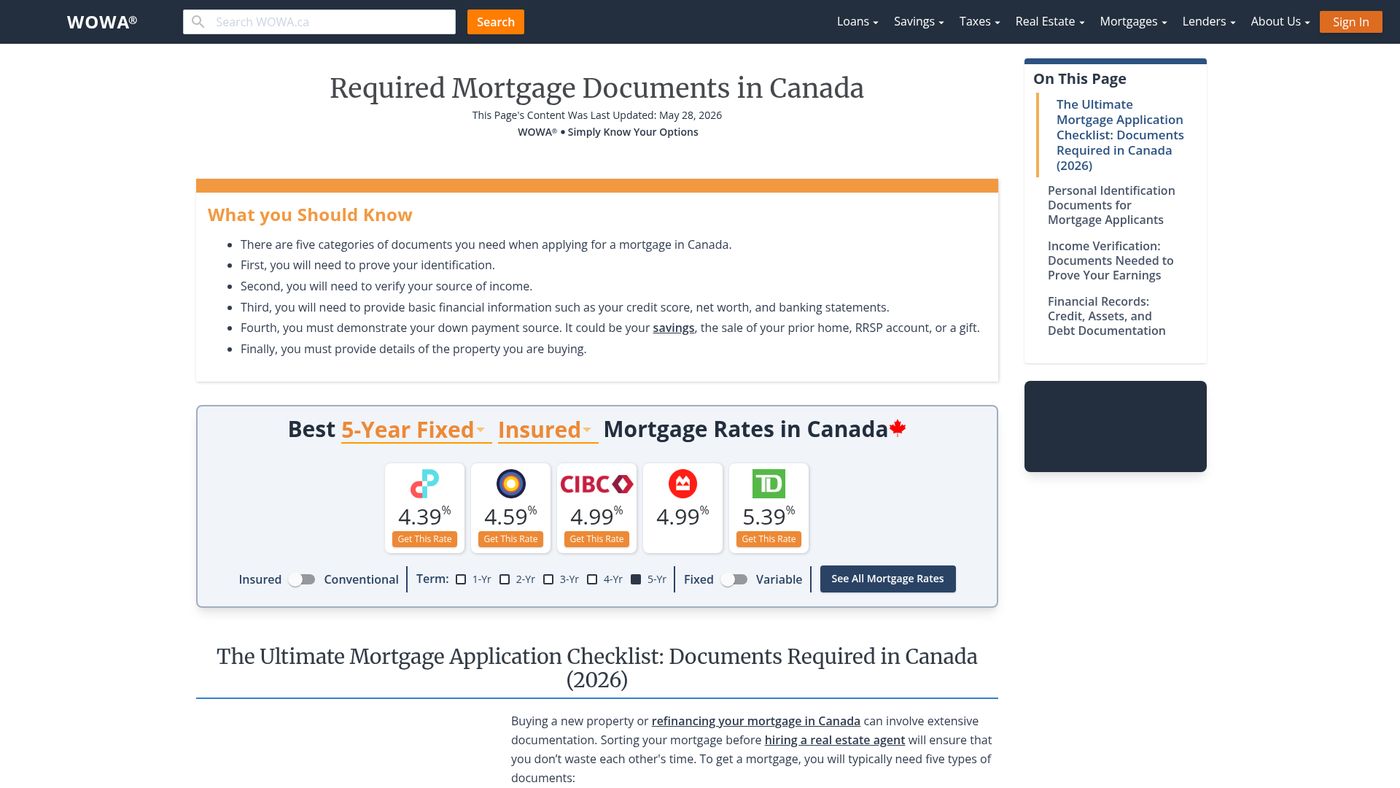
The best fixed mortgage rates in Canada are determined by a combination of your down payment, the mortgage term you select, and your province. As of 2026, the lowest rates are typically available on insured mortgages, which require a down payment of less than 20%, with some lenders advertising rates starting from 4.34% for a 5-year fixed term. Understanding how rates are tiered and the factors that influence pricing is crucial for Canadian homebuyers and renewers to secure the most favourable financing. This guide explains the mechanics of fixed mortgage rates, the key eligibility criteria, and the steps to compare offers effectively.
How Fixed Mortgage Rates Are Determined
Fixed mortgage rates in Canada are primarily influenced by the yields on government bonds, particularly the 5-year Government of Canada bond. Lenders use these yields as a benchmark to price their fixed-rate mortgage products, adding a margin to cover their costs and profit. The broader economic environment, including inflation expectations and the Bank of Canada's monetary policy, directly impacts these bond yields and, consequently, the rates offered to consumers. While variable rates move with the lender's prime rate, fixed rates provide payment certainty for the chosen term, which can range from six months to ten years.
The specific rate a borrower is offered depends heavily on the risk profile of the loan, which is categorized by insurance status. Mortgages with a down payment of less than 20% must be insured against default by the Canada Mortgage and Housing Corporation (CMHC), Sagen, or Canada Guaranty. These insured mortgages carry the lowest rates because the insurer assumes the lender's risk. Mortgages with a 20% or larger down payment are uninsured, but a subset known as insurable mortgages can still qualify for lower rates if they meet specific criteria, such as a 25-year amortization and an owner-occupied home purchased for under $1 million. Lenders also apply rate premiums for certain risk factors, which increase the advertised rate. Common premiums include an additional 10 basis points for rental properties and 15 basis points for cash-back mortgage offers. Pre-approvals can also cost more due to the hedging costs lenders incur for rates that may not close.
Key Factors That Affect Your Mortgage Rate
Several borrower-specific factors directly influence the mortgage rate you will be offered. Your credit score is a primary determinant, with the best prime rates generally available to borrowers with a score around 700 or higher. The size of your down payment not only dictates whether you need insurance but also places you in a specific rate tier, with insured loans often having lower rates than conventional uninsured ones. Your debt service ratios, calculated using the federal stress test, must also be within the lender's limits to qualify for the posted rates.
The property type and its intended use are significant factors. Mortgages for owner-occupied primary residences receive the most favourable pricing. The location of the property also matters, as mortgage competition and lender licensing vary by province, leading to different best available rates in Ontario, British Columbia, Alberta, and other regions. Lenders assess all these elements together to determine the final interest rate for your application.
The term length you choose is another major factor in the rate. Lenders price risk differently across terms, leading to variations where a 2-year fixed rate may be higher or lower than a 5-year fixed rate at any given time. Historically, shorter terms and variable rates have saved borrowers more money over the long run when the prime rate is above its five-year average and flattening. In contrast, long-term fixed rates typically perform better when the prime rate is well below its historical average. Your choice of term should align with your financial outlook and tolerance for payment variability upon renewal.
Understanding Mortgage Insurance and Rate Tiers
Mortgage default insurance is a critical component of the Canadian housing market and directly creates tiered pricing for interest rates. For homes with a purchase price under $1.5 million, a down payment of less than 20% mandates this insurance, which is provided by CMHC, Sagen, or Canada Guaranty. The insurance protects the lender if the borrower defaults, which allows lenders to offer lower interest rates on these loans. This creates the counterintuitive situation where putting down a smaller amount can result in a lower mortgage rate compared to a larger, uninsured down payment.
Mortgages are generally classified into three rate tiers based on insurance status. The first and lowest tier is for insured mortgages, which have the default insurance premium paid by the borrower. The next tier is for insurable mortgages, which are conventional loans with at least 20% equity, a 25-year or less amortization, and are for an owner-occupied home purchased for less than $1 million. These can qualify for lender-paid insurance and often have rates 10 to 25 basis points lower than the highest tier. The final tier is for uninsurable mortgages, which include all loans that do not meet the insurable criteria, such as those with amortizations over 25 years or for rental properties, and they carry the highest rates.
Maintaining insurance status can provide long-term benefits. If you switch lenders at maturity without increasing your mortgage amount or amortization, you can often transfer your existing insurance to the new lender. This allows you to continue qualifying for lower insured or insurable rates in the future, potentially saving thousands of dollars over the life of your mortgage. A savings of just 10 basis points keeps over $470 in your pocket over five years for every $100,000 borrowed on a 25-year amortization.

Provincial Variations in Mortgage Rates
Mortgage rates are not uniform across Canada due to differences in provincial regulation, lender competition, and local market conditions. Lenders and brokers are licensed provincially, and their pricing strategies can vary from one region to another. This means the best available rate for a 5-year fixed mortgage in Ontario may differ from the best rate offered for the same product in Alberta or Quebec. Consumers are advised to compare rates specifically for their province to ensure they are seeing the most accurate and competitive offers for their location. The level of competition among financial institutions, credit unions, and monoline lenders in a particular province influences rate pricing, with major urban centres like Toronto, Vancouver, and Calgary often having intense competition that can drive rates lower.
| Province | Rate Variation Factor |
|---|---|
| Ontario | High competition, frequent rate updates |
| British Columbia | Influenced by high-value markets |
| Alberta | Competitive lender landscape |
| Quebec | Distinct financial institution presence |
| Atlantic Provinces | Rates set by regional competition |
To find the most current rates for your area, you can use online comparison tools that filter offers by province or major city. These tools collect data directly from lender websites and brokerages, providing a snapshot of the lowest insured, insurable, and uninsured rates available. It is important to note that some brokerages or monoline lenders may not be included in every comparison, so consulting with a licensed mortgage professional in your province is also a recommended step. The specific rates are updated multiple times per day based on data collected from over fifty lenders across the country, though the exact numbers fluctuate daily.
Steps to Compare and Secure the Best Fixed Rate
Securing the best fixed mortgage rate requires a systematic approach to shopping and negotiation. The process begins with knowing your credit score and getting a copy of your credit report to ensure there are no errors that could affect your application. You should then gather all necessary documentation, including proof of income, employment verification, and details about your down payment source. Having these documents ready will speed up the application process once you find a suitable rate.
The next step is to compare rates from multiple sources. This includes checking with major banks, credit unions, and online mortgage brokerages. Rate comparison websites collect data from numerous lenders and can provide a broad view of the market, though they may not include every monoline lender. It is crucial to compare not just the interest rate but also the terms and conditions, prepayment privileges, and any associated fees. When you have a shortlist of potential lenders, you should contact them directly or work with a mortgage broker to get a formal quote.
- Check your credit score and report for accuracy.
- Gather proof of income, employment, and down payment.
- Compare rates from banks, credit unions, and brokerages.
- Review all terms, conditions, and fees, not just the rate.
- Obtain formal quotes from multiple lenders.
- Negotiate with lenders, using competing offers as leverage.
- Understand the full cost breakdown before committing.
- Ensure you can meet the stress test requirements.
Negotiation is a key part of the process. Use competing offers as leverage when speaking with lenders or brokers. Ask about the possibility of a rate buy-down, where the broker or lender reduces their commission to secure you a lower rate. Be sure you understand the full cost breakdown, including any appraisal fees, legal fees, or potential penalties for breaking the mortgage early. Finally, ensure your application can pass the federal stress test, which requires proving you can afford payments at your contract rate plus 2% or at 5.25%, whichever is higher.
Common Mistakes to Avoid When Mortgage Shopping
One of the most common mistakes is focusing solely on the headline interest rate without considering the overall cost of the mortgage. A slightly lower rate from one lender could come with restrictive terms, high penalties for breaking the mortgage, or hefty fees that erase any savings. Borrowers must read the mortgage commitment carefully, paying close attention to prepayment privileges, portability options, and the calculation method for interest rate differential penalties. These factors can have a significant financial impact if your circumstances change before the term ends.
Failing to shop around adequately is another frequent error. Relying on a single bank or broker may mean missing out on better rates available elsewhere. The mortgage market is highly competitive, and rates can vary significantly between institutions. Similarly, not getting a pre-approval can be a misstep, as it locks in a rate and gives you a clear budget, though it is important to understand that pre-approval rates are sometimes slightly higher than final offer rates due to the hedging costs for lenders. However, a pre-approval provides valuable certainty in a rising rate environment.
Many borrowers underestimate the importance of the federal stress test. Even if you qualify for a mortgage at the offered rate, you must also prove you can afford the payments at the qualifying rate, which is the higher of your contract rate plus 2% or 5.25%. This test can limit the amount you are able to borrow and may influence the term or product you can be approved for. Another mistake is not reviewing your mortgage at renewal time. Simply accepting your current lender's renewal offer without shopping around can cost you thousands of dollars, as you are no longer subject to the stress test when switching lenders for a renewal with the same amount and amortization.
The Impact of Term Length on Fixed Rates
The length of your mortgage term is a contract locking in your interest rate and conditions, and it is a primary driver of the rate you pay. Terms commonly range from six months to ten years, with the five-year fixed term being the most popular in Canada. However, lender pricing varies by term based on their cost of funds and outlook for future interest rates. In 2026, shorter fixed terms like one, two, and three years are priced competitively as borrowers anticipate potential rate decreases, leading to situations where a 3-year fixed rate may be lower than a 5-year fixed rate.
Choosing a term involves balancing payment certainty with flexibility. A longer term, such as five or ten years, provides stability and protection against rate increases for an extended period. A shorter term, like one or two years, offers more frequent opportunities to renew or renegotiate at potentially lower rates but carries the risk of rates being higher at renewal. Your choice should align with your financial plan, risk tolerance, and expectations for the interest rate cycle. Historically, shorter terms and variable rates have saved borrowers more money when the prime rate is above its long-term average and beginning to flatten.
It is important to compare rates across all available terms to see which offers the best value for your situation. Online comparison tools allow you to view best rates for 1-year fixed, 2-year fixed, 3-year fixed, and 5-year fixed mortgages separately. The rate differentials between these terms can change daily based on bond market movements. Borrowers should also consider their future plans, such as selling the home or needing to break the mortgage, as penalties for breaking a fixed-rate mortgage before maturity can be substantial and are calculated based on the remaining term and the lender's posted rates.
Frequently asked questions
What is the best fixed mortgage rate in Canada?
The best fixed mortgage rate changes daily and varies by province, down payment, and term. As of 2026, the lowest advertised rates for a 5-year fixed mortgage start from 4.34% for insured mortgages. Insured mortgages, which require a down payment of less than 20%, typically offer the lowest rates because the lender's risk is covered by default insurance. To find the current best rate for your situation, you must compare offers from multiple lenders and brokerages, filtering for your specific province and mortgage type.
How does a down payment affect my mortgage rate?
Your down payment directly affects your mortgage rate by determining its insurance status. A down payment of less than 20% requires you to purchase mortgage default insurance, which often results in a lower interest rate because the insurer assumes the lender's risk. A down payment of 20% or more means your mortgage is uninsured. However, if it meets specific criteria like a 25-year amortization and is for a primary home under $1 million, it may qualify as 'insurable' and still get relatively low rates. Uninsurable mortgages, which do not meet these criteria, have the highest rates.
What is the mortgage stress test in Canada?
The mortgage stress test is a federal rule that requires borrowers to qualify for their mortgage at a higher interest rate than their actual contract rate. The qualifying rate is the greater of your contract rate plus 2% or 5.25%. This test ensures you can afford your payments if interest rates rise. It applies to most new mortgages and refinances with federally regulated lenders. An important update effective November 21, 2024, is that the stress test no longer applies when borrowers switch lenders at renewal, provided the mortgage amount and amortization remain unchanged.
Can I get a 30-year amortization in Canada?
Yes, 30-year amortizations are available in Canada, but with restrictions. They are permitted for uninsured mortgages, where the down payment is 20% or more. Since December 2024, 30-year amortizations are also available on insured mortgages, but only for first-time homebuyers and buyers of newly built homes. For all other insured mortgages, the maximum amortization is 25 years. It is important to note that non-prime lenders are the primary source for amortizations over 30 years, but these come with significantly higher interest rates.
Do mortgage rates vary by province?
Yes, mortgage rates can vary by province due to differences in lender competition, provincial licensing, and local market conditions. The best available rate for a fixed-term mortgage in Ontario may not be the same as in Alberta or Quebec. Many rate comparison websites allow you to filter results by province or major city to see the most relevant offers. This variation means it is essential for borrowers to seek out rate information specific to their location rather than relying on a single national average.
What is the difference between insured and insurable mortgages?
An insured mortgage is one where the borrower pays a premium for default insurance because the down payment is less than 20%. An insurable mortgage is a conventional mortgage with at least 20% down that still meets insurer guidelines (25-year amortization, owner-occupied, purchase price under $1 million). Lenders can pay the insurance premium on these loans internally, allowing them to offer rates that are typically 10 to 25 basis points lower than uninsurable mortgages. Uninsurable mortgages, which include rentals or loans with longer amortizations, do not meet these guidelines and have the highest rates.
Sources and further reading
- Ratehub.ca: Compare Mortgages and Personal Finance ... ratehub.ca
- Best Mortgage Rates Canada from 3.25% (Compare 50 ... wowa.ca
- Canada Mortgage Rates from 2.49% | 19,000 Five Star Reviews truenorthmortgage.ca
- The best mortgage rates in Canada right now financialpost.com
- Current Mortgage Rates | RBC Royal Bank of Canada rbcroyalbank.com
This article explains how things work and is not financial, tax or legal advice. Rules, limits and rates change, so check the current figures with the Canada Revenue Agency, your province or your financial institution before you act.