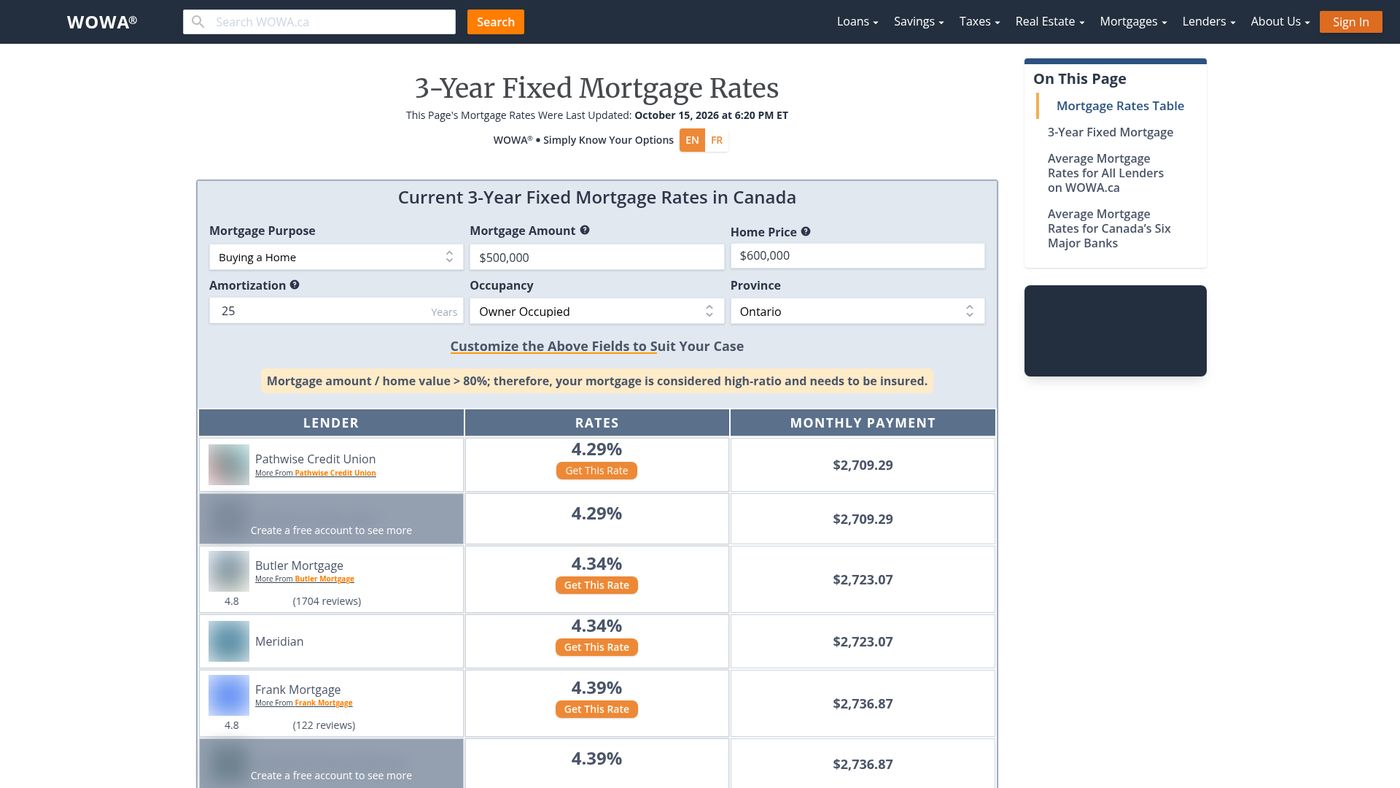
The best 3-year mortgage rates in Canada are determined by comparing offers from over fifty lenders and vary based on insurance status, location, and borrower qualifications. As of October 2026, the lowest nationally advertised 3-year fixed rate is 4.54%, while major banks average closer to 5.23%. Securing a competitive rate on this medium-term mortgage can lead to significant interest savings over the life of a loan. Understanding the factors that influence these rates is essential for Canadian homeowners and buyers.
How 3-Year Mortgage Rates Are Determined
Mortgage rates for a three-year term are not set arbitrarily but are priced by lenders based on risk, cost of funds, and market competition. Lenders assess the risk of a loan default primarily through the lens of mortgage default insurance. A mortgage that is insured, typically because the borrower has put down less than 20 percent, carries the lowest risk for the lender as the insurer covers potential losses. This results in the lowest available rates, which is why a smaller down payment can sometimes secure a better rate than a conventional loan. For conventional mortgages with 20 percent equity or more, the best rates are offered on loans that are still 'insurable', meaning they meet insurer guidelines for owner-occupied homes under $1 million and 25-year amortizations. Uninsured mortgages, which fall outside these guidelines, carry higher rates as the lender assumes more risk. The broader interest rate environment also directly affects pricing, with fixed rates like the 3-year term generally moving in correlation with government bond yields. Variable mortgage rates are tied to lenders' prime rates, which typically move in response to changes in the Bank of Canada's policy rate. Lenders also price different terms differently based on their expectations for future rate movements and their desire to attract business in specific segments of the market, which is why shorter terms like three years have been priced competitively since 2023.
Key Factors That Affect Your 3-Year Rate
Several specific borrower and property characteristics directly influence the mortgage rate a lender will offer for a three-year term. Your credit score is a primary factor, with the best prime rates generally requiring a strong credit history and a score around 700 or higher. Your debt service ratios are calculated using a mandatory stress test, which is your contract rate plus two percentage points or 5.25 percent, whichever is higher. This test can limit qualification options for those with higher debt levels, and for those with high debt-to-income ratios, the stress test often dictates what rate and term they will get approved for. The property type and its intended use matter, with owner-occupied primary residences qualifying for the best rates. Investment properties or rental units typically incur a rate premium. The size of your down payment and the resulting insurance status create distinct rate tiers, from insured to insurable to uninsurable. Furthermore, your province or city can affect the rate, as lender competition and licensing vary regionally. Finally, whether you are seeking a pre-approval or a live deal can impact the rate, as lenders may add a premium to pre-approvals due to the hedging costs associated with offers that do not always close. Saving 10 basis points on your rate keeps over $470 in your pocket over five years for every $100,000 borrowed with a 25-year amortization, highlighting the financial impact of even small rate differences.
Mortgage rates are not uniform across Canada and can vary by province or city due to local lender competition. The specific term length of a mortgage, such as a 3-year fixed rate, is a major factor in determining the offered rate. Rates are presented for prime residential mortgages, which are for borrowers with strong credit and verified income. These factors, along with the borrower's down payment amount and the broader economic environment, influence the final rate.
- An additional 10 basis points or more for rental properties.
- An additional 10 basis points or more for multi-unit properties.
- An additional 10 basis points or more for condominiums.
- An additional 10 basis points or more for non-owner-occupied properties.
- Higher premiums for non-prime borrowers, often 100-200 basis points above prime rates.
Comparing 3-Year Fixed and Variable Rates
The choice between a fixed or variable rate mortgage on a three-year term involves different risk and pricing structures. A 3-year fixed rate provides payment certainty for the entire term, as the interest rate and principal and interest payments do not change. These rates are influenced by the bond market and lender pricing strategies. As of October 2026, the lowest nationally advertised 3-year fixed rate is 4.54%, while Canada's Big 6 Banks currently average 5.23% on the same term. A 3-year variable rate mortgage has an interest rate that fluctuates with the lender's prime rate, which in turn moves with the Bank of Canada's policy rate. The monthly payment may stay the same, but the proportion going to interest versus principal will adjust with rate changes. The lowest advertised 3-year variable rate as of October 2026 is 3.55%. Historically, variable rates and shorter terms have saved borrowers money over the long run, particularly when the prime rate is above its long-term average and flattening out. Long-term fixed rates typically perform better when the prime rate is well below its five-year average. The 5-year fixed mortgage has traditionally been Canada's most popular option, although shorter terms became more popular between 2023 and 2025 as borrowers anticipated lower rates in the future, and in 2026 they remain popular as they are priced more competitively.

Provincial Variations and Rate Tiers
Mortgage rates in Canada are not uniform across the country due to differences in provincial lender licensing, market competition, and economic conditions. The same national lender may offer slightly different rates in Ontario compared to Alberta or British Columbia. Regional credit unions and monolines also compete aggressively in their home markets, which can drive down the best available rates in specific provinces. For this reason, rate comparison websites and brokers filter rates by province to provide the most accurate local information, with specific pages for Ontario, British Columbia, Alberta, Quebec, Manitoba, Nova Scotia, Saskatchewan, New Brunswick, and Newfoundland and Labrador. Borrowers should always check rates specific to their province or even their city, such as Toronto, Calgary, Vancouver, Montreal, or Ottawa, to ensure they are seeing the most competitive local offers. This provincial granularity is a key reason why using a broker or comparison service that aggregates rates from over fifty lenders can be advantageous. The rates shown are for prime residential mortgages for owner-occupied homes bought by borrowers with strong credit and verified income, and they represent the lowest tier in the market.
| Rate Tier | Typical Down Payment | Key Characteristics | Relative Rate Level |
|---|---|---|---|
| Insured | Less than 20% | Mandatory default insurance, owner-occupied under $1.5M | Lowest |
| Insurable | 20% or more | Meets insurer guidelines, owner-occupied under $1M, 25-yr amortization | Lower |
| Uninsurable | 20% or more | Outside insurer guidelines (e.g., rental, longer amortization) | Highest |
Steps to Secure the Best 3-Year Mortgage Rate
Obtaining a competitive 3-year mortgage rate requires research, preparation, and strategic negotiation. Following a structured process can help Canadian borrowers work through the market effectively. The first step is to check your credit report and score well in advance, ensuring there are no errors and that your profile is as strong as possible. Next, you should get pre-approved to understand your budget and lock in a rate guarantee, though note that pre-approval rates may be slightly higher. It is then crucial to shop around by comparing rates from multiple lenders, including major banks, credit unions, and monolines, using brokerages and comparison websites that collect data three times a day on business days. When comparing, look beyond the headline rate to consider all fees, prepayment privileges, and penalty calculations. You should then negotiate with lenders or have your broker negotiate on your behalf, using competing offers as leverage, as brokers can sometimes secure volume discounts or buy down rates. Be prepared to provide full documentation of your income, down payment, and debts promptly. Finally, ensure you understand all the terms before signing the commitment, paying close attention to the conditions for the rate hold and the details of the stress test application. An eight-step guide for negotiation includes getting your documents in order, comparing total costs, and being ready to walk away from unfavorable terms.
Common Mistakes and Financial Implications
Several common errors can prevent borrowers from securing the best possible 3-year mortgage rate or lead to future financial strain. One major mistake is focusing solely on the posted interest rate without considering the total cost of borrowing, which includes lender fees, appraisal costs, and potential penalties. Another error is not understanding the mortgage stress test rules, which can disqualify applicants who appear qualified based on the contract rate alone. Borrowers sometimes fail to verify if their existing default insurance can be transferred when switching lenders at renewal, which could qualify them for lower insured rates. A quick tip is to ensure the new lender keeps your insurance in force if you do not increase your borrowing or amortization. Accepting the first offer from your current bank without shopping around is another frequent misstep, as loyalty is rarely rewarded with the best market rates and brokers can often get a better rate from your own bank. Overlooking the flexibility offered by prepayment privileges can be costly if you plan to make lump-sum payments or increase your regular payments. Finally, not reading the mortgage contract thoroughly can lead to surprises regarding discharge fees, portability rules, or the method used to calculate interest rate differential penalties. For non-prime borrowers, the costs are significantly higher, with premiums of 100-200 basis points and fees of one percent or more of the mortgage amount.
Using Brokers and Understanding Compensation
Mortgage brokers and online rate comparison platforms are significant participants in the Canadian mortgage market by aggregating offers and increasing transparency. These services collect rates multiple times per day from the websites of over fifty federal and provincial lenders and major brokerages. They filter these rates by province and classify them as insured, insurable, or uninsurable to provide borrowers with tailored, up-to-date information. A key function of brokers is to act as a single point of access to multiple lenders, which can include institutions that do not deal directly with the public. They can often negotiate volume discounts or buy down rates to secure better terms for their clients, and some brokerages are salaried to provide unbiased advice. It is important to understand that these services may be compensated by lenders through commissions, advertising, or leads. Reputable brokers and sites disclose this relationship and maintain that it does not influence their rate sorting for non-sponsored listings, as they sort all non-sponsored rates from lowest to highest independent of any business relationship. Using these services can save time and provide access to a wider range of mortgage products than most individuals could research on their own, and some have been named Canada's Brokerage of the Year and have over 13,000 online reviews.
Historical Context and Market Trends
The popularity and pricing of 3-year mortgage terms exist within broader historical trends in the Canadian housing finance market. The 5-year fixed mortgage has traditionally been Canada's most popular option, offering a long period of payment stability. However, borrower preferences shifted between 2023 and 2025 as many anticipated lower interest rates in the future, making shorter terms like the 3-year fixed and variable options more attractive. In 2026, shorter terms remain popular because they are often priced more competitively by lenders. The rules governing mortgages have also evolved, with a significant change occurring in December 2024 when 30-year amortizations became available on insured mortgages for first-time homebuyers and buyers of newly built homes. Another key regulatory change took effect on November 21, 2024, when the federal government's stress test was removed for borrowers switching lenders at maturity, provided the mortgage amount and amortization remain the same. This creates a potential loophole for existing homeowners to secure better rates without undergoing a new stress test. The market also includes alternative mortgage products like the Rate Relief product, which offers six months of a lower rate to help with closing costs, and Compass Mortgage, which is designed for greater approval flexibility using non-traditional income sources.
Frequently asked questions
What is the best 3-year fixed mortgage rate in Canada right now?
As of October 2026, the lowest nationally advertised 3-year fixed mortgage rate in Canada is 4.54%. This rate is typically for an insured mortgage, meaning the borrower has a down payment of less than 20 percent. Rates from Canada's major banks average around 5.23% for the same term. It is important to note that the best rate for any individual borrower depends on their specific financial situation, property location, and the insurance status of their mortgage, and rates are collected and updated multiple times daily from lender websites.
How does a 3-year mortgage term work?
A 3-year mortgage term is the length of your rate contract with the lender, during which your interest rate and payment conditions are locked in. At the end of the three-year term, the mortgage matures, and you must renew it with your existing lender, refinance, or switch to a new lender under a new term. The amortization period, which is often 25 years but can be 30 years under certain conditions, is the total time to pay off the loan, and it continues across successive terms. Choosing a three-year term offers a middle ground between short-term flexibility and medium-term payment certainty.
What is the difference between insured, insurable, and uninsurable mortgages?
An insured mortgage requires the borrower to purchase default insurance because the down payment is less than 20 percent. These loans have the lowest rates and are for owner-occupied homes under $1.5 million. An insurable mortgage has at least 20 percent equity, a 25-year or less amortization, and is for an owner-occupied home under $1 million. It qualifies for insurer guidelines and receives better rates. An uninsurable mortgage falls outside those guidelines and carries the highest rates as the lender assumes all the risk.
Do I have to pass a stress test for a 3-year mortgage?
Yes, for most new mortgages and refinances with federally regulated lenders, you must pass a stress test. Your debt service ratios are calculated using your contract rate plus two percentage points or 5.25 percent, whichever is higher. This rule ensures you can afford payments if rates rise. An important exemption applies if you are switching lenders at maturity without changing the mortgage amount or amortization. As of November 2024, the stress test does not apply in this specific scenario, which can make switching easier for existing homeowners.
Can I get a 30-year amortization on a 3-year term mortgage?
Thirty-year amortizations are available, but with specific conditions. For uninsured mortgages, 30-year amortizations have long been an option. For insured mortgages, since December 2024, 30-year amortizations are permitted for first-time homebuyers and buyers of newly built homes. However, it is important to know that non-prime lenders are typically the ones offering amortizations over 30 years, and these come with significantly higher interest rates and often additional fees. A home equity line of credit offers an effectively infinite amortization if only interest payments are made.
Are mortgage rates the same in every Canadian province?
No, mortgage rates can vary by province due to differences in lender competition, licensing, and local market conditions. The same national bank may offer a slightly different rate in Ontario than it does in Alberta or Quebec. Regional lenders and credit unions can also influence local pricing, which is why many comparison sites have separate pages for each province and major city. For this reason, rate comparison services allow you to filter results by province or major city like Toronto, Calgary, or Vancouver to see the most competitive offers available in your specific area.
Sources and further reading
- Ratehub.ca: Compare Mortgages and Personal Finance ... ratehub.ca
- Best Mortgage Rates Canada from 3.25% (Compare 50 ... wowa.ca
- Canada Mortgage Rates from 2.49% | 19,000 Five Star Reviews truenorthmortgage.ca
- The best mortgage rates in Canada right now financialpost.com
- Fixed Rate Mortgages | Scotiabank Canada scotiabank.com
This article explains how things work and is not financial, tax or legal advice. Rules, limits and rates change, so check the current figures with the Canada Revenue Agency, your province or your financial institution before you act.