A Home Equity Line of Credit calculator helps Canadian homeowners estimate how much they may borrow against their home's equity. It uses key inputs like your home's current value and outstanding mortgage balance to determine a potential credit limit based on regulated lending rules. Understanding this calculation is crucial for financial planning, whether for renovations, debt consolidation, or other major expenses. This tool provides an initial estimate to inform discussions with a lender or mortgage advisor.
How a HELOC Calculator Works
A home equity line of credit calculator performs a specific calculation to estimate your borrowing power. The core formula determines your maximum available HELOC amount by applying regulatory limits to your home's value and subtracting your existing secured debt. The primary inputs are your home's current market value and the outstanding balance on your mortgage. Some calculators may also ask for the value of any other debts secured by your home, such as a second mortgage. The calculator then applies the standard Canadian rule that a HELOC cannot exceed 65% of the home's appraised value. Furthermore, your total secured borrowing, meaning your mortgage plus the HELOC, cannot surpass 80% of your home's value. The result is an estimate of the credit limit you might qualify for, which serves as a starting point for a formal application with a lender.
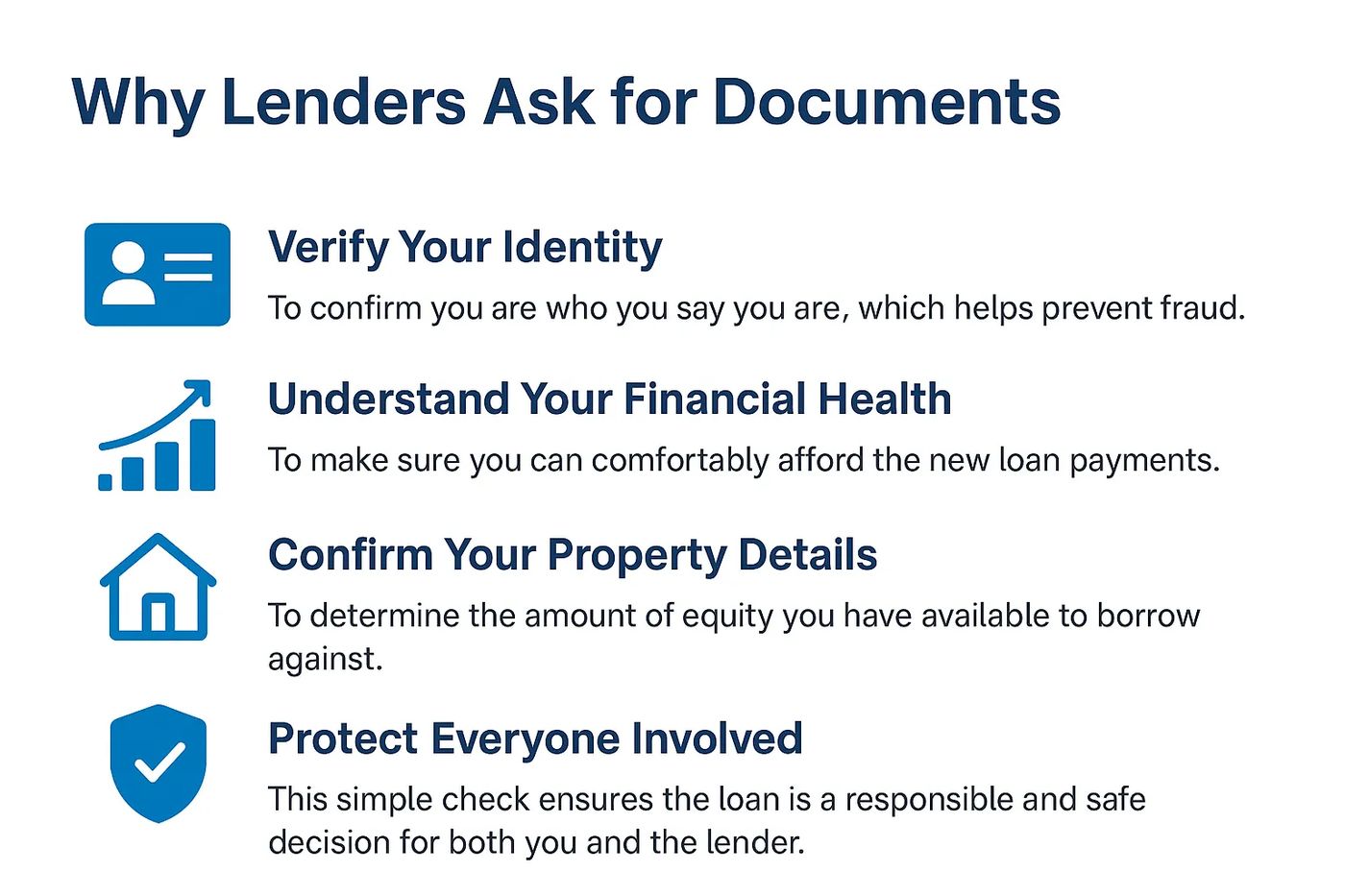
It is important to understand that the calculator provides an estimate based on these mathematical rules. Your actual approved limit from a bank or credit union will also depend on a credit assessment and a stress test. Your credit score, proof of income, and other debt obligations like credit cards and auto loans will also be considered. Therefore, the calculator's result is a best-case scenario under the loan-to-value rules, not a guarantee of approval. For a precise assessment, you must consult with a mortgage advisor who can review your full financial picture.
Key Inputs and How They Affect Your Result
Every input in a HELOC calculator directly influences the final estimated credit limit. The most critical input is your home's current market value. A higher appraised value increases both the 65% HELOC limit and the 80% combined limit, potentially raising your available equity. However, lenders will require a professional appraisal or use automated valuation models to confirm this figure, not just your own estimate. The next essential input is your current mortgage balance. A lower mortgage balance means you have used less of the 80% combined limit, leaving more room for a HELOC. If your mortgage balance is high, it may be the factor that caps your HELOC amount at a figure lower than 65% of your home's value.
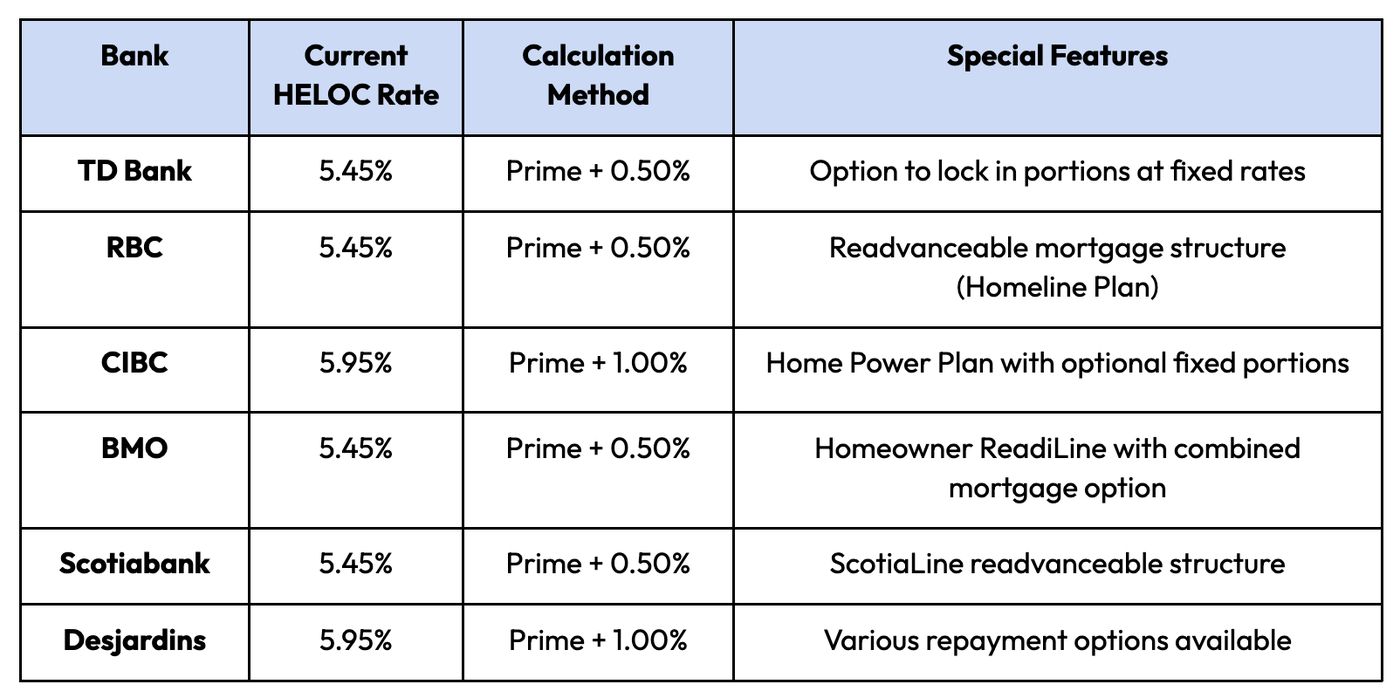
Some calculators may include a field for other debts secured by your real estate, such as a second mortgage or a construction loan. Including these amounts gives a more accurate picture of your total secured borrowing, which must stay under the 80% threshold. Omitting them could result in an overestimate of your available HELOC limit. The interest rate used in payment calculators is another vital input. HELOC rates are typically variable, set at the lender's prime rate plus a margin, often between 0.5% and 1%. As of 2026, the prime rate is 4.45%. Using a higher or lower rate in the calculator will change the estimated monthly interest payment if you draw funds, but it does not affect the calculated credit limit itself.
Canadian HELOC Rules and Limits
Home equity lines of credit in Canada operate under specific rules set by the Office of the Superintendent of Financial Institutions (OSFI). The central rule limits the maximum HELOC amount to 65% of your home's appraised value. This is known as the loan-to-value (LTV) ratio for the line of credit. Furthermore, OSFI mandates that the total of all registered charges against your property, typically your first mortgage plus the HELOC, cannot exceed 80% of the home's value. This is the combined loan-to-value (CLTV) rule. These rules apply to federally regulated financial institutions like banks. Credit unions and other non-federally-regulated lenders may use different criteria, but most adhere to similar standards for prudent lending.
The practical application of these rules means your maximum HELOC is the lower of two calculations. First, calculate 65% of your home's value. Second, calculate 80% of your home's value and subtract your current mortgage balance. The smaller of these two numbers is your theoretical maximum HELOC limit under the regulations.
- The maximum HELOC amount is up to 65% of your home's market value.
- The combined total of your mortgage and HELOC cannot exceed 80% of your home's value.
- Your approved limit is also subject to credit score, income, and other debt assessments.
- Some combination products, like the Scotia Total Equity Plan, may allow an initial limit up to 80% of home value.
HELOC Rates and Payment Calculations
The interest rate on a home equity line of credit in Canada is almost always variable. It is typically set as the lender's prime rate plus a margin. The margin depends on the lender and your credit profile, but common ranges are from prime + 0.5% to prime + 1%. This variable rate means your cost of borrowing and your minimum monthly payment will change whenever the lender adjusts its prime rate in response to Bank of Canada policy changes. Unlike mortgages, fixed-rate HELOCs are not commonly offered by major lenders, though some allow you to convert a portion of the drawn balance into a fixed-term loan.
Payment calculations for a HELOC are straightforward if you only make the minimum payment. The minimum payment is usually interest-only, calculated on the outstanding drawn balance. There is typically no required principal repayment, which provides flexibility but also means the debt does not decrease unless you make additional payments. To estimate a monthly interest payment, you can use the formula: (Outstanding Balance x Interest Rate) / 12. Most lenders calculate interest daily but charge it monthly. If you pay more than the interest, the extra amount reduces your principal, and subsequent interest charges are calculated on the new, lower balance.
HELOC Versus Mortgage Refinancing
A home equity line of credit and mortgage refinancing are two distinct ways to access your home's equity, each with different cost structures and suitability. A HELOC provides a revolving pool of credit up to a limit, where you only pay interest on the amount you use. It offers ongoing access without needing to reapply for new funds. Refinancing involves breaking your current mortgage contract and taking out a new, larger mortgage, receiving the extra funds as a lump sum at closing. This usually incurs a prepayment penalty, which can be three months' interest or the interest rate differential, a potentially significant cost. Refinancing is better suited for a single, large, one-time expense.
The interest rate comparison is a key differentiator. HELOC rates are variable and typically higher than initial mortgage rates, often sitting at prime plus a margin. A refinanced mortgage can often be secured at a lower promotional or discounted rate, and it can be locked in for a fixed term, providing payment certainty. However, mortgage payments include both principal and interest, resulting in a higher mandatory monthly payment than a HELOC's interest-only minimum. Furthermore, mortgages often have prepayment limitations and penalties for paying off the balance early, whereas a HELOC allows you to repay the principal at any time without penalty.
| Feature | Home Equity Line of Credit (HELOC) | Mortgage Refinancing |
|---|---|---|
| Funds Access | Revolving credit, draw as needed | Lump sum at closing |
| Interest Rate | Variable (e.g., prime + 0.5%) | Fixed or variable, often lower |
| Typical Upfront Cost | Appraisal/administration fees | Prepayment penalty + fees |
| Monthly Payment | Interest-only minimum | Principal + interest |
| Repayment Flexibility | Repay principal anytime, no penalty | Prepayment limits, possible penalties |
| Best For | Ongoing, unpredictable expenses | Large, one-time expenses |

A Worked Example Using Canadian Figures
Consider a homeowner with a property appraised at $600,000. They have an existing first mortgage with a remaining balance of $250,000. They want to know how much they could potentially access through a home equity line of credit. This is the absolute maximum a HELOC could be under the 65% LTV rule. Next, we apply the combined loan-to-value rule of 80%. They could choose to pay only this interest or make larger payments to reduce the principal. This example illustrates how the calculator uses the inputs and rules to provide a concrete estimate.
Risks and Considerations for Canadian Borrowers
While a HELOC offers flexible access to low-cost funds, it carries specific risks that Canadian borrowers must consider. Since the line of credit is secured by your home, failure to repay could ultimately lead to foreclosure. This risk underscores the importance of borrowing only what you need and can manage. Another significant risk is related to the variable interest rate. During a period of rising interest rates, your minimum payment will increase, which can strain your monthly budget if you carry a large balance. Unlike a fixed-rate mortgage, there is no payment certainty with a HELOC.
The convenience of interest-only payments can also be a pitfall. Making only the minimum payment means the principal debt never decreases, which can lead to a perpetual debt cycle. It requires financial discipline to actively pay down the principal. Furthermore, when you apply for a HELOC, lenders will perform a stress test on your ability to repay at a higher qualifying rate. Finally, opening a large HELOC can affect your ability to qualify for other credit, as lenders will consider this available credit as a potential future liability.
Frequently asked questions
How much can I borrow with a HELOC in Canada?
You can borrow up to 65% of your home's appraised value through a HELOC. However, your total secured debt, including your mortgage, cannot exceed 80% of your home's value. Therefore, your actual limit is the lower of these two calculations: 65% of your home's value, or 80% of your home's value minus your mortgage balance. Federally regulated lenders must also apply a stress test to your application, which may further reduce the approved amount.
What is the current interest rate for a HELOC?
HELOC interest rates are variable and typically set at the lender's prime rate plus a margin. As of 2026, the prime rate is 4.45%. Your specific rate depends on the lender, your credit score, and other financial factors. Remember that this variable rate will change whenever the lender adjusts its prime rate.
What are the monthly payments on a HELOC?
The minimum monthly payment on a HELOC is usually interest-only, calculated on the outstanding balance you have drawn. There is no required principal payment, which keeps the minimum payment low. You can calculate an estimated monthly interest payment by multiplying your drawn balance by your annual interest rate and dividing by 12. You have the flexibility to pay more than the interest at any time to reduce the principal, and there are no prepayment penalties for doing so.
Can I have a HELOC and a mortgage at the same time?
Yes, it is common to have both a mortgage and a HELOC simultaneously. In fact, many combination products bundle them together. The key rule is that the sum of your mortgage balance and your HELOC limit cannot surpass 80% of your home's value. Some financial institutions, like TD and Scotiabank, offer integrated plans that manage both under a single limit, such as the TD Home Equity FlexLine or the Scotia Total Equity Plan.
Is a HELOC better than refinancing my mortgage?
The better option depends on your needs. A HELOC is a revolving line of credit ideal for ongoing or unpredictable expenses, as you only pay interest on what you use. Refinancing provides a lump sum upfront but usually incurs a mortgage prepayment penalty. Refinancing often offers a lower interest rate, especially on fixed terms, but requires higher monthly payments that include principal. A HELOC offers more repayment flexibility with no penalty for paying off the balance.
What can I use a HELOC for?
A HELOC can be used for a wide variety of purposes. Common uses include home renovations, which may increase your property's value, and consolidating higher-interest debt like credit cards into a lower-rate product. Other frequent uses are funding large purchases like a vehicle or a wedding, covering education expenses, or serving as an emergency fund. The funds are flexible, and you are not required to specify the use when you draw on the line.
Sources and further reading
- Home Equity Calculator, Mortgages cibc.com
- Home Equity Line of Credit (HELOC) Calculator 2026 wowa.ca
- Scotia Total Equity ® Plan Calculator dmts.scotiabank.com
- TD Home Equity FlexLine (HELOC), TD Canada Trust td.com
- HELOC Calculator Canada 2026 · Home Equity Line canadacalculator.ca
This article explains how things work and is not financial, tax or legal advice. Rules, limits and rates change, so check the current figures with the Canada Revenue Agency, your province or your financial institution before you act.