TORONTO
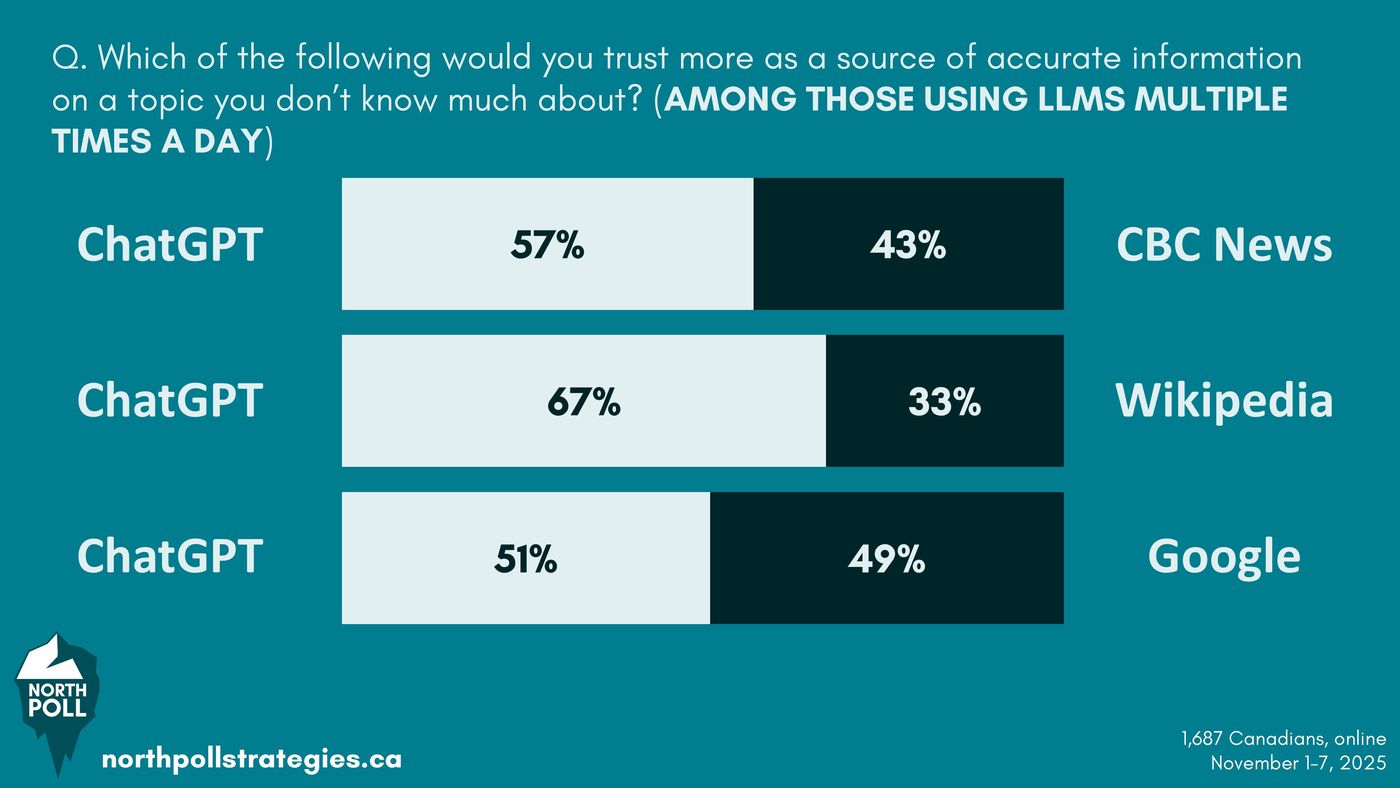
Some young Canadians are turning to artificial intelligence chatbots for stock-picking advice and investing real money based on the recommendations.
The Globe and Mail reported on a 23-year-old Toronto investor who uses ChatGPT to discover new stocks and guide investment decisions.
Personal finance columnist Rob Carrick analyzed what AI gets right, its limitations and how to use it safely without risking savings.
The trend emerges as the stock market experiences significant volatility.
On Monday, the main S&P 500 index fund rose 2.36 percent, its biggest gain since April 8, 2026, while the fund tracking the Nasdaq-100 rose 3.54 percent, its best day in 18 months, according to 24/7 Wall St.
The S&P 500 index itself closed last week at 7,376.86, 5.65 percent below its Oct. 6 record of 7,818.93, after a 4.36 percent drop on Thursday that was its worst day since the April 2025 tariff crash.
Monday's rally put back 51 percent of Thursday's drop in the S&P 500 fund and a little over half of it in the Nasdaq-100 fund.
Analysts are divided on the rally's meaning.
Morgan Stanley's Mike Wilson told CNBC the correction is in its "final innings," put the likely bottom for the S&P 500 at 7,100 to 7,300 and expects a rally toward 8,000 by year end.
JPMorgan's Dubravko Lakos-Bujas called the pullback "largely a deleveraging event" and kept his 8,000 year-end target.
On the other side, Barron's told readers not to buy the bounce, and InvestorPlace's Luke Lango said chip-index breakdowns like last week's have historically been a coin flip between a bounce and a bear market.
Historical data shows that of the 14 corrections since 1999 in which the S&P 500 fund posted a 2 percent day from this far below its record, nine gave the whole bounce back within a month, and eight of the 13 with a year behind them were higher a year later.
"Nobody on either side of Monday's argument can tell you which list this one joins," 24/7 Wall St. reported.
The market volatility followed the U.S. midterm elections, which historically have triggered moves in bank stocks.
Analysis by Trefis shows that after elections where bank stocks jumped, such as in 2010, 2016 and 2024, the excitement was often priced in quickly.
After 2010 the bank fund was up another 13 percent three months later, then finished the year down 18 percent.
After 2016 it was up 17 percent at three months and ended up 15 percent.
After 2024 it was flat after a month, slightly down at three months, and flat after twelve.
"The excitement got priced in fast," Trefis reported.
This year, the bank fund rose about 2 percent on the day after the election, then ended the week down 1 percent.
What changed in between wasn't politics but a broader market selloff.
On Thursday the S&P 500 fell 4.4 percent as the AI trade unwound following a backlash against data centers and talk of bans and moratoriums.
Trefis argued the bank jumps historically came when the market bet an election meant higher interest rates, and what made jumps fade was rates and credit, not politics.
e2gold.ca reported in November that U.S. midterm election results could trigger market volatility, with a shift in control of Congress potentially changing key policies like tariffs.
Tuesday brings the October inflation report and the odds of a December rate increase with it.
"Nothing that happened Monday answered the questions about AI spending that set off Thursday's selling," 24/7 Wall St. reported.
This story was written by the e2gold.ca newsroom from reporting by The Globe and Mail, 24/7 Wall St. and Trefis. Quotes are checked word for word against that reporting.