A standard variable mortgage rate in Canada is an interest rate that fluctuates with a lender's prime rate, which itself moves in response to the Bank of Canada's policy decisions. These rates are typically expressed as the lender's prime rate plus or minus a fixed percentage spread. As of October 2026, the prime rate among major Canadian lenders is 4.45%, with the best available five-year variable rates around 3.30%. Understanding how these rates work is crucial for Canadian homeowners and buyers, as they offer potential savings compared to fixed rates but also introduce payment uncertainty tied directly to the country's monetary policy.
How Variable Mortgage Rates Are Determined
Standard variable mortgage rates in Canada are directly tied to the monetary policy set by the Bank of Canada. The central bank's key policy tool is the overnight lending rate, which is the interest rate at which major financial institutions borrow and lend one-day funds among themselves. When the Bank of Canada adjusts this rate, typically at one of its eight scheduled announcements each year, commercial lenders respond by changing their own prime lending rates. This spread is fixed for the duration of the mortgage term, meaning the borrower's rate will move up and down in lockstep with the lender's prime rate. This mechanism creates a direct link between national economic conditions, central bank decisions, and a homeowner's monthly mortgage payment.
The prime rate itself is a benchmark interest rate used by financial institutions to set interest rates for various loans, including lines of credit and variable-rate mortgages. While each lender sets its own prime rate, these rates are highly correlated and typically move in unison following Bank of Canada announcements. As of September 2026, the Bank of Canada has held its overnight rate steady at 2.25%, which has maintained the prime rate at 4.45% across major lenders. The spread applied to the prime rate to determine a borrower's variable mortgage rate depends on several factors including the loan-to-value ratio, whether the mortgage is default-insured, and the borrower's credit profile. Insured mortgages, where the borrower has a down payment of less than 20%, often qualify for the deepest discounts from prime. Uninsured mortgages, for those with more than 20% equity, generally have rates set closer to the prime rate, and some may even carry a premium above prime.
It is important to distinguish between a variable mortgage rate and an adjustable mortgage rate, though the terms are often used interchangeably. In a true variable-rate mortgage, the interest rate changes with the prime rate, but the monthly payment amount often remains fixed. When rates rise, a larger portion of that fixed payment goes toward interest, which can extend the amortization period or, in extreme cases, lead to negative amortization where the principal balance grows. With an adjustable-rate mortgage, the monthly payment itself changes whenever the interest rate changes, ensuring the amortization schedule stays on track. Most lenders in Canada offer the variable-rate with fixed-payment structure. The frequency of rate adjustments is typically monthly, meaning a borrower's interest rate and the allocation of their payment can change every month based on the lender's prime rate, even if the total payment amount stays the same.
Current Variable Rate Landscape and Comparisons
As of October 2026, the Canadian variable mortgage rate environment is characterized by relative stability following a period of central bank rate cuts. The Bank of Canada cut its policy rate nine times between June 2024 and October 2025 before holding steady at 2.25%. This has resulted in a prime rate of 4.45% and has kept the lowest available five-year variable mortgage rate at 3.30%. This rate is typically available on insured mortgages, which are loans with a down payment of less than 20% that require default insurance from the Canada Mortgage and Housing Corporation or other private insurers. For uninsured mortgages, where the borrower has more than 20% equity, variable rates are generally higher, sitting closer to the prime rate. The average uninsured five-year variable rate among Canada's major banks was 4.47% as of October 2026. The spread between the best variable and fixed rates remains a key consideration for borrowers, with the lowest insured five-year fixed rate at 4.09% compared to the 3.30% variable option.
Variable rates are consistently priced below fixed-rate mortgages, though the gap can widen or narrow based on bond market expectations and central bank policy. The historical 25-year average for variable rates has been lower than for fixed rates, contributing to potential long-term savings for borrowers who can tolerate payment fluctuations. The pricing for variable and adjustable-rate mortgages works on a different principle than fixed rates. While fixed rates track Government of Canada bond yields, variable rates are set at a fixed discount or premium from the lender's prime rate. This spread is locked in for the full term, even as the underlying prime rate moves. For example, a common posted rate from a major bank for a five-year closed variable mortgage might be the prime rate plus 0.00%, resulting in an annual percentage rate of 4.480%. In contrast, a five-year open variable mortgage, which offers greater flexibility to pay off the mortgage without penalty, might be priced at prime plus 3.300%, for an APR of 7.780%.
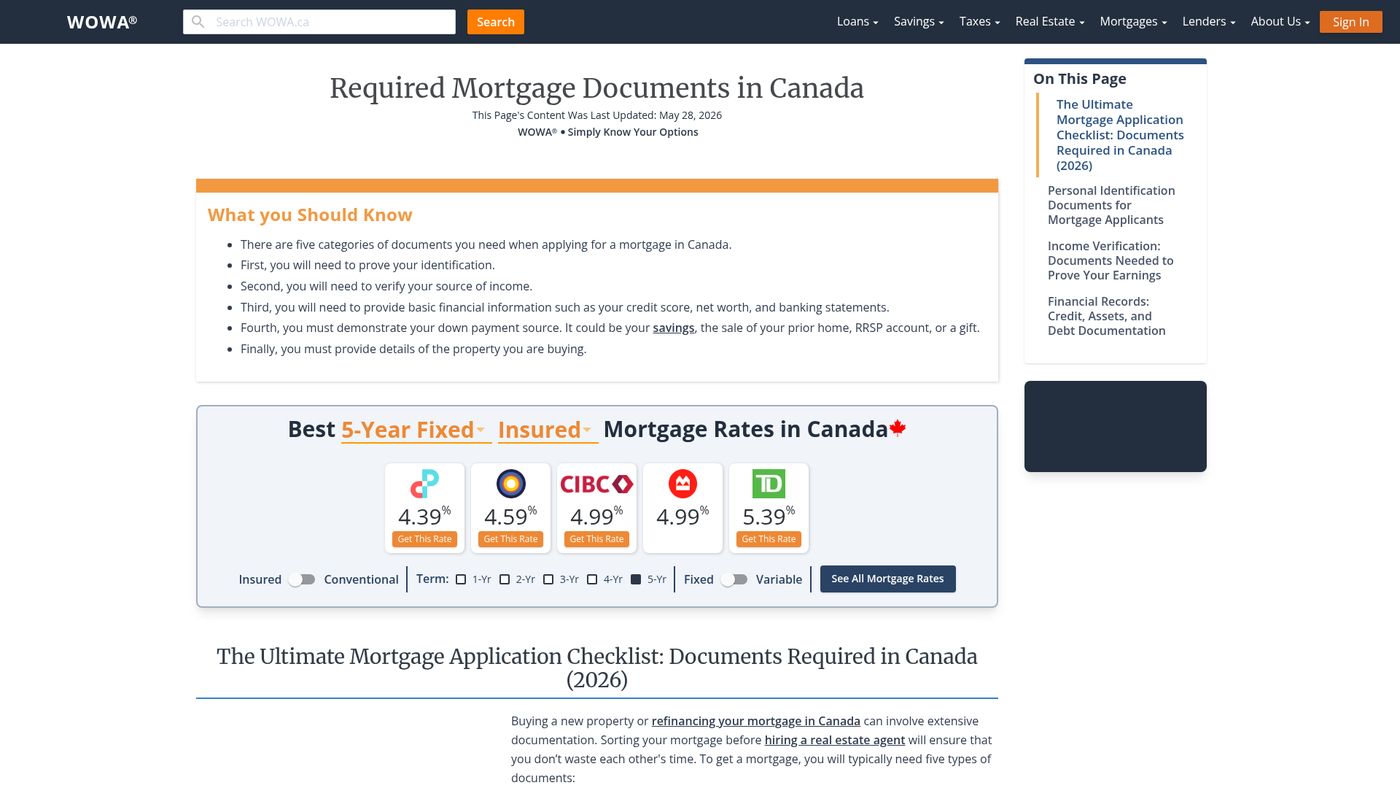
The table below shows a snapshot of average mortgage rates from Canada's six largest banks, known as the Big Six, as of October 2026. These averages serve as a useful benchmark for borrowers to gauge whether an offer they receive is competitive. The rates differ based on whether the mortgage is insured or uninsured. The average uninsured five year fixed rate in Canada is 5.39 percent. Insured mortgages with less than 20 percent down payment qualify for lower rates, such as a five year fixed rate of 4.59 percent. The Big Six Bank average for a five year fixed insured mortgage is 5.18 percent.
| Term & Type | Big 6 Bank Average Rate (Insured) | Big 6 Bank Average Rate (Uninsured) |
|---|---|---|
| 5-Year Variable | 4.27% | 4.47% |
| 3-Year Variable | 5.05% | 4.65% |
| 5-Year Fixed | 5.18% | 5.39% |
| 3-Year Fixed | 5.23% | 5.23% |
These averages highlight that insured mortgages generally receive more favourable pricing. The best available rates in the market are often found through monolines or alternative lenders, with the best high-ratio five-year variable rate reported at 3.43% as of October 21, 2026. It is crucial for borrowers to understand that advertised rates are often special offers contingent on factors like the loan amount, property value, and down payment percentage. For instance, some of the lowest advertised rates apply to insured mortgage balances between $700,000 and $1,375,000 for properties valued under $1.5 million. Discounted rates also commonly apply to insurable mortgages with a loan-to-value of 80% or less on properties valued under $1 million, and these offers may be subject to change or withdrawal without notice.
Key Factors That Influence Your Variable Rate
Several specific factors determine the variable mortgage rate a Canadian borrower will qualify for, with the most significant being the loan-to-value ratio and the presence of default insurance. The loan-to-value ratio compares the mortgage amount to the appraised value of the property. A lower LTV, indicating more equity, generally results in a more favourable interest rate. Mortgages with an LTV of 80% or less are considered insurable, even if the borrower chooses not to get insurance, and often qualify for discounted rates. For a mortgage to be officially insured, the borrower must have a down payment of less than 20%, which mandates insurance from CMHC or another provider. These insured mortgages typically receive the deepest discounts from the lender's prime rate, as the insurance protects the lender from default. As of October 2026, the best rates are reserved for insured transactions on properties valued under $1 million with an LTV of 80% or less.
The term of the mortgage is another important factor. While five-year terms are the most common in Canada, variable rates are available for a range of terms from three to ten years. The discount or premium from prime may vary depending on the chosen term length. For example, a three-year variable term might have a different spread compared to a five-year term from the same lender. The borrower's creditworthiness, income, and overall debt service ratios also play a critical role during the approval process. Lenders use these metrics to assess risk, and borrowers with stronger financial profiles may qualify for a better spread relative to prime. Furthermore, the type of property being financed can affect the rate, with rates for owner-occupied principal residences typically being lower than those for rental properties or secondary homes.
Macroeconomic conditions set by the Bank of Canada are the overarching influence on all variable rates. The central bank's decisions are based on economic indicators such as inflation, employment data, and global economic pressures. As of late 2026, inflation is hovering around 3%, with factors like higher energy prices and tariffs adding upward pressure, which could influence the Bank of Canada to maintain or even increase its policy rate in the future. Any change to the policy rate directly impacts lenders' prime rates and, consequently, every variable-rate mortgage payment in the country. Borrowers should be aware that while the spread on their mortgage is fixed, the absolute rate is not, and it will change whenever the Bank of Canada makes a move. The next policy announcement after September 2026 was scheduled for October 28, 2026, illustrating the regular schedule of potential rate changes.

The Mechanics of Variable Rate Mortgages
Variable rate mortgages function on a different operational principle than their fixed-rate counterparts. Once a borrower secures a variable rate mortgage, their interest rate is recalculated regularly, typically on a monthly basis, based on the lender's current prime rate. The monthly mortgage payment, however, is often set at a fixed amount for the term, similar to a fixed-rate mortgage. When the interest rate increases, a larger portion of that fixed payment is allocated to covering the interest, and a smaller portion goes toward paying down the principal loan balance. Conversely, when the interest rate decreases, more of the payment is applied to the principal. This system can lead to a situation where the amortization period, or the total time to pay off the loan, stretches out or shortens depending on the rate environment.
A critical concept for borrowers with fixed-payment variable mortgages is the trigger rate. This is the specific interest rate at which the entire fixed monthly payment is consumed by the interest portion, with nothing left to reduce the principal. If the interest rate rises above this trigger point, the borrower will enter a state of negative amortization, meaning their mortgage balance will start to increase because the payments are insufficient to cover the accruing interest. Lenders are required to inform borrowers when they are approaching or hit their trigger rate. At that point, the lender will typically recast the mortgage, which involves increasing the monthly payment amount to ensure the loan is repaid within the original amortization schedule. Borrowers should proactively understand their trigger rate and monitor their mortgage statements, especially during periods of rising interest rates.
The process for converting a variable rate mortgage to a fixed rate is generally straightforward but has important financial implications. Most lenders allow borrowers to convert their variable rate mortgage to a fixed rate at any time during the term without breaking the mortgage contract, a process known as an internal conversion. This option does not require a new credit application or stress test, but the borrower will be offered the lender's current posted or discounted fixed rate, which may be higher than the best market rates available elsewhere. The alternative is to refinance the mortgage with a new lender to secure a fixed rate. This involves a full re-qualification under current stress-test rules, paying potential break penalties on the old mortgage, and incurring legal and appraisal fees. Before locking in, borrowers should carefully weigh the rate spread between their current variable rate and the available fixed rate, as converting during a period of high fixed rates could lead to significantly higher payments for the remainder of the term.
Common Considerations and Potential Risks
Choosing a variable mortgage rate involves weighing potential savings against the risk of payment uncertainty. The primary advantage is cost. Historically, borrowers with variable rates have paid less interest over the long term compared to those with fixed rates. This is because variable rates are typically priced below fixed rates at the start of the term, and they can decrease further if the Bank of Canada cuts rates. As of 2026, the spread between the best five-year variable rate at 3.30% and the best insured five-year fixed rate at 4.09% provides a tangible initial saving. However, this advantage is not guaranteed. The primary risk is payment volatility. If the Bank of Canada raises its policy rate, variable mortgage rates will increase, leading to higher interest costs. For those with fixed payments, this means less of their payment goes to principal, potentially extending their amortization.
Several other practical considerations are important for Canadian borrowers. Prepayment privileges, which allow extra payments without penalty, are commonly available on variable-rate mortgages and can be a strategic tool to pay down the principal faster when rates are low. Portability, the ability to transfer a mortgage to a new property, is also usually an option, though terms vary by lender. Breaking a variable-rate mortgage contract before the end of its term typically incurs a penalty equal to three months' interest, which is often lower than the interest rate differential penalty common with fixed-rate mortgages. Borrowers should also be aware of the stress test qualification rules. When applying for a new variable-rate mortgage or refinancing, borrowers must qualify at the greater of the contract rate plus 2% or the Bank of Canada's five-year benchmark rate, which ensures they can afford payments if rates rise.
- Payment Structure Risk: Fixed-payment variable mortgages risk negative amortization if rates rise above the trigger rate.
- Conversion Flexibility: Most lenders allow conversion to a fixed rate at any time, but often at their posted rate.
- Break Penalty: Penalties for breaking a variable mortgage early are usually three months' interest.
- Qualification Hurdle: All new mortgages require a stress test at a qualifying rate higher than the contract rate.
- Rate Lock Options: Pre-approval can lock in a rate for a period, such as 120 days, protecting against increases while home shopping.
- Economic Dependence: Your mortgage payment is directly tied to the Bank of Canada's eight annual policy decisions.
Finally, the decision between a variable and fixed rate is highly personal and depends on financial stability and risk tolerance. Borrowers who have a secure income, significant emergency savings, and the capacity to absorb higher payments may be better positioned to handle the fluctuations of a variable rate. Those who prioritize budget certainty and peace of mind, or who are stretching their finances to afford a home, may find the stability of a fixed rate more suitable. It is essential to run scenarios based on potential rate increases to understand the full financial impact before committing to a variable-rate mortgage. The choice ultimately hinges on your personal comfort with the inherent link between your housing costs and the broader Canadian economy.

Frequently asked questions
What is a standard variable mortgage rate in Canada?
A standard variable mortgage rate in Canada is an interest rate that changes in relation to your lender's prime rate. The prime rate itself moves when the Bank of Canada changes its overnight lending rate. As of October 2026, the prime rate is 4.45%, and the best five-year variable rates are around 3.30%. Your monthly payment may be fixed, but the portion that goes to interest changes whenever your rate adjusts.
How often do variable mortgage rates change?
Variable mortgage rates can change as often as the lender's prime rate changes, which typically happens after a Bank of Canada policy announcement. The Bank of Canada makes eight scheduled rate decisions per year. Lenders usually adjust their prime rates within a day of a Bank of Canada move. Your mortgage interest rate is typically recalculated on a monthly basis, meaning your effective rate and the interest portion of your payment can change every month based on the current prime rate.
Can I switch from a variable to a fixed mortgage rate?
Yes, you can usually convert your variable rate mortgage to a fixed rate at any time during your term. The simplest method is an internal conversion with your current lender, which does not require a new application. You will be moved to your lender's posted or discounted fixed rate. Alternatively, you can refinance with a new lender to seek a lower fixed rate. Refinancing involves a full re qualification and a new stress test. This process may also involve potential break penalties and legal costs.
What is the trigger rate on a variable mortgage?
The trigger rate is the interest rate at which your fixed monthly payment only covers the interest charges. At this point, nothing is left to pay down the principal loan balance. If rates rise to or above the trigger rate, you will experience negative amortization. This means your mortgage debt will start to grow instead of shrinking. Lenders must notify you if you approach or hit your trigger rate. They will typically increase your payment amount to correct the situation and keep your amortization on track.
Are variable mortgage rates lower than fixed rates?
Historically and in current markets, variable mortgage rates are typically priced below fixed rates. As of October 2026, the best available five-year variable rate is 3.30%, while the best insured five-year fixed rate is 4.09%. This initial discount is a key attraction of variable rates. However, because variable rates can increase, the total cost over the term is not guaranteed to be lower. The long-term 25-year average for variable rates has been lower than for fixed rates, but past performance does not guarantee future results.
What factors affect the variable rate I am offered?
The variable rate you qualify for depends on several factors. The most significant is whether your mortgage is default-insured, which happens with a down payment of less than 20%. Insured mortgages generally get the deepest discounts from prime. Your loan-to-value ratio, credit score, income, debt levels, and the property type also influence the spread you receive. Macroeconomic conditions and the Bank of Canada's policy decisions determine the prime rate, which is the base for all variable rate calculations.
Sources and further reading
- Current Mortgage Rates | RBC Royal Bank of Canada rbcroyalbank.com
- Find the best 5-year variable mortgage rates in Canada ratehub.ca
- Mortgages Rates | Scotiabank Canada scotiabank.com
- Mortgage rates: see current rates nbc.ca
- Today's Mortgage Rates in Canada | Compare All Terms nesto.ca
This article explains how things work and is not financial, tax or legal advice. Rules, limits and rates change, so check the current figures with the Canada Revenue Agency, your province or your financial institution before you act.