A 30-year fixed mortgage rate in Canada is an interest rate that remains constant for a 30-year amortization period, providing long-term payment stability. While standard mortgage terms in Canada are typically between one and ten years, the 30-year figure refers to the total length of time to pay off the loan, known as the amortization period. This structure allows for lower monthly payments compared to shorter amortizations, making homeownership more accessible. Understanding how these rates are set and what influences them is crucial for Canadian homebuyers planning their long-term financial commitments.
How Fixed Mortgage Rates Work in Canada
In Canada, a fixed mortgage rate is an interest rate that does not change for the duration of a chosen loan term, which is separate from the amortization period. The amortization period is the total length of time set to pay off the entire mortgage, which can extend up to 30 years for insured mortgages. The term, however, is the length of time you are committed to a specific lender and interest rate, commonly ranging from six months to ten years. At the end of each term, you must renew your mortgage, at which point you can renegotiate the interest rate and terms with your current lender or switch to a new one. This system provides payment certainty during the term while requiring periodic review of your financial agreement. The interest rate you secure is influenced by the lender's cost of funding and broader economic conditions set by the Bank of Canada.
Financial institutions, including the major chartered banks, set their own prime lending rates, which serve as a base for variable-rate products and influence the pricing environment for fixed rates. The posted rates you see advertised are the standard rates offered, but most borrowers qualify for special discounted rates that are lower. These discounted rates are often negotiated through mortgage brokers or offered as promotional specials for a limited time. For instance, promotional offers from major banks may have expiry dates, such as one noted until October 31, 2026. It is important to distinguish between the advertised posted rate and the actual rate you may be offered upon application and qualification.
Current Rate Environment and Key Influences
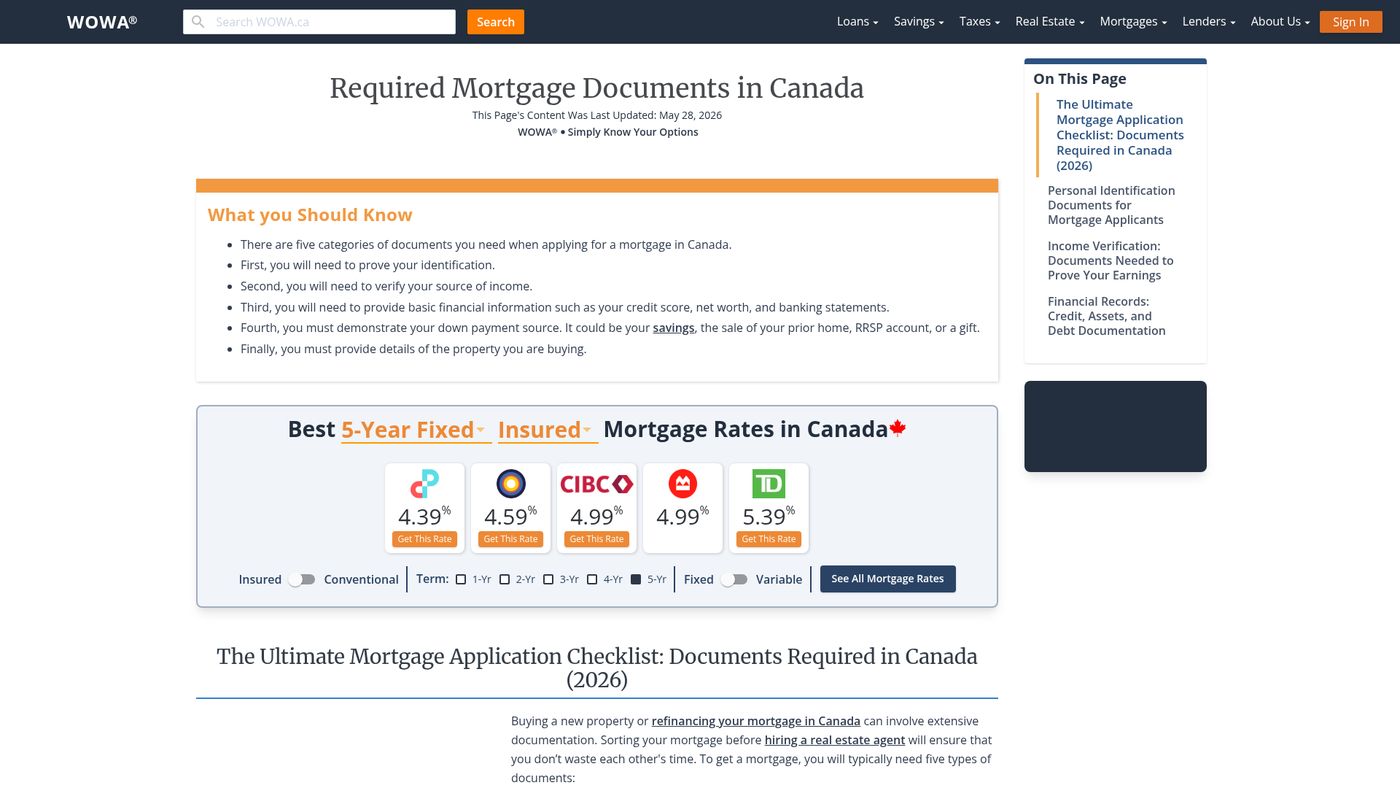
As of recent data, fixed mortgage rates in Canada are influenced by a combination of lender competition, bond yields, and monetary policy. Sample rates from various sources show five-year fixed mortgage rates starting around 4.34% to 4.59%, while five-year variable rates can be found starting around 3.25% to 3.49%. These rates are not static and change frequently based on market conditions. The Bank of Canada's target for the overnight rate is a primary driver, as it affects the cost at which banks lend to each other and, consequently, their prime rates. While fixed rates are not directly tied to the prime rate, the overall interest rate environment set by the central bank influences the bond market, which in turn affects fixed mortgage pricing.
Consumers can access information on prevailing rates through weekly data publications from the six major chartered banks, which is typically released on Wednesdays by 14:30 Eastern Time. This data provides the statistical mode, or most typical, of the posted rates for conventional mortgages and other products. Monitoring these trends helps borrowers understand whether rates are generally rising, falling, or holding steady. It is also common for lenders to offer rate hold features, where a pre-approved borrower can lock in a specified fixed rate for up to 120 days, protecting them from potential increases during their home search. This feature is subject to the borrower meeting all the lender's conditions for final approval.
Eligibility and the Mortgage Qualification Process
Qualifying for a mortgage in Canada, including one with a 30-year amortization, requires meeting lender criteria focused on income, debt, credit history, and the property itself. Lenders use two key ratios to assess eligibility: the Gross Debt Service ratio and the Total Debt Service ratio. Your down payment size is also a critical factor, as it determines whether you need mortgage loan insurance from providers like Canada Mortgage and Housing Corporation. A down payment of less than 20% of the purchase price mandates this insurance, which protects the lender in case of default. The insurance premium is added to your mortgage principal and influences the total cost of borrowing.
The application process typically involves several structured steps. You start by getting a pre-approval, which involves a credit check and an assessment of your finances to determine a borrowing limit and secure a rate hold. Next, you find a property and make an offer, at which point you submit a full application with supporting documentation like proof of income and employment. The lender then orders an appraisal to confirm the property's value and conducts a final review before providing a formal commitment. Finally, a lawyer or notary handles the legal transfer of funds and property title on the closing date. Working with a mortgage broker can provide access to multiple lenders and potentially better rates, as brokers often have volume discounts and can negotiate on your behalf.
- Step 1: Obtain a mortgage pre-approval to determine budget and lock a rate.
- Step 2: Find a property and submit a formal mortgage application with full documentation.
- Step 3: The lender appraises the property and conducts a final credit assessment.
- Step 4: Receive a formal mortgage commitment from the lender.
- Step 5: Complete the transaction with legal assistance on the closing date.
Different mortgage products cater to various financial situations. Traditional mortgages from banks and credit unions are widely used, while alternative or private lenders may offer solutions for those with non-traditional income or complex financial histories. Some brokerages advertise products designed for greater approval flexibility, considering extended income ratios or non-standard income sources. It is important to compare the Annual Percentage Rate, which includes interest and applicable fees like property valuation costs, to understand the full cost of borrowing. The APR is a more comprehensive figure than the interest rate used to calculate your regular payments.

Comparing Fixed and Variable Rate Mortgages
Canadian borrowers choose between fixed and variable rate mortgages, each with distinct characteristics. A fixed rate mortgage offers payment stability, as the interest rate and the resulting principal and interest payments remain unchanged for the entire term. You can select term lengths such as six months, one, two, three, four, five, six, seven, or ten years. This predictability makes budgeting easier and provides peace of mind against rising interest rates. In contrast, a variable rate mortgage has an interest rate that fluctuates based on changes in the lender's prime rate. While the total payment amount usually stays the same, the portion allocated to interest versus principal adjusts with rate changes.
The choice between fixed and variable involves weighing the security of a fixed payment against the potential savings of a variable rate, which often starts lower. Historical data shows variable rates have often cost less over the long term, but they carry the risk of payment increases if interest rates rise. Some lenders offer hybrid products or special programs, like a short-term Rate Relief product advertised to provide six months of a lower rate to help with closing costs. Borrowers should use online calculators to model different scenarios based on their down payment, amortization, and interest rate type. These tools can illustrate potential monthly payments and total interest costs over time.
Common Features and Borrower Flexibility
Canadian mortgages often include features that provide financial flexibility to borrowers. One common feature is the ability to make prepayments without penalty. On many closed mortgages, you can pay up to 15% of the original principal amount each year without incurring a prepayment charge. Open mortgages allow for 100% prepayment at any time, though they typically come with higher interest rates. Another useful feature is the payment skip option, where you can request to skip the equivalent of one monthly payment per year under certain conditions. These features help homeowners pay down their mortgage faster or manage cash flow during unexpected financial situations.
Other important aspects include portability, which allows you to transfer your existing mortgage to a new property if you move, and assumability, which lets a qualified buyer take over your mortgage when you sell. Collateral mortgages, which use your home as security for additional borrowing like a home equity line of credit, offer different advantages and restrictions compared to standard charge mortgages. A home equity line of credit is a secured revolving credit product with an interest rate that is typically lower than unsecured credit options. Understanding these features and how they align with your long-term financial goals is a key part of selecting the right mortgage product.

Provincial and Federal Rules Affecting Mortgages
Mortgage lending in Canada is governed by a combination of federal regulations and provincial property laws. Federally, the Office of the Superintendent of Financial Institutions sets guidelines for federally regulated lenders, including stress test rules that require borrowers to qualify at a rate higher than their contracted rate. The Canada Mortgage and Housing Corporation, along with other private insurers, provides mortgage loan insurance for high-ratio mortgages, which is mandatory for down payments below 20%. The rules for mortgage insurance, including premium calculations, are set at the federal level and apply across all provinces and territories. Provincial differences emerge in areas like land transfer taxes, property registration systems, and legal procedures for closing a real estate transaction.
Some provinces, such as Ontario and British Columbia, levy additional land transfer taxes on properties in major urban centres like Toronto and Metro Vancouver. The specific tax rates and any available first-time home buyer rebates differ significantly across each provincial jurisdiction. The legal closing process for a mortgage is managed by a lawyer or notary public in accordance with provincial regulations. These professionals conduct title searches on the property, prepare the mortgage deed, and register the transaction with the appropriate land registry.
| Provincial/Territorial Consideration | Key Aspect |
|---|---|
| Ontario | Land transfer tax applies. Additional tax in Toronto. |
| British Columbia | Property transfer tax applies. Additional tax in Metro Vancouver. |
| Alberta | No provincial land transfer tax. |
| Quebec | Uses a notary system for real estate transactions. |
| All Provinces | Must adhere to federal mortgage qualification rules and insurance requirements. |
First-time home buyer programs offering tax credits or rebates are administered provincially. The eligibility criteria and the amount of benefits available vary from one province to another. Potential borrowers must include these provincial costs and incentives when calculating the total funds required for a home purchase. Underestimating these closing costs is a common financial error made during the home buying process.
Frequent Mistakes to Avoid
One common mistake is focusing solely on the interest rate without considering the full mortgage product, including prepayment penalties, portability, and the flexibility of terms. A slightly lower rate may come with restrictive conditions that could cost more in the long run if your circumstances change. Another error is not getting a pre-approval before house hunting, which can lead to disappointment if you find a home outside your budget or miss out on a rate hold during a period of rising interest rates. Pre-approval provides a realistic price range and protects your rate for a specified period, often up to 120 days. Failing to budget for all closing costs is another significant oversight, as buyers need funds for land transfer tax, legal fees, home inspection costs, and potential mortgage default insurance premiums.
Underestimating these costs can create a financial shortfall at closing. Some borrowers also neglect to review their mortgage at renewal time, simply accepting their current lender's renewal offer without shopping around. Renewal is an opportunity to renegotiate terms, switch lenders, or adjust your amortization, and failing to compare options can mean missing out on better rates or more suitable features. Finally, some borrowers do not fully understand the implications of a longer amortization period, as a 30-year amortization lowers monthly payments but results in paying significantly more interest over the life of the loan compared to a shorter amortization.
- Mistake: Choosing a mortgage based only on the lowest advertised rate.
- Mistake: Skipping the mortgage pre-approval process before shopping for a home.
- Mistake: Not accounting for all closing costs like land transfer tax and legal fees.
- Mistake: Automatically renewing with your current lender without comparing offers.
- Mistake: Overextending on a home purchase by maximizing the pre-approval amount without a buffer for other expenses.
It is crucial for borrowers to use mortgage calculators to understand the long-term cost differences between various mortgage options. This analysis helps decide if a lower payment is worth the extra interest paid over the life of the loan. Consulting with a qualified mortgage professional can assist with these complex decisions and help avoid costly errors. Mortgage brokers provide access to multiple lenders and can fully explain the implications of different mortgage features and terms.
Frequently asked questions
What is a 30-year fixed mortgage rate in Canada?
A 30-year fixed mortgage rate in Canada refers to a home loan with an interest rate that remains constant, but this applies to the amortization period, not the term. The amortization is the total time set to pay off the loan, which can be up to 30 years for insured mortgages. The mortgage term, during which the rate is fixed, is typically much shorter, such as five years. At the end of each term, you renew the mortgage, potentially at a new interest rate, while continuing the amortization schedule.
How are mortgage rates determined in Canada?
Mortgage rates in Canada are determined by individual lenders based on their cost of funding and competitive positioning. The Bank of Canada's target for the overnight rate influences lenders' prime rates, which affect variable mortgage rates and the broader interest rate environment. Fixed mortgage rates are more closely tied to bond market yields. Lenders advertise posted rates, but most borrowers receive discounted special rates. The six major chartered banks publish their typical posted rates weekly, providing a benchmark for the market.
What is the difference between a fixed and variable rate mortgage?
A fixed rate mortgage has an interest rate that does not change for the entire term, which can range from six months to ten years, resulting in predictable payments. A variable rate mortgage has an interest rate that fluctuates with the lender's prime rate, meaning your payment amount or the interest-principal split can change. Fixed rates offer stability against rate hikes, while variable rates often start lower but carry the risk of increasing if the prime rate rises. Your choice depends on your risk tolerance and view on future interest rate movements.
Can I lock in a mortgage rate before I buy a home?
Yes, you can lock in a mortgage rate through a pre-approval process. Many lenders offer a rate hold feature for fixed-rate mortgages, where they guarantee a specific interest rate for a set period, commonly up to 120 days. This protects you from rate increases while you search for a home. To secure a rate hold, you typically need to complete a pre-approval application and meet the lender's initial credit and income conditions. The held rate is subject to you finalizing a mortgage application and meeting all approval requirements before the hold expires.
What is mortgage loan insurance and when is it required?
Mortgage loan insurance is required by federal regulation for any home purchase where the down payment is less than 20% of the purchase price. This insurance protects the lender, not the borrower, in case of default. It is provided by the Canada Mortgage and Housing Corporation or other private insurers. The insurance premium is calculated as a percentage of the loan amount and is usually added to the mortgage principal, increasing the total amount borrowed. This insurance allows lenders to offer mortgages with high loan-to-value ratios.
What are prepayment privileges on a mortgage?
Prepayment privileges are features that allow you to pay more than your scheduled mortgage payments without penalty. On a standard closed mortgage, a common privilege is the ability to pay up to 15% of the original principal amount each calendar year. On an open mortgage, you can typically prepay 100% of the balance at any time. These privileges help you pay down your mortgage faster, save on interest, and become mortgage-free sooner. Some mortgages also allow you to skip a payment under certain conditions, providing cash flow flexibility.
Sources and further reading
- Current Mortgage Rates | RBC Royal Bank of Canada rbcroyalbank.com
- Compare best mortgage rates in Canada today ratehub.ca
- Mortgages Rates, TD Canada Trust td.com
- Canada Mortgage Rates from 2.49% | 19,000 Five Star Reviews truenorthmortgage.ca
- Interest rates posted for selected products by the major ... bankofcanada.ca
This article explains how things work and is not financial, tax or legal advice. Rules, limits and rates change, so check the current figures with the Canada Revenue Agency, your province or your financial institution before you act.